Doherty Applied Microbial Genomics, Department of Microbiology and Immunology, The University of Melbourne, The Peter Doherty Institute for Infection and Immunity, 792 Elizabeth Street, Level 1, Melbourne, Victoria 3000, Australia.
The Microbiological Diagnostic Unit Public Health Laboratory, The University of Melbourne, The Peter Doherty Institute for Infection and Immunity, 792 Elizabeth Street, Level 1, Melbourne, Victoria 3000, Australia.
J Antimicrob Chemother. 2018 Feb 1;73(2):353-364. doi: 10.1093/jac/dkx405.
Antimicrobial-resistant Neisseria gonorrhoeae is a major threat to public health. No studies to date have examined the genomic epidemiology of gonorrhoea in the Western Pacific Region, where the incidence of gonorrhoea is particularly high.
A population-level study of N. gonorrhoeae in New Zealand (October 2014 to May 2015). Comprehensive susceptibility testing and WGS data were obtained for 398 isolates. Relatedness was inferred using phylogenetic trees, and pairwise core SNPs. Mutations and genes known to be associated with resistance were identified, and correlated with phenotype.
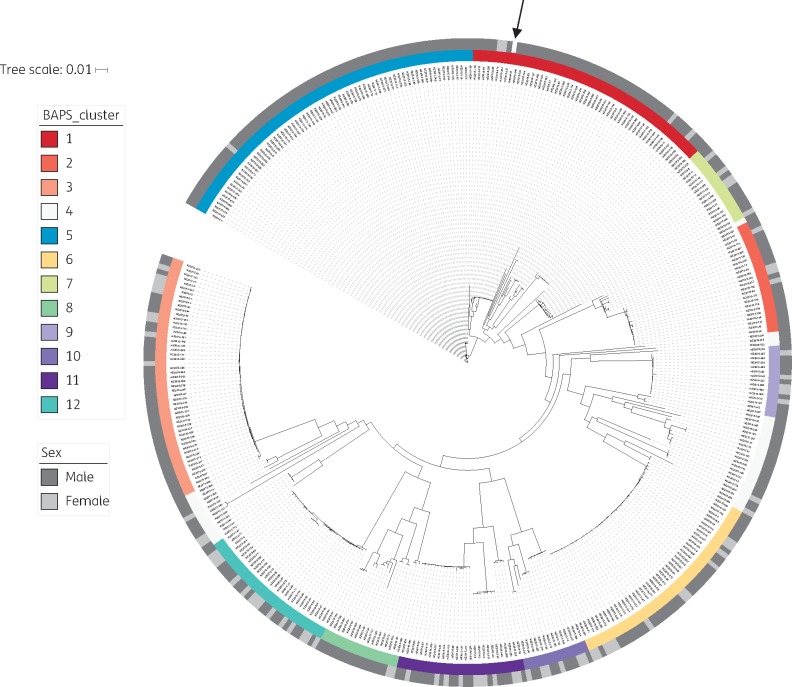
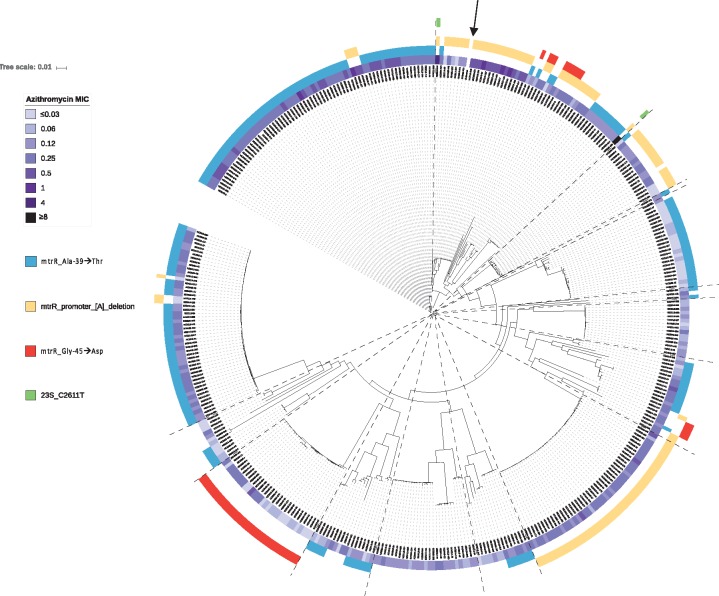
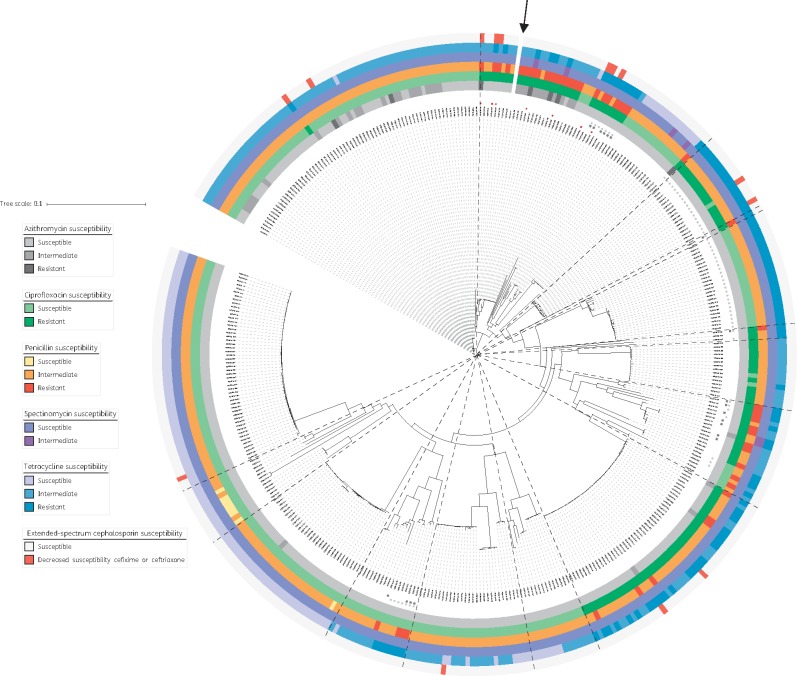
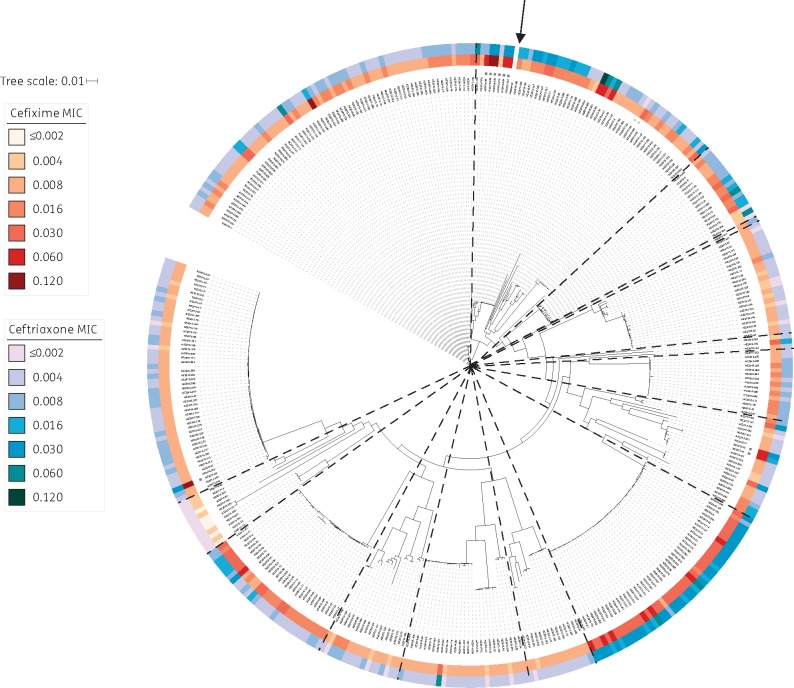
Eleven clusters were identified. In six of these clusters, >25% of isolates were from females, while in eight of them, >15% of isolates were from females. Drug resistance was common; 98%, 32% and 68% of isolates were non-susceptible to penicillin, ciprofloxacin and tetracycline, respectively. Elevated MICs to extended-spectrum cephalosporins (ESCs) were observed in 3.5% of isolates (cefixime MICs ≥ 0.12 mg/L, ceftriaxone MICs ≥ 0.06 mg/L). Only nine isolates had penA XXXIV genotypes, three of which had decreased susceptibility to ESCs (MIC = 0.12 mg/L). Azithromycin non-susceptibility was identified in 43 isolates (10.8%); two of these isolates had 23S mutations (C2611T, 4/4 alleles), while all had mutations in mtrR or its promoter.
The high proportion of females in clusters suggests transmission is not exclusively among MSM in New Zealand; re-assessment of risk factors for transmission may be warranted in this context. As elevated MICs of ESCs and/or azithromycin were found in closely related strains, targeted public health interventions to halt transmission are urgently needed.
耐抗生素淋病奈瑟菌对公共卫生构成重大威胁。迄今为止,尚无研究检测过西太平洋地区淋病的基因组流行病学情况,而该地区的淋病发病率特别高。
对新西兰的淋病奈瑟菌进行了人群水平研究(2014 年 10 月至 2015 年 5 月)。对 398 株分离株进行了全面的药敏试验和 WGS 数据分析。使用系统发育树和成对核心 SNP 推断关联性。鉴定与耐药性相关的突变和基因,并与表型相关联。
确定了 11 个聚类。在其中 6 个聚类中,超过 25%的分离株来自女性,而在其中 8 个聚类中,超过 15%的分离株来自女性。耐药性很常见;98%、32%和 68%的分离株分别对青霉素、环丙沙星和四环素不敏感。3.5%的分离株对头孢菌素类抗生素的 MIC 值升高(头孢克肟 MIC 值≥0.12mg/L,头孢曲松 MIC 值≥0.06mg/L)。仅有 9 株分离株具有 penA XXXIV 基因型,其中 3 株对头孢菌素类抗生素的敏感性降低(MIC=0.12mg/L)。43 株分离株(10.8%)对阿奇霉素不敏感;其中 2 株分离株具有 23S 突变(C2611T,4/4 等位基因),而所有分离株均具有 mtrR 或其启动子突变。
聚类中女性比例较高表明传播并非仅在新西兰男男性行为者中进行;在这种情况下,可能需要重新评估传播的危险因素。由于密切相关的菌株中发现了头孢菌素类抗生素和/或阿奇霉素的 MIC 值升高,迫切需要采取有针对性的公共卫生干预措施来阻止传播。