Kuhner Andreas, Schubert Tobias, Cenciarini Massimo, Wiesmeier Isabella Katharina, Coenen Volker Arnd, Burgard Wolfram, Weiller Cornelius, Maurer Christoph
Department of Computer Science, University of Freiburg, Freiburg, Germany.
BrainLinks BrainTools, Cluster of Excellence, University of Freiburg, Freiburg, Germany.
Front Neurol. 2017 Nov 14;8:607. doi: 10.3389/fneur.2017.00607. eCollection 2017.
Objective assessments of Parkinson's disease (PD) patients' motor state using motion capture techniques are still rarely used in clinical practice, even though they may improve clinical management. One major obstacle relates to the large dimensionality of motor abnormalities in PD. We aimed to extract global motor performance measures covering different everyday motor tasks, as a function of a clinical intervention, i.e., deep brain stimulation (DBS) of the subthalamic nucleus.
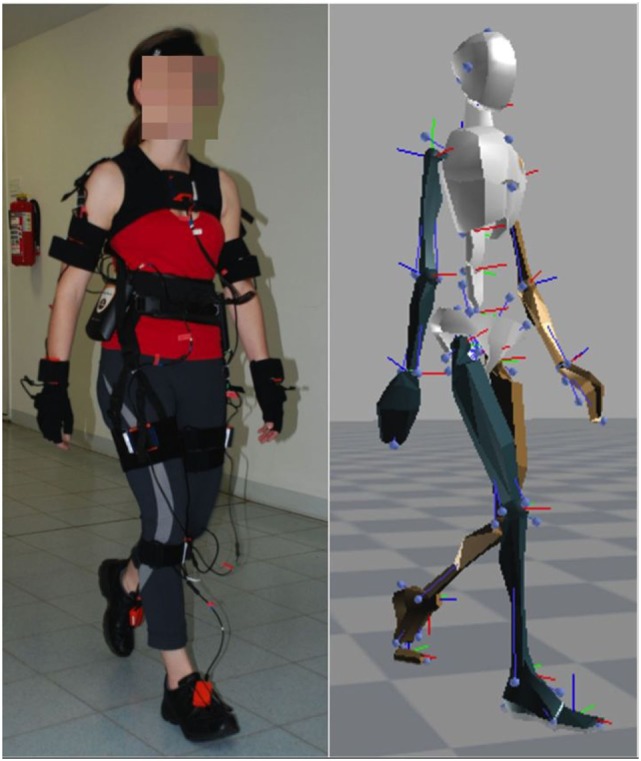
We followed a data-driven, machine-learning approach and propose performance measures that employ Random Forests with probability distributions. We applied this method to 14 PD patients with DBS switched-off or -on, and 26 healthy control subjects performing the Timed Up and Go Test (TUG), the Functional Reach Test (FRT), a hand coordination task, walking 10-m straight, and a 90° curve.
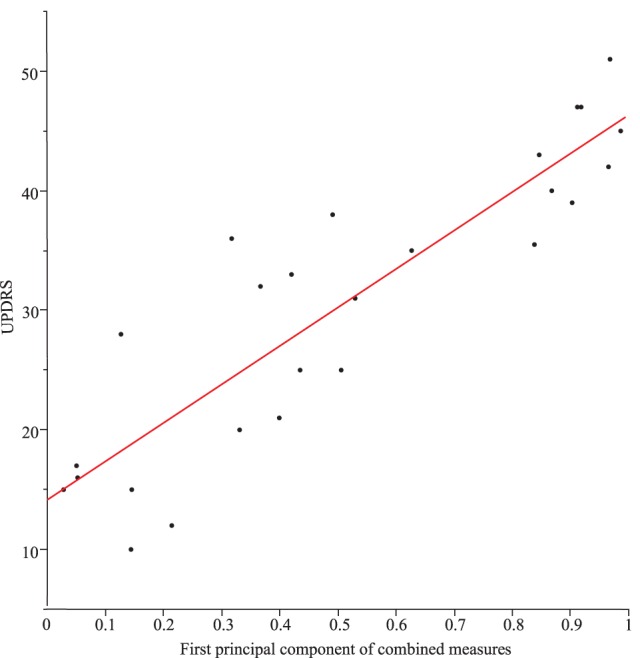
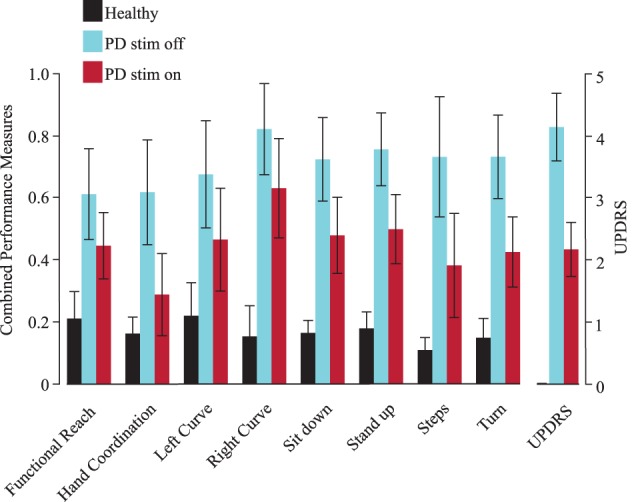
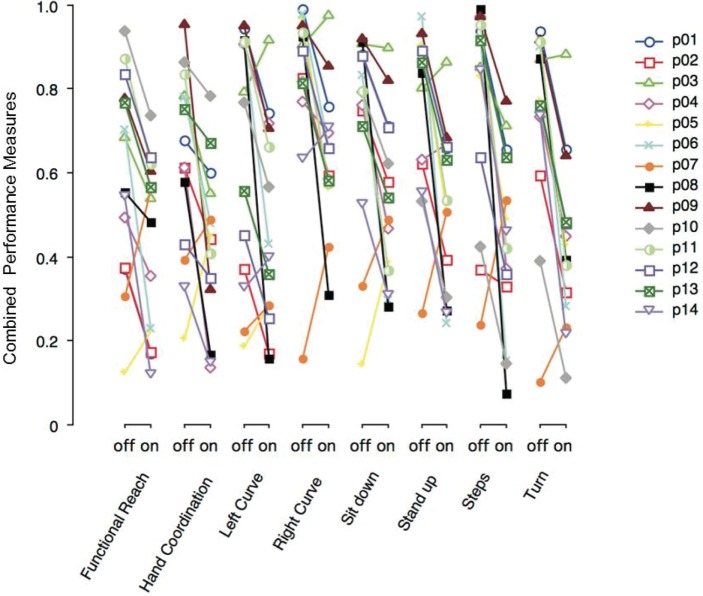
For each motor task, a Random Forest identified a specific set of metrics that optimally separated PD off DBS from healthy subjects. We noted the highest accuracy (94.6%) for standing up. This corresponded to a sensitivity of 91.5% to detect a PD patient off DBS, and a specificity of 97.2% representing the rate of correctly identified healthy subjects. We then calculated performance measures based on these sets of metrics and applied those results to characterize symptom severity in different motor tasks. Task-specific symptom severity measures correlated significantly with each other and with the Unified Parkinson's Disease Rating Scale (UPDRS, part III, correlation of = 0.79). Agreement rates between different measures ranged from 79.8 to 89.3%.
The close correlation of PD patients' various motor abnormalities quantified by different, task-specific severity measures suggests that these abnormalities are only facets of the underlying one-dimensional severity of motor deficits. The identification and characterization of this underlying motor deficit may help to optimize therapeutic interventions, e.g., to "automatically" adapt DBS settings in PD patients.
尽管利用运动捕捉技术对帕金森病(PD)患者的运动状态进行客观评估可能会改善临床管理,但在临床实践中仍很少使用。一个主要障碍与PD运动异常的高维度有关。我们旨在提取涵盖不同日常运动任务的整体运动表现指标,作为一种临床干预(即丘脑底核深部脑刺激(DBS))的函数。
我们采用数据驱动的机器学习方法,提出采用具有概率分布的随机森林的表现指标。我们将此方法应用于14例DBS关闭或开启的PD患者以及26名健康对照者,他们进行了定时起立行走测试(TUG)、功能性伸展测试(FRT)、手部协调任务、直线行走10米和90°转弯。
对于每项运动任务,随机森林确定了一组特定的指标,这些指标能最佳地区分DBS关闭的PD患者与健康受试者。我们注意到起立的准确率最高(94.6%)。这对应于检测DBS关闭的PD患者的灵敏度为91.5%,以及代表正确识别健康受试者率的特异性为97.2%。然后,我们基于这些指标集计算表现指标,并将这些结果应用于表征不同运动任务中的症状严重程度。特定任务的症状严重程度指标彼此之间以及与统一帕金森病评定量表(UPDRS,第三部分,相关性为 = 0.79)显著相关。不同测量之间的一致率在79.8%至89.3%之间。
通过不同的、特定任务的严重程度测量所量化的PD患者各种运动异常之间的密切相关性表明,这些异常只是潜在的一维运动缺陷严重程度的不同方面。识别和表征这种潜在的运动缺陷可能有助于优化治疗干预,例如在PD患者中“自动”调整DBS设置。