Beijing Neurosurgical Institute, Capital Medical University, Beijing, 100070, China.
Department of neurosurgery, the First Hospital of Hebei Medical University, Shijiazhuang, 050031, Hebei, China.
BMC Neurol. 2021 Mar 17;21(1):122. doi: 10.1186/s12883-021-02148-1.
To investigate the relationship between the position of bilateral STN-DBS location of active contacts and the clinical efficacy of STN-DBS on motor symptoms in Parkinson's disease (PD) patients.
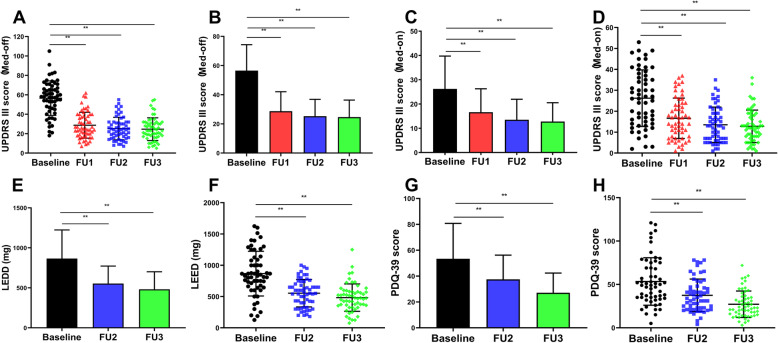
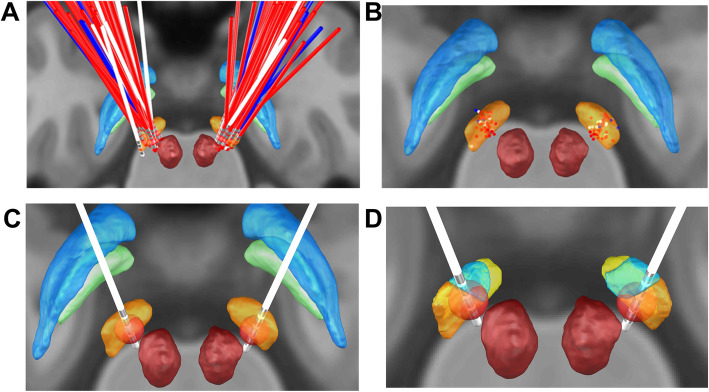
Retrospectively analyze the clinical data of 57 patients with PD who underwent bilateral STN-DBS from March 2018 to December 2018. Unified Parkinson's Disease Rating Scale-Part III (UPDRS-III) score, levodopa equivalent day dose (LEDD), Parkinson's Disease Quality of Life Scale (PDQ-39) before operation and within 6 months after operation, determine the location of activated contacts and volume of tissue activated (VTA) in the Montreal Neurological Institute (MNI) space, and analyze their correlation with the improvement rate of motor symptoms (UPDRS-III score improvement rate).
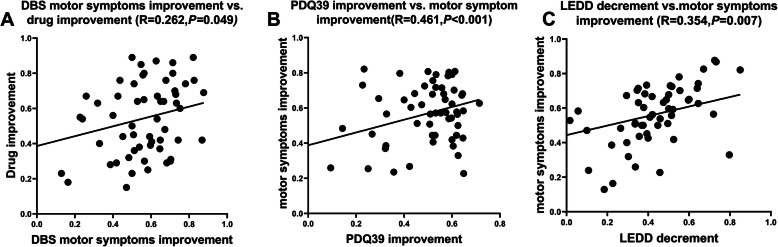
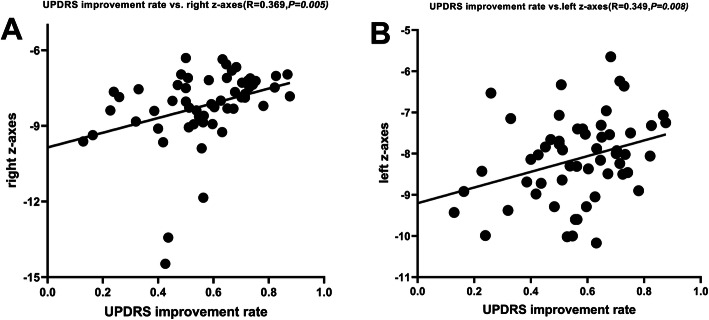
After 6 months of follow up, the UPDRS-III scores of 57 patients (Med-off) were improved by 55.4 ± 18.9% (P<0.001) compared with that before operation. The improvement rate of PDQ-39 scores [(47.4 ± 23.2)%, (P < 0.001)] and the reduction rate of LEDD [(40.1 ± 24.3)%, (P < 0.01)] at 6 months postoperation were positively correlated with the improvement rate of motor symptoms (Med-off)(PDQ-39:r = 0.461, P<0.001; LEDD: r = 0.354, P = 0.007), the improvement rate of UPDRS-III (Med-off) and the Z-axis coordinate of the active contact in the MNI space were positively correlated (left side: r = 0.349,P = 0.008;right side: r = 0.369,P = 0.005). In the MNI space, there was no correlation between the UPDRS-III scores improvement rate (Med-off) at 6 months after operation and bilateral VTA in the STN motor subregion, STN associative subregion and STN limbic subregion of the active electrode contacts of 57 patients (all P > 0.05). At 6 months after surgery, the difference between the Z-axis coordinate in the different improvement rate subgroups(<25, 25 to 50%, and>50%) in the MNI space was statistically significant (left side: P = 0.030; right side: P = 0.024). In the MNI space, there was no statistically significant difference between the groups in the VTA of the electrode active contacts (all P > 0.05).
STN-DBS can improve the motor symptoms of PD patients and improve the quality of life. The closer the stimulation is to the STN dorsolateral sensorimotor area, the higher the DBS is to improve the motor symptoms of PD patients.
研究双侧 STN-DBS 刺激触点位置与 STN-DBS 对帕金森病(PD)患者运动症状疗效的关系。
回顾性分析 2018 年 3 月至 2018 年 12 月期间接受双侧 STN-DBS 的 57 例 PD 患者的临床资料。采用统一帕金森病评定量表第三部分(UPDRS-III)评分、左旋多巴等效日剂量(LEDD)、帕金森病生活质量量表(PDQ-39)于术前及术后 6 个月评估患者的运动症状,确定激活触点的位置和组织激活体积(VTA)在蒙特利尔神经学研究所(MNI)空间,并分析其与运动症状改善率(UPDRS-III 评分改善率)的相关性。
57 例患者(关药期)术后 6 个月 UPDRS-III 评分改善 55.4±18.9%(P<0.001),PDQ-39 评分改善率[(47.4±23.2)%]和 LEDD 降低率[(40.1±24.3)%]均高于术前(P<0.001),且与运动症状改善率(关药期)呈正相关(PDQ-39:r=0.461,P<0.001;LEDD:r=0.354,P=0.007),UPDRS-III 评分(关药期)与 MNI 空间中触点的 Z 轴坐标呈正相关(左侧:r=0.349,P=0.008;右侧:r=0.369,P=0.005)。在 MNI 空间中,术后 6 个月双侧 STN 运动亚区、STN 联合亚区和 STN 边缘亚区的电极触点的 UPDRS-III 评分改善率(关药期)与 VTA 无相关性(均 P>0.05)。术后 6 个月,MNI 空间中不同改善率亚组(<25%、25%~50%和>50%)之间 Z 轴坐标的差异有统计学意义(左侧:P=0.030;右侧:P=0.024)。MNI 空间中电极触点的 VTA 无统计学差异(均 P>0.05)。
STN-DBS 可改善 PD 患者的运动症状,提高生活质量,刺激越接近 STN 背外侧感觉运动区,对 PD 患者的 DBS 改善运动症状的效果越好。