Terranova Joseph I, Ferris Craig F, Albers H Elliott
Center for Behavioral Neuroscience, Neuroscience Institute, Georgia State University, Atlanta, GA, United States.
Department of Psychology, Center for Translational NeuroImaging, Northeastern University, Boston, MA, United States.
Front Endocrinol (Lausanne). 2017 Nov 14;8:308. doi: 10.3389/fendo.2017.00308. eCollection 2017.
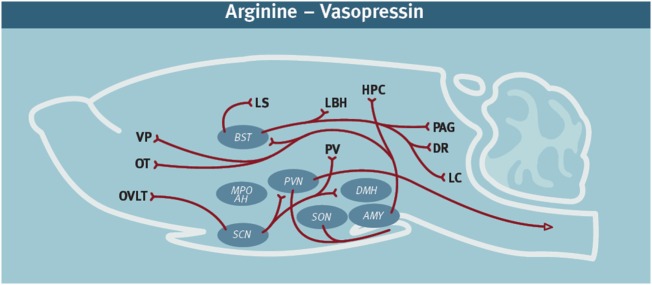
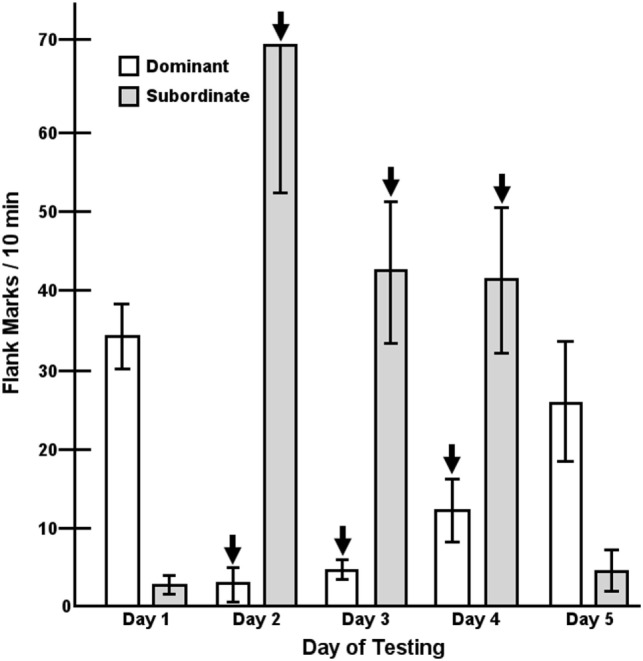
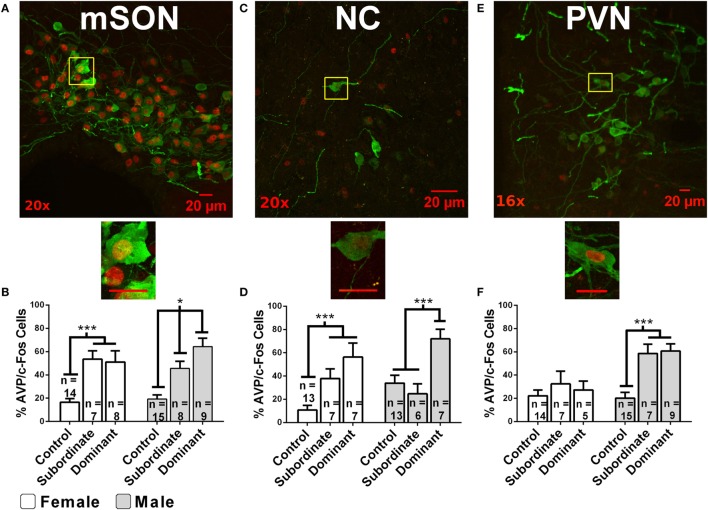
Arginine-vasopressin (AVP) plays a critical role in the regulation of offensive aggression and social status in mammals. AVP is found in an extensive neural network in the brain. Here, we discuss the role of AVP in the regulation of aggression in the limbic system with an emphasis on the critical role of hypothalamic AVP in the control of aggression. In males, activation of AVP V1a receptors (V1aRs) in the hypothalamus stimulates offensive aggression, while in females activation of V1aRs inhibits aggression. Serotonin (5-HT) also acts within the hypothalamus to modulate the effects of AVP on aggression in a sex-dependent manner. Activation of 5-HT1a receptors (5-HT1aRs) inhibits aggression in males and stimulates aggression in females. There are also striking sex differences in the mechanisms underlying the acquisition of dominance. In males, the acquisition of dominance is associated with the activation of AVP-containing neurons in the hypothalamus. By contrast, in females, the acquisition of dominance is associated with the activation of 5-HT-containing neurons in the dorsal raphe. AVP and 5-HT also play critical roles in the regulation of a form of social communication that is important for the maintenance of dominance relationships. In both male and female hamsters, AVP acts V1aRs in the hypothalamus, as well as in other limbic structures, to communicate social status through the stimulation of a form of scent marking called flank marking. 5-HT acts on 5-HT1aRs as well as other 5-HT receptors within the hypothalamus to inhibit flank marking induced by AVP in both males and females. Interestingly, while AVP and 5-HT influence the expression of aggression in opposite ways in males and females, there are no sex differences in the effects of AVP and 5-HT on the expression of social communication. Given the profound sex differences in the incidence of many psychiatric disorders and the increasing evidence for a relationship between aggressiveness/dominance and the susceptibility to these disorders, understanding the neural regulation of aggression and social status will have significant import for translational studies.
精氨酸加压素(AVP)在哺乳动物的攻击性行为调节和社会地位维持中起着关键作用。AVP存在于大脑中的广泛神经网络中。在此,我们讨论AVP在边缘系统攻击行为调节中的作用,重点关注下丘脑AVP在攻击行为控制中的关键作用。在雄性动物中,下丘脑AVP V1a受体(V1aRs)的激活会刺激攻击性行为,而在雌性动物中,V1aRs的激活则会抑制攻击行为。血清素(5-HT)也在下丘脑中发挥作用,以性别依赖的方式调节AVP对攻击行为的影响。5-HT1a受体(5-HT1aRs)的激活会抑制雄性动物的攻击行为,并刺激雌性动物的攻击行为。在获取支配地位的潜在机制方面也存在显著的性别差异。在雄性动物中,获取支配地位与下丘脑含AVP神经元的激活有关。相比之下,在雌性动物中,获取支配地位与中缝背核含5-HT神经元的激活有关。AVP和5-HT在一种对维持支配关系很重要的社会交流形式的调节中也起着关键作用。在雄性和雌性仓鼠中,AVP作用于下丘脑以及其他边缘结构中的V1aRs,通过刺激一种称为胁腹标记的气味标记形式来传达社会地位。5-HT作用于下丘脑内的5-HT1aRs以及其他5-HT受体,抑制雄性和雌性动物中由AVP诱导的胁腹标记。有趣的是,虽然AVP和5-HT对雄性和雌性动物攻击行为表达的影响方式相反,但AVP和5-HT对社会交流表达的影响不存在性别差异。鉴于许多精神疾病发病率存在深刻的性别差异,以及越来越多的证据表明攻击性/支配地位与这些疾病的易感性之间存在关联,了解攻击行为和社会地位的神经调节对转化研究具有重要意义。