Physics of Living Systems, Department of Physics, Massachusetts Institute of Technology, Cambridge, MA, USA
Cajal Institute, Consejo Superior de Investigaciones Científicas, Madrid, Spain.
J R Soc Interface. 2017 Nov;14(136). doi: 10.1098/rsif.2017.0748.
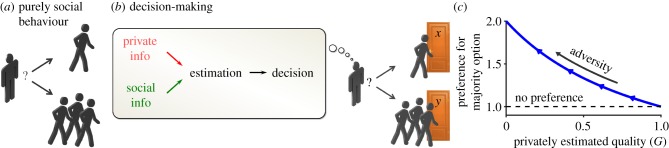
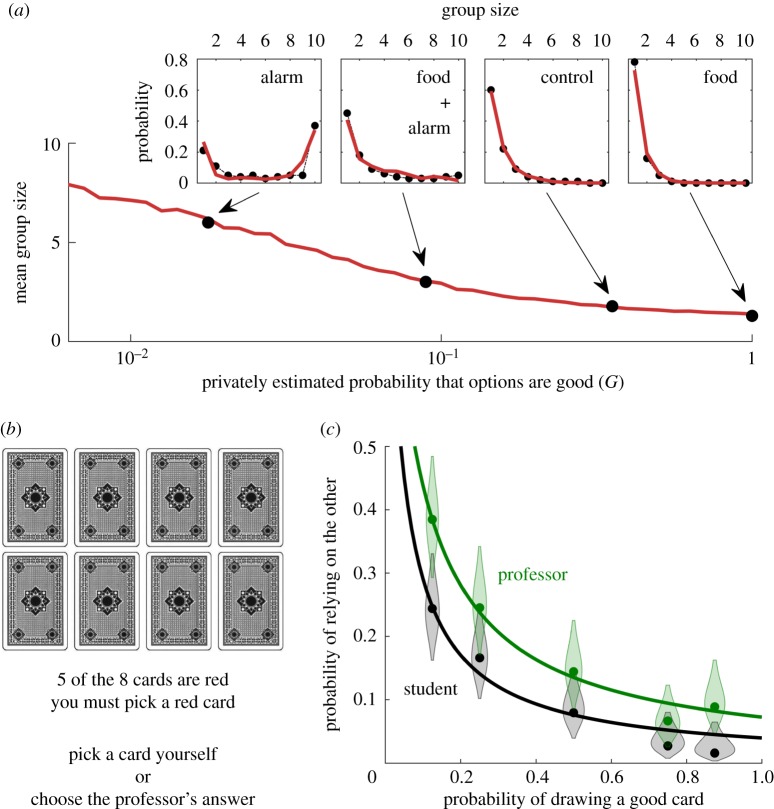
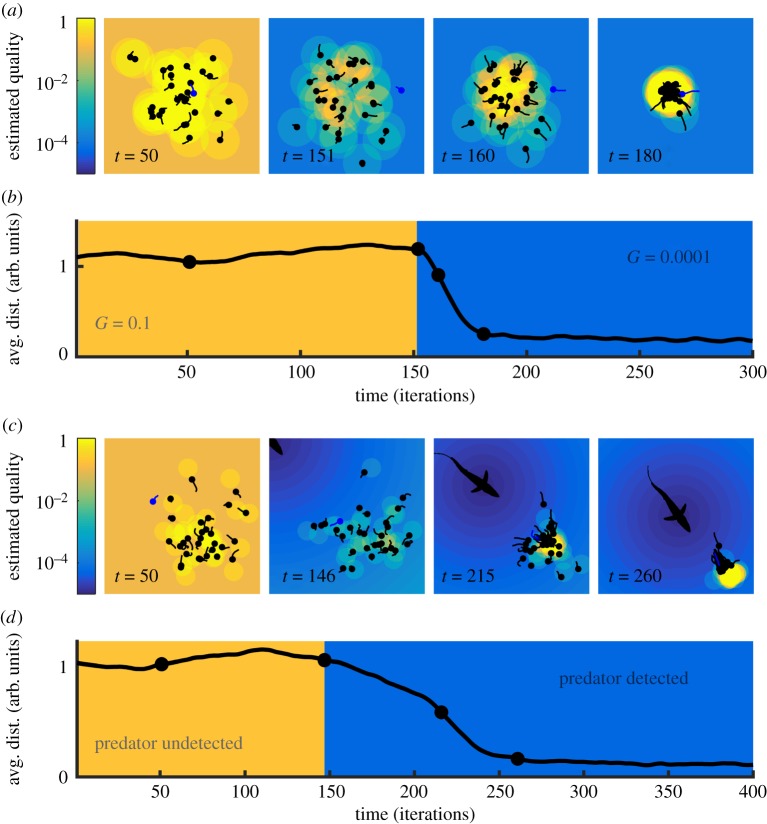
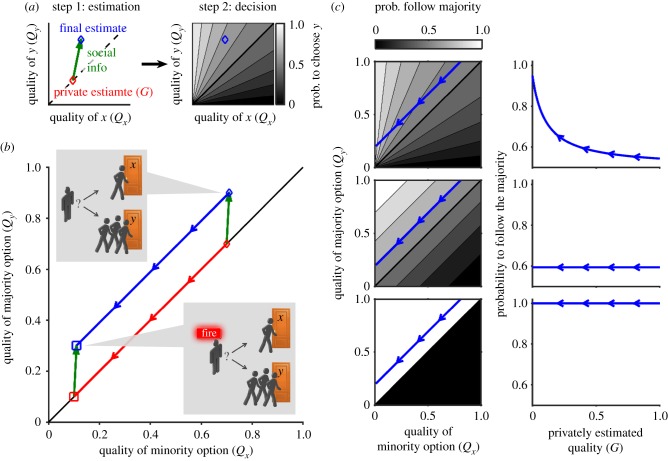
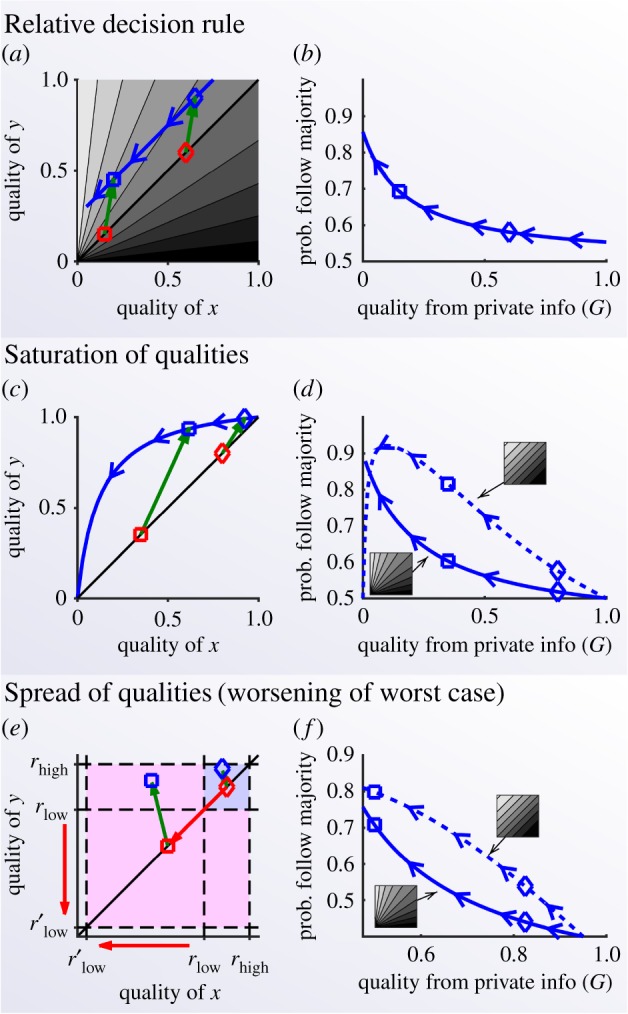
Decision-making theories explain animal behaviour, including human behaviour, as a response to estimations about the environment. In the case of collective behaviour, they have given quantitative predictions of how animals follow the majority option. However, they have so far failed to explain that in some species and contexts social cohesion increases when conditions become more adverse (i.e. individuals choose the majority option with higher probability when the estimated quality of all available options decreases). We have found that this failure is due to modelling simplifications that aided analysis, like low levels of stochasticity or the assumption that only one choice is the correct one. We provide a more general but simple geometric framework to describe optimal or suboptimal decisions in collectives that gives insight into three different mechanisms behind this effect. The three mechanisms have in common that the private information acts as a gain factor to social information: a decrease in the privately estimated quality of all available options increases the impact of social information, even when social information itself remains unchanged. This increase in the importance of social information makes it more likely that agents will follow the majority option. We show that these results quantitatively explain collective behaviour in fish and experiments of social influence in humans.
决策理论解释了动物行为,包括人类行为,将其解释为对环境的估计的反应。在集体行为的情况下,它们对动物如何跟随多数选项进行了定量预测。然而,到目前为止,它们还没有解释为什么在某些物种和环境中,当条件变得更加不利时(即当所有可用选项的估计质量下降时,个体更有可能选择多数选项),社会凝聚力会增加。我们发现,这种失败是由于建模简化,例如低水平的随机性或假设只有一个选择是正确的,这有助于分析。我们提供了一个更通用但简单的几何框架来描述集体中的最优或次优决策,深入了解了这种效应背后的三种不同机制。这三种机制的共同点是,私人信息作为社会信息的增益因素:所有可用选项的私人估计质量的下降增加了社会信息的影响,即使社会信息本身保持不变。社会信息的重要性增加,使得代理人更有可能遵循多数选项。我们表明,这些结果从数量上解释了鱼类的集体行为和人类社会影响实验。