1 University of Amsterdam, The Netherlands.
2 University of Kent, Canterbury, UK.
Pers Soc Psychol Bull. 2018 Mar;44(3):384-405. doi: 10.1177/0146167217741314. Epub 2017 Dec 1.
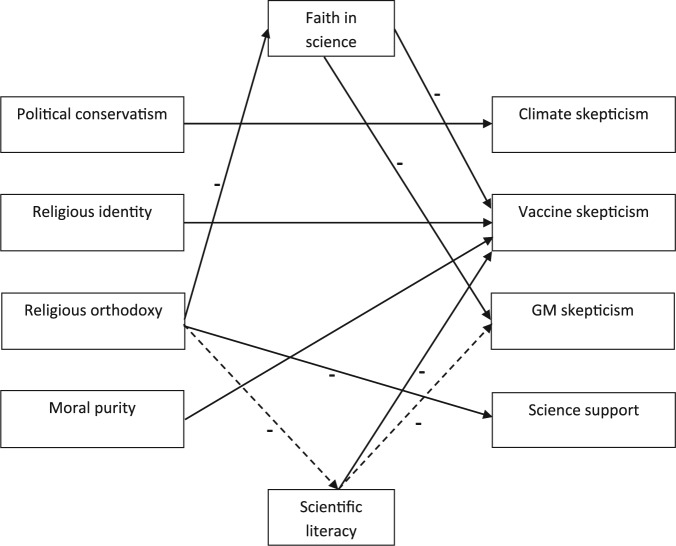
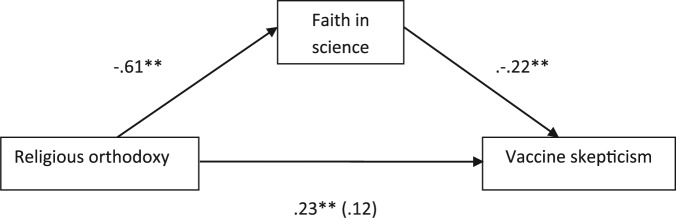
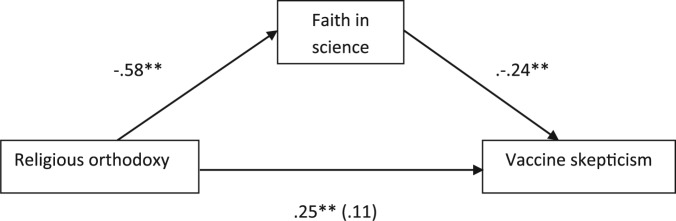
Many topics that scientists investigate speak to people's ideological worldviews. We report three studies-including an analysis of large-scale survey data-in which we systematically investigate the ideological antecedents of general faith in science and willingness to support science, as well as of science skepticism of climate change, vaccination, and genetic modification (GM). The main predictors are religiosity and political orientation, morality, and science understanding. Overall, science understanding is associated with vaccine and GM food acceptance, but not climate change acceptance. Importantly, different ideological predictors are related to the acceptance of different scientific findings. Political conservatism best predicts climate change skepticism. Religiosity, alongside moral purity concerns, best predicts vaccination skepticism. GM food skepticism is not fueled by religious or political ideology. Finally, religious conservatives consistently display a low faith in science and an unwillingness to support science. Thus, science acceptance and rejection have different ideological roots, depending on the topic of investigation.
许多科学家研究的主题都涉及到人们的思想世界观。我们报告了三项研究,包括对大规模调查数据的分析,这些研究系统地调查了对科学的普遍信仰和支持科学的意愿,以及对气候变化、疫苗接种和基因改造(GM)的科学怀疑的思想前提。主要的预测因素是宗教信仰和政治取向、道德和科学理解。总的来说,科学理解与疫苗和 GM 食品的接受度有关,但与气候变化的接受度无关。重要的是,不同的意识形态预测因素与对不同科学发现的接受程度有关。政治保守主义最能预测对气候变化的怀疑。宗教信仰,以及对道德纯洁性的关注,最能预测对疫苗接种的怀疑。GM 食品的怀疑并不是由宗教或政治意识形态驱动的。最后,宗教保守派一贯表现出对科学的低信仰和不愿意支持科学。因此,科学的接受和拒绝有不同的思想根源,这取决于研究的主题。