Computational Social Science, ETH Zurich, Clausiusstrasse 50, CH-8092, Zurich, Switzerland.
Nat Commun. 2017 Dec 1;8(1):1888. doi: 10.1038/s41467-017-02078-y.
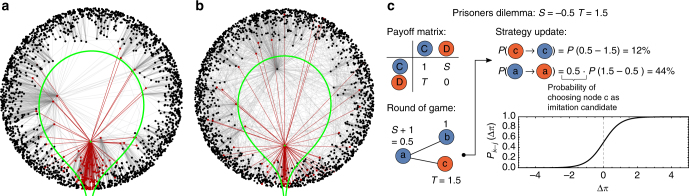
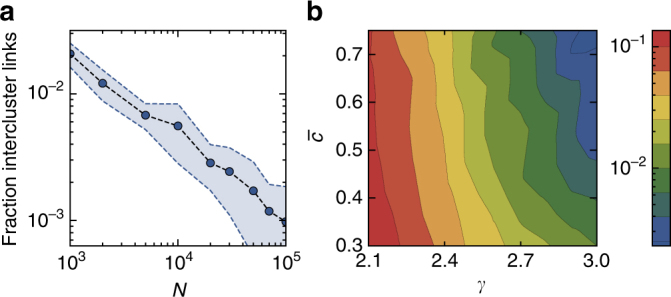
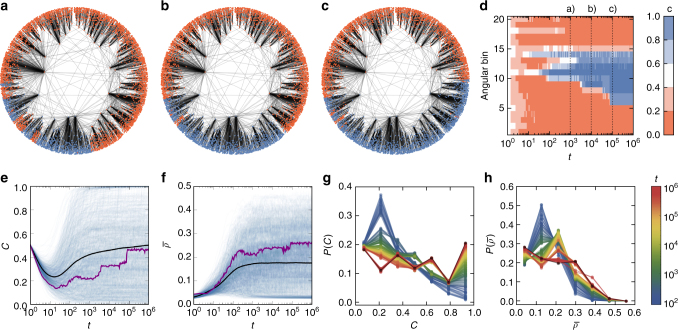
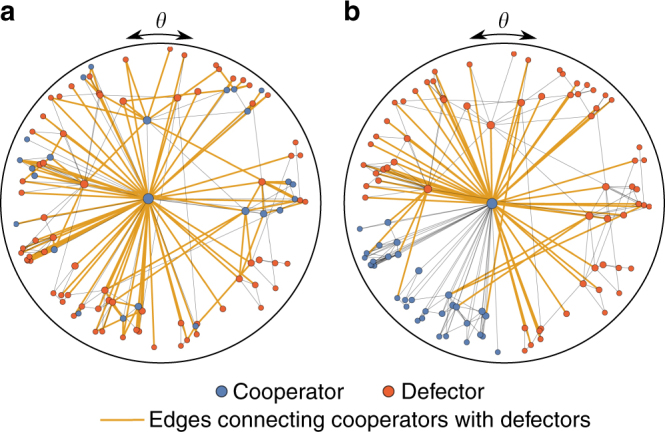
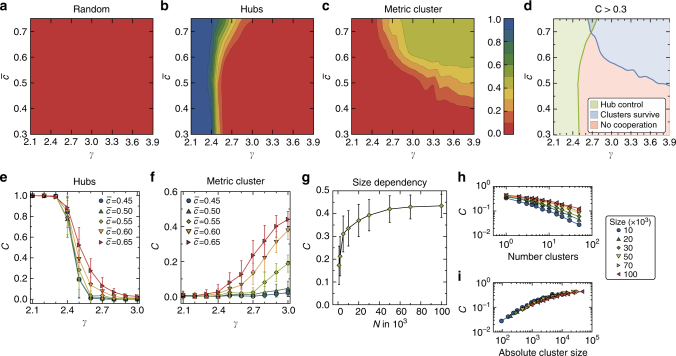
The evolution of cooperation in social dilemmas in structured populations has been studied extensively in recent years. Whereas many theoretical studies have found that a heterogeneous network of contacts favors cooperation, the impact of spatial effects in scale-free networks is still not well understood. In addition to being heterogeneous, real contact networks exhibit a high mean local clustering coefficient, which implies the existence of an underlying metric space. Here we show that evolutionary dynamics in scale-free networks self-organize into spatial patterns in the underlying metric space. The resulting metric clusters of cooperators are able to survive in social dilemmas as their spatial organization shields them from surrounding defectors, similar to spatial selection in Euclidean space. We show that under certain conditions these metric clusters are more efficient than the most connected nodes at sustaining cooperation and that heterogeneity does not always favor-but can even hinder-cooperation in social dilemmas.
近年来,人们对结构化群体中社会困境下合作的演变进行了广泛的研究。虽然许多理论研究发现,异质的联系网络有利于合作,但在无标度网络中,空间效应的影响仍未得到很好的理解。除了异质性之外,真实的联系网络还表现出较高的平均局部聚类系数,这意味着存在一个潜在的度量空间。在这里,我们表明,无标度网络中的进化动力学在潜在的度量空间中自组织成空间模式。合作的度量聚类能够在社会困境中存活下来,因为它们的空间组织使它们免受周围的缺陷者的影响,类似于欧几里得空间中的空间选择。我们表明,在某些条件下,这些度量聚类比最连通的节点更有效地维持合作,而且异质性并不总是有利于——甚至可能阻碍——社会困境中的合作。