Cardiac MR PET CT Program, Department of Radiology (Cardiovascular Imaging) and Division of Cardiology, Massachusetts General Hospital and Harvard Medical School, 165 Cambridge Street, Suite 400, Boston, MA 02114-2750, USA; Department for Diagnostic and Interventional Radiology, University Hospital Frankfurt, Johann-Wolfgang-Goethe University, Theodor-Stern-Kai 7, 60590 Frankfurt/Main, Germany.
Cardiac MR PET CT Program, Department of Radiology (Cardiovascular Imaging) and Division of Cardiology, Massachusetts General Hospital and Harvard Medical School, 165 Cambridge Street, Suite 400, Boston, MA 02114-2750, USA.
J Cardiovasc Comput Tomogr. 2018 Jan-Feb;12(1):28-33. doi: 10.1016/j.jcct.2017.11.005. Epub 2017 Nov 14.
Pulmonary nodules (PN) are frequently detected incidentally during coronary computed tomography angiography (CTA). We evaluated whether the 2017 Fleischner Society guidelines may result in a decrease of follow-up testing of incidental PN as compared to prior guidelines in patients undergoing coronary CTA.
We conducted a retrospective study of a registry of emergency department patients who underwent coronary CTA for acute coronary syndrome assessment between 2012 and 2017. Based on guidelines, patients <35 years, history of cancer, or prior exams showing stability of PN were excluded. Patients >60 years, history of smoking, irregular/spiculated PN morphology, or PN size >20 mm were classified as high-risk for lung cancer. Radiological findings pertaining to PN were identified (PN size, morphology, quantity) through review of radiology reports. PN follow-up recommendations were established using 2017 Fleischner Society Guidelines and compared with prior guidelines for solid (2005) and subsolid (2013) PN. Data were analyzed with Student's t-test.
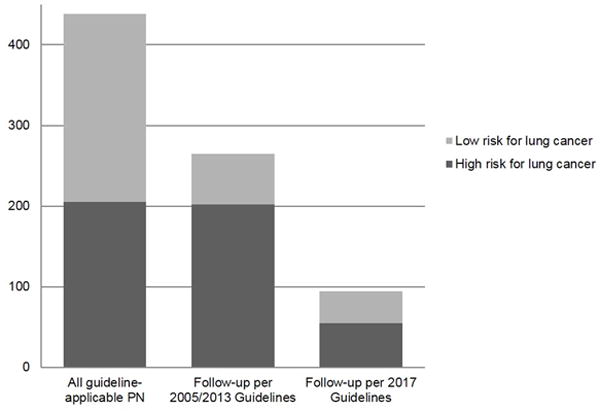
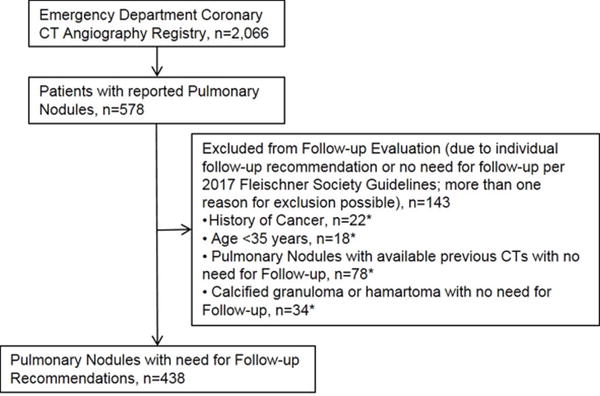
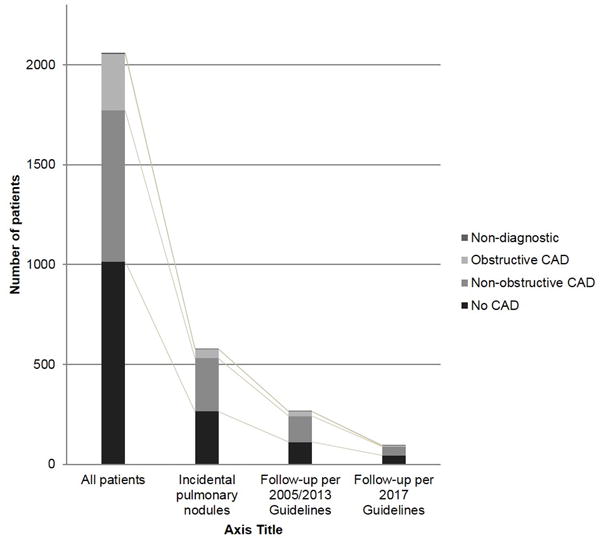
The registry included 2066 patients (female 45.1%, 52.9 ± 11.0 years), of which 578 (28.0%) reported PN. 438 of those (21.2%) were eligible for guideline-based follow-up evaluation. 205 (4 6.8%) were classified as high-risk for lung cancer. 2017 guidelines reduced the number of individuals requiring follow-up by 64.5%, from 264 (12.8%) to 94 patients (4.5%) when compared to prior guidelines (p < 0.001). The minimum number of follow-up chest CTs decreased by 55.8% from 430 to 190 (p < 0.001).
Application of the 2017 Fleischner Society Guidelines resulted in a significant decrease of follow-up testing for incidental PN in patients undergoing coronary CTA for suspected acute coronary syndrome.
在冠状动脉 CT 血管造影(CTA)期间,经常偶然发现肺部结节(PN)。我们评估了与之前的指南相比,2017 年 Fleischner 学会指南是否会导致接受冠状动脉 CTA 的患者对偶然发现的 PN 的随访检测减少。
我们对 2012 年至 2017 年期间因急性冠状动脉综合征评估而行冠状动脉 CTA 的急诊科患者的注册中心进行了回顾性研究。根据指南,排除<35 岁、癌症病史或先前检查显示 PN 稳定的患者。>60 岁、吸烟史、不规则/刺状 PN 形态或 PN 直径>20mm 的患者被归类为肺癌高危人群。通过回顾放射学报告确定与 PN 相关的放射学发现(PN 大小、形态、数量)。使用 2017 年 Fleischner 学会指南确定 PN 的随访建议,并与固体(2005 年)和亚固体(2013 年)PN 的先前指南进行比较。使用学生 t 检验进行数据分析。
该注册中心纳入了 2066 名患者(女性占 45.1%,52.9±11.0 岁),其中 578 名(28.0%)报告有 PN。其中 438 名(21.2%)符合基于指南的随访评估条件。205 名(46.8%)被归类为肺癌高危人群。与之前的指南相比,2017 年的指南将需要随访的人数减少了 64.5%,从 264 人(12.8%)减少到 94 人(4.5%)(p<0.001)。随访胸部 CT 检查的最低数量减少了 55.8%,从 430 次减少到 190 次(p<0.001)。
应用 2017 年 Fleischner 学会指南可显著减少疑似急性冠状动脉综合征行冠状动脉 CTA 患者偶然发现的 PN 的随访检测。