Institute of Biomedical and Clinical Science, University of Exeter Medical School, Exeter, UK.
Institute of Biomedical and Clinical Science, University of Exeter Medical School, Exeter, UK.
Lancet Diabetes Endocrinol. 2018 Feb;6(2):122-129. doi: 10.1016/S2213-8587(17)30362-5. Epub 2017 Nov 30.
Type 1 diabetes is typically considered a disease of children and young adults. Genetic susceptibility to young-onset type 1 diabetes is well defined and does not predispose to type 2 diabetes. It is not known how frequently genetic susceptibility to type 1 diabetes leads to a diagnosis of diabetes after age 30 years. We aimed to investigate the frequency and phenotype of type 1 diabetes resulting from high genetic susceptibility in the first six decades of life.
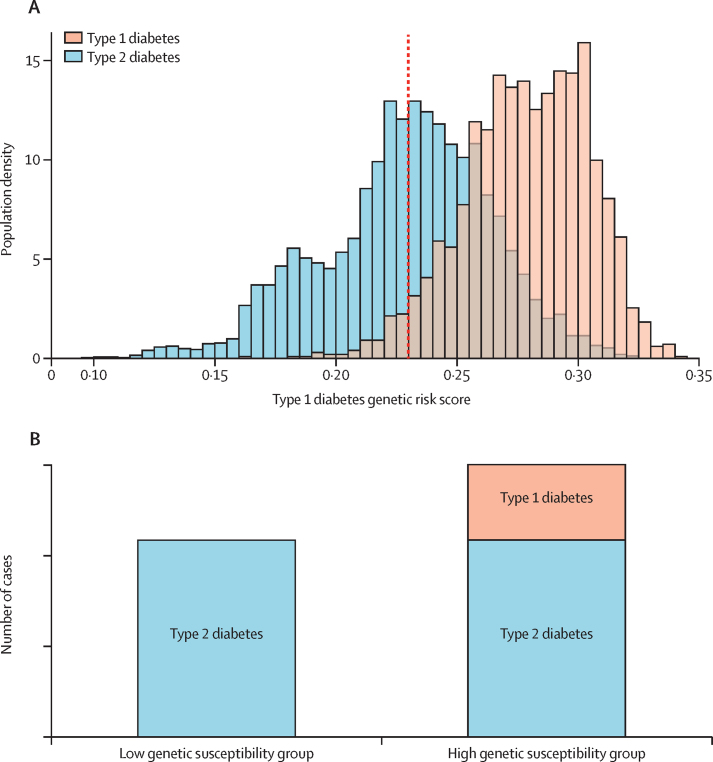
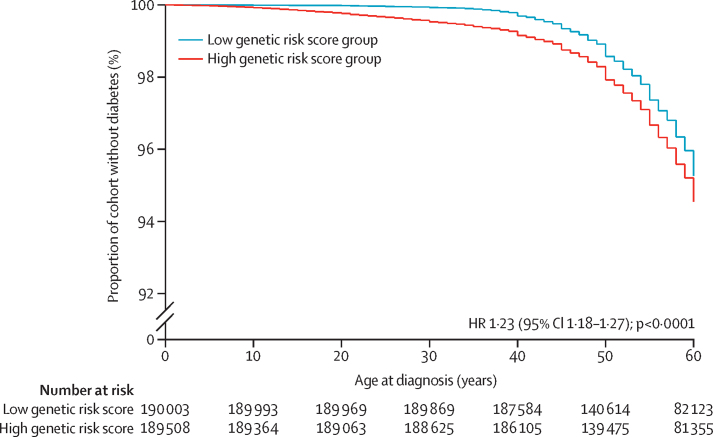
In this cross-sectional analysis, we used a type 1 diabetes genetic risk score based on 29 common variants to identify individuals of white European descent in UK Biobank in the half of the population with high or low genetic susceptibility to type 1 diabetes. We used Kaplan-Meier analysis to evaluate the number of cases of diabetes in both groups in the first six decades of life. We genetically defined type 1 diabetes as the additional cases of diabetes that occurred in the high genetic susceptibility group compared with the low genetic susceptibility group. All remaining cases were defined as type 2 diabetes. We assessed the clinical characteristics of the groups with genetically defined type 1 or type 2 diabetes.
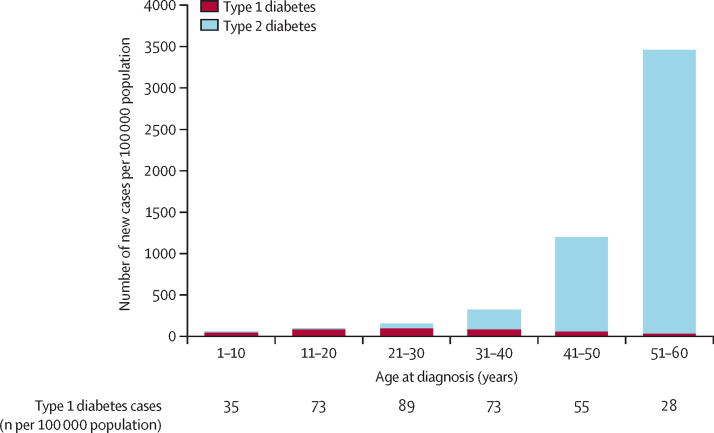
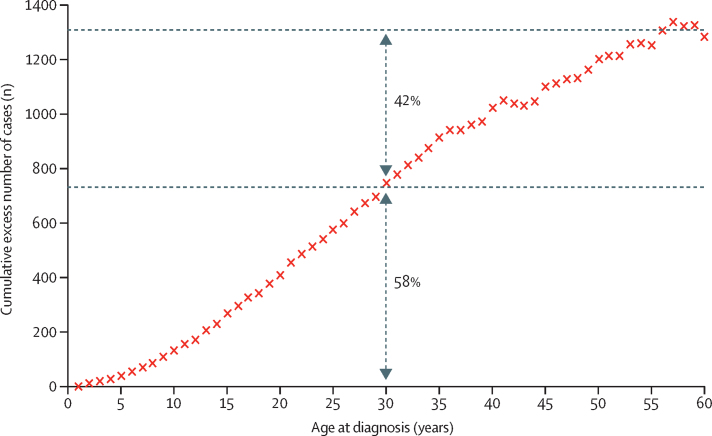
13 250 (3·5%) of 379 511 white European individuals in UK Biobank had developed diabetes in the first six decades of life. 1286 more cases of diabetes were in the half of the population with high genetic susceptibility to type 1 diabetes than in the half of the population with low genetic susceptibility. These genetically defined cases of type 1 diabetes were distributed across all ages of diagnosis; 537 (42%) were in individuals diagnosed when aged 31-60 years, representing 4% (537/12 233) of all diabetes cases diagnosed after age 30 years. The clinical characteristics of the group diagnosed with type 1 diabetes when aged 31-60 years were similar to the clinical characteristics of the group diagnosed with type 1 diabetes when aged 30 years or younger. For individuals diagnosed with diabetes when aged 31-60 years, the clinical characteristics of type 1 diabetes differed from those of type 2 diabetes: they had a lower BMI (27·4 kg/m [95% CI 26·7-28·0] vs 32·4 kg/m [32·2-32·5]; p<0·0001), were more likely to use insulin in the first year after diagnosis (89% [476/537] vs 6% [648/11 696]; p<0·0001), and were more likely to have diabetic ketoacidosis (11% [61/537] vs 0·3% [30/11 696]; p<0·0001).
Genetic susceptibility to type 1 diabetes results in non-obesity-related, insulin-dependent diabetes, which presents throughout the first six decades of life. Our results highlight the difficulty of identifying type 1 diabetes after age 30 years because of the increasing background prevalence of type 2 diabetes. Failure to diagnose late-onset type 1 diabetes can have serious consequences because these patients rapidly develop insulin dependency.
Wellcome Trust and Diabetes UK.
1 型糖尿病通常被认为是儿童和青年人群的疾病。年轻人易患 1 型糖尿病的遗传易感性已得到明确界定,不会导致 2 型糖尿病。尚不清楚导致 1 型糖尿病的遗传易感性导致多少人在 30 岁后被诊断患有糖尿病。我们旨在研究生命前 60 年中由高遗传易感性引起的 1 型糖尿病的发生频率和表型。
在这项横断面分析中,我们使用了基于 29 个常见变异的 1 型糖尿病遗传风险评分,根据对 1 型糖尿病的遗传易感性高低,在 UK Biobank 中识别出白种欧洲血统的人群。我们使用 Kaplan-Meier 分析评估了两组在生命的前 60 年中糖尿病的发病数量。我们通过基因将 1 型糖尿病定义为高遗传易感性组中比低遗传易感性组中额外发生的糖尿病病例。所有其余病例均定义为 2 型糖尿病。我们评估了具有基因定义的 1 型或 2 型糖尿病的两组的临床特征。
在 UK Biobank 的 379511 名白种欧洲个体中,有 13250(3.5%)人在生命的前 60 年中已患有糖尿病。在高遗传易感性 1 型糖尿病的人群中,糖尿病病例比低遗传易感性的人群多 1286 例。这些通过基因定义的 1 型糖尿病病例分布在所有诊断年龄;537 例(42%)在 31-60 岁诊断,占所有 30 岁以后诊断的糖尿病病例的 4%(537/12233)。诊断为 31-60 岁的 1 型糖尿病的人群的临床特征与诊断为 30 岁或更年轻的 1 型糖尿病的人群的临床特征相似。对于诊断为 31-60 岁的糖尿病患者,1 型糖尿病的临床特征与 2 型糖尿病不同:他们的 BMI 较低(27.4kg/m[95%CI26.7-28.0]vs32.4kg/m[32.2-32.5];p<0.0001),在诊断后的第一年更有可能使用胰岛素(89%[476/537]vs6%[648/112696];p<0.0001),并且更有可能发生糖尿病酮症酸中毒(11%[61/537]vs0.3%[30/112696];p<0.0001)。
1 型糖尿病的遗传易感性导致非肥胖相关、依赖胰岛素的糖尿病,其发生在生命的前 60 年。我们的结果强调了由于 2 型糖尿病背景患病率的增加,难以识别 30 岁以后的 1 型糖尿病。未能诊断出迟发性 1 型糖尿病可能会产生严重后果,因为这些患者会迅速出现胰岛素依赖。
惠康信托基金会和英国糖尿病协会。