Department of Gynecology and Obstetrics, Shanghai Jiao Tong University Affiliated Sixth People's Hospital.
Department of Gynecology and Obstetrics, Shanghai Sixth People's Hospital East Branch.
Clin Interv Aging. 2017 Nov 23;12:1993-2001. doi: 10.2147/CIA.S148688. eCollection 2017.
The present study aimed to develop a symptom-based (namely, hot flashes and sweating) scoring system for predicting the risk of depressive symptoms in menopausal women via a multicentre cross-sectional survey.
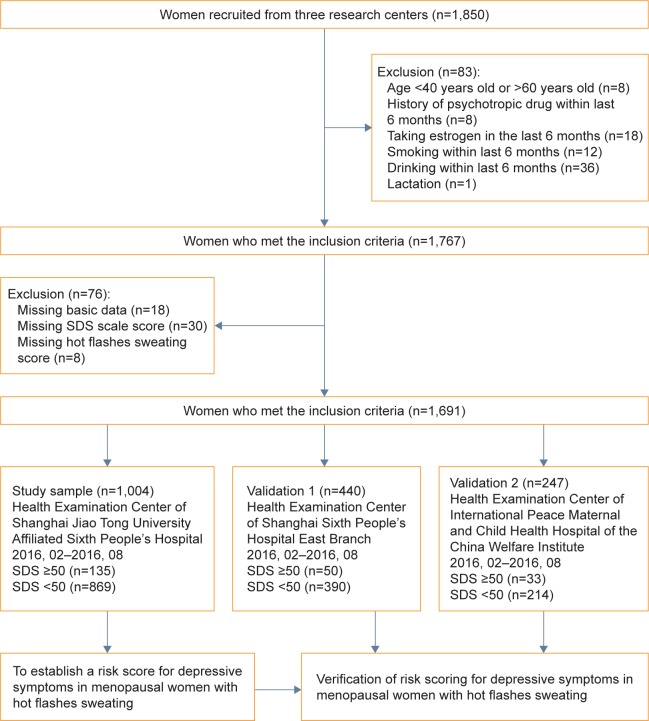
The data examined in the present study were obtained from 1,004 women aged 40-60 years who underwent physical examination at A Hospital. The basic information was obtained using a questionnaire-based survey. A self-rating depression scale was used to obtain the depressive symptom scores, while the Kupperman Menopausal Index was used to obtain the scores for the frequency of hot flashes and sweating. A logistic regression model was also established. The resulting β coefficient was employed to calculate and predict the risk of depressive symptoms in these women and a risk scoring system was established. The scoring system was validated using samples from 2 other centers (validation sample 1: B Hospital, 440 women; validation sample 2: C Hospital, 247 women).
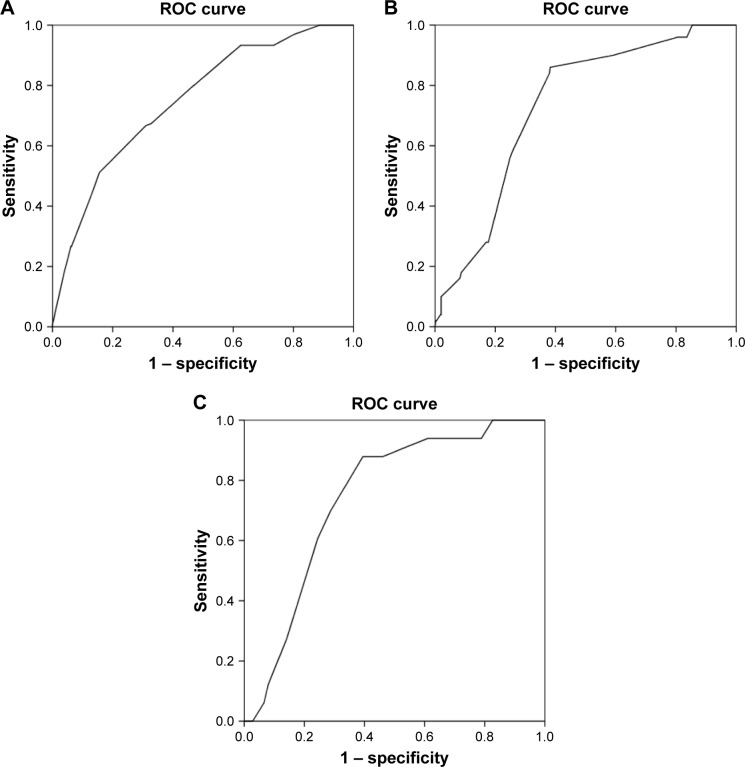
The scoring system developed to predict the risk of depressive symptoms in menopausal women was based on hot flash and sweating symptoms and associated with menopausal status, hot flash scores, education level (high school education and below) and being diabetic. The scoring system yielded a total score of 0-54 points. For women in the study sample, the area under the curve (AUC) of depressive symptom risk score was 0.750 (95% CI, 0.708-0.793). Validation sample 1 had an AUC of 0.731 (95% CI, 0.667-0.794), while validation sample 2 had an AUC of 0.744 (95% CI, 0.669-0.820). The optimal cut-off score to assess depressive symptoms in women participating in the present study was 31 points. The sensitivity and specificity for predicting depressive symptoms in the study sample were 0.667 and 0.701, respectively. In contrast, the sensitivity was 0.840 in validation sample 1 and 0.879 in validation sample 2.
The hot flash and sweating symptom-based scoring system developed to predict the risk of depressive symptoms in menopausal women relies on non-laboratory survey data. The system is simple, practical, and convenient to use. For Chinese huge population of menopausal women, the scoring system should be considered a reliable screening tool for depressive symptoms.
本研究旨在通过多中心横断面调查,建立基于症状(即热潮和出汗)的评分系统,预测围绝经期妇女抑郁症状的发生风险。
本研究的数据来自 A 医院接受体检的 1004 名 40-60 岁女性。基本信息通过问卷调查获得。采用自评抑郁量表获得抑郁症状评分,采用 Kupperman 绝经指数获得热潮和出汗频率评分。还建立了 logistic 回归模型。利用该模型的β系数计算和预测这些女性发生抑郁症状的风险,并建立风险评分系统。该评分系统在另外 2 个中心的样本(验证样本 1:B 医院,440 名女性;验证样本 2:C 医院,247 名女性)中进行了验证。
预测围绝经期妇女发生抑郁症状风险的评分系统基于热潮和出汗症状,与绝经状态、热潮评分、教育程度(高中及以下)和糖尿病相关。评分系统的总分为 0-54 分。在研究样本中,抑郁症状风险评分的曲线下面积(AUC)为 0.750(95%CI:0.708-0.793)。验证样本 1 的 AUC 为 0.731(95%CI:0.667-0.794),验证样本 2 的 AUC 为 0.744(95%CI:0.669-0.820)。评估本研究中女性抑郁症状的最佳截断值为 31 分。研究样本中预测抑郁症状的敏感度和特异度分别为 0.667 和 0.701,而验证样本 1 的敏感度为 0.840,验证样本 2 的敏感度为 0.879。
本研究建立的预测围绝经期妇女抑郁症状发生风险的基于热潮和出汗症状的评分系统,依赖于非实验室调查数据。该系统简单、实用、方便。对于中国庞大的围绝经期妇女人群,该评分系统应被视为一种可靠的抑郁症状筛查工具。