Kelly-Hope Louise A, Stanton Michelle C, Zouré Honorat G M, Kinvi Boniface E, Mikhailov Alexei, Tekle Afework, King Jonathan D
Department of Parasitology, Liverpool School of Tropical Medicine, Liverpool, UK.
African Programme for Onchocerciasis Control, Ouagadougou, Burkina Faso.
Glob Health Res Policy. 2017 May 1;2:12. doi: 10.1186/s41256-017-0032-0. eCollection 2017.
Lymphatic filariasis (LF) is a vector-borne parasitic disease that is being targeted for elimination through mass drug administration (MDA). The co-distribution of in Central Africa poses a significant barrier to the expansion of the MDA due to risk of severe adverse events (SAEs) associated with the drug ivermectin that is routinely used. National LF programmes are yet to significantly scale up in co-endemic areas and need a practical approach to make preliminary decisions based on the mapping status and potential treatment strategies.
We reviewed relevant data available to WHO and in the literature for LF- endemic countries to develop a simple method to support the scale-up of MDA to eliminate LF.
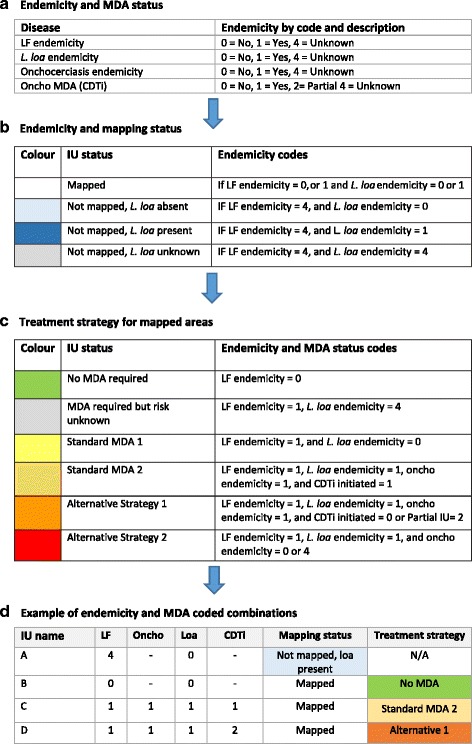
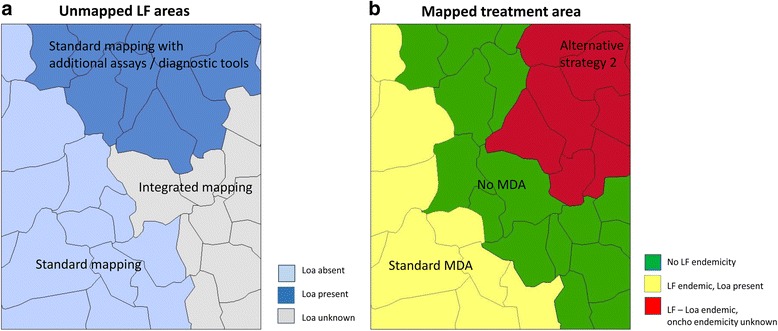
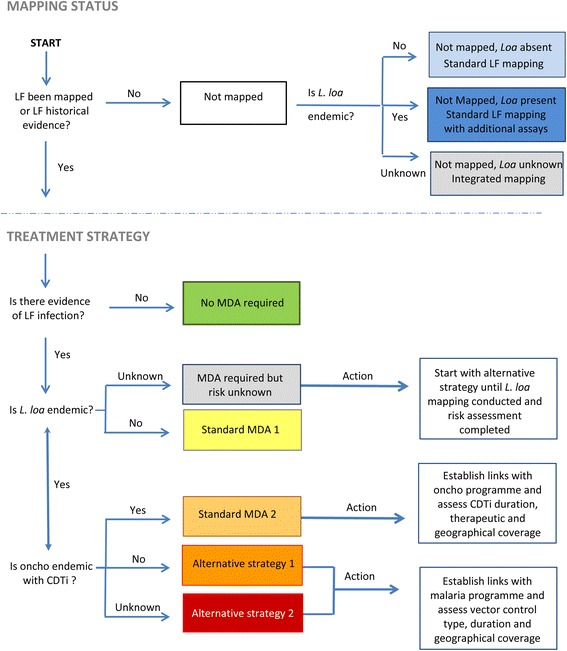
A basic model for national LF programmes to work from at the administrative or implementation unit (IU) level has been developed for LF - co-endemic countries. The model includes five practical steps, which comprise the development of a national filarial database and a simple classification system to help determine the mapping status and most appropriate treatment strategy. Steps are colour-coded and linked to a general decision tree, which is also presented.
This IU-level model is simple to follow and will help LF elimination programmes develop an action plan and scale up the implementation of alternative treatment strategies in co-endemic areas. The model could be further developed to incorporate the additional complexity of IUs where an intervention is required to eliminate onchocerciasis, particularly in hypo-endemic areas where ivermectin has not been used.
淋巴丝虫病(LF)是一种通过媒介传播的寄生虫病,目前正通过大规模药物治疗(MDA)来实现消除目标。在中非,盘尾丝虫病与淋巴丝虫病的共同流行构成了MDA扩大实施的重大障碍,这是因为常规使用的伊维菌素药物存在严重不良事件(SAE)风险。在两种疾病共同流行的地区,国家淋巴丝虫病防治项目尚未大规模开展,需要一种切实可行的方法,以便根据疾病分布情况和潜在治疗策略做出初步决策。
我们查阅了世界卫生组织及文献中可获取的有关淋巴丝虫病流行国家的相关数据,以制定一种简单方法来支持扩大MDA以消除淋巴丝虫病。
已为淋巴丝虫病和盘尾丝虫病共同流行的国家开发了一个国家级淋巴丝虫病防治项目在行政或实施单位(IU)层面开展工作的基本模型。该模型包括五个实际步骤,其中包括建立一个国家丝虫病数据库和一个简单的分类系统,以帮助确定疾病分布情况和最合适的治疗策略。这些步骤用颜色编码,并与一个通用决策树相联系,该决策树也一并列出。
这个IU层面的模型易于遵循,将有助于淋巴丝虫病消除项目制定行动计划,并在两种疾病共同流行地区扩大替代治疗策略的实施。该模型可以进一步完善,以纳入需要采取干预措施来消除盘尾丝虫病的IU地区的更多复杂情况,特别是在尚未使用伊维菌素的低流行地区。