Bekeny James R, Ozer Enver
Department of Otolaryngology-Head and Neck Surgery, The Ohio State University Medical Center, The James Cancer Hospital and Solove Research Institute, Columbus, OH 43210, USA.
World J Otorhinolaryngol Head Neck Surg. 2016 Jul 6;2(2):130-135. doi: 10.1016/j.wjorl.2016.05.001. eCollection 2016 Jun.
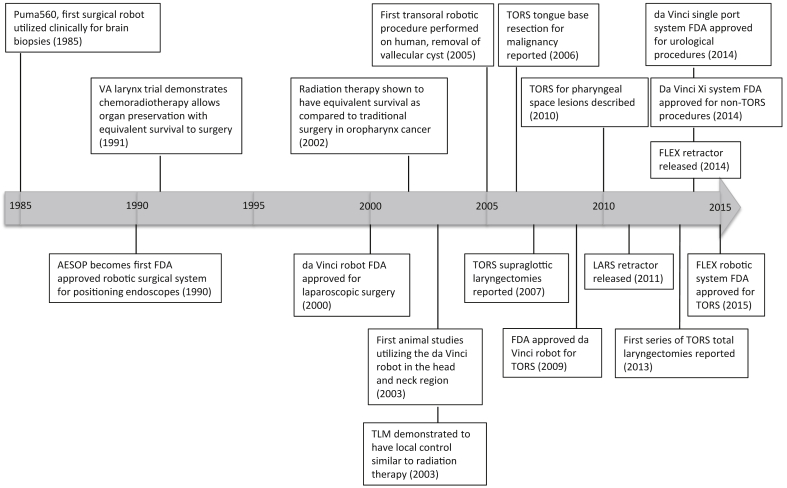
Transoral robotic surgery is a exciting field that continues to develop and push the boundaries of current procedural ability and challenges historical treatment paradigms. With the first use of a surgical robot in 1985, to the first clinical use of the robot transorally in 2005, there was some lag in adoption of robotic techniques in the head and neck region. However, since 2005 transoral robotic surgery has rapidly gained momentum amongst head and neck surgeons. With FDA approval of the da Vinci robot in 2009, transoral robotic surgery is currently offered as a treatment modality for malignant and nonmalignant disease of the head and neck region. This new technology is being used to reconsider historical treatment paradigms for malignancies of the upper aerodigestive tract due to the fact that minimally invasive surgical access to the oropharynx and larynx has been improved. Along with this enhanced access have come innovative procedures and uses of the technology for multiple facets of head and neck disease. Technology continues to improve and innovation in surgical robotics is expected to continue as more companies attempt to capture this market. This article aims to provide a view at the landscape of transoral robotic surgery and explore the future frontiers.
经口机器人手术是一个令人兴奋的领域,它不断发展,突破当前手术能力的边界,并挑战传统治疗模式。从1985年首次使用手术机器人,到2005年首次将机器人经口用于临床,机器人技术在头颈部区域的应用存在一定延迟。然而,自2005年以来,经口机器人手术在头颈部外科医生中迅速发展。随着2009年美国食品药品监督管理局(FDA)批准达芬奇机器人,经口机器人手术目前已作为头颈部区域恶性和非恶性疾病的一种治疗方式。由于改善了对上消化道和喉部的微创外科手术入路,这项新技术正被用于重新审视上消化道恶性肿瘤的传统治疗模式。随着这种入路的改善,出现了创新的手术方法以及该技术在头颈部疾病多个方面的应用。随着更多公司试图占领这个市场,技术不断进步,手术机器人领域的创新预计也将持续。本文旨在审视经口机器人手术的现状,并探索未来的前沿领域。