Korea University Sejong campus, Division of Economics and Statistics, Department of National Statistics, Sejong, 30019, Korea.
The Ohio State University, Division of Biostatistics and Mathematical Biosciences Institute, Columbus, OH, 43210, USA.
Sci Rep. 2017 Dec 5;7(1):17018. doi: 10.1038/s41598-017-17072-z.
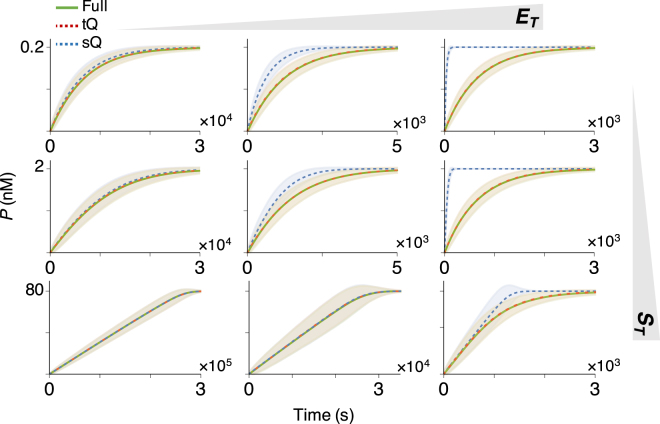
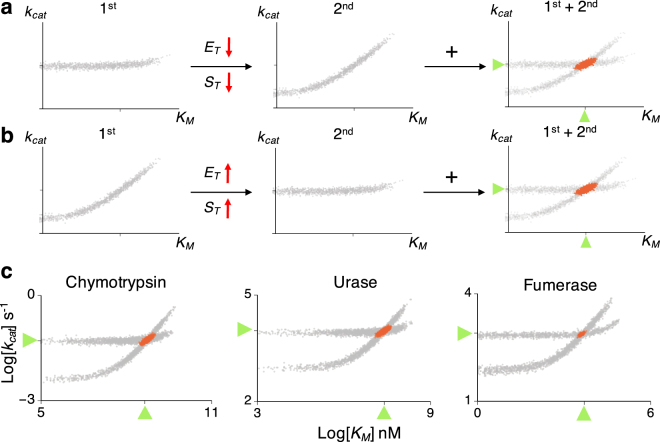
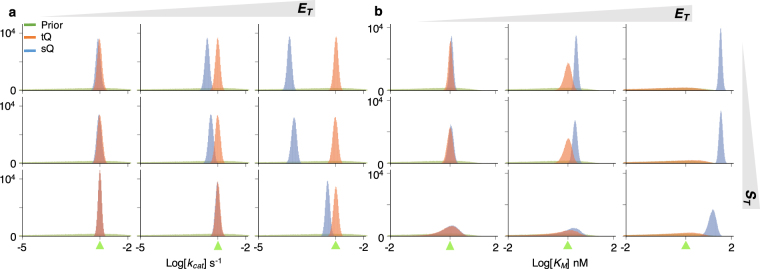
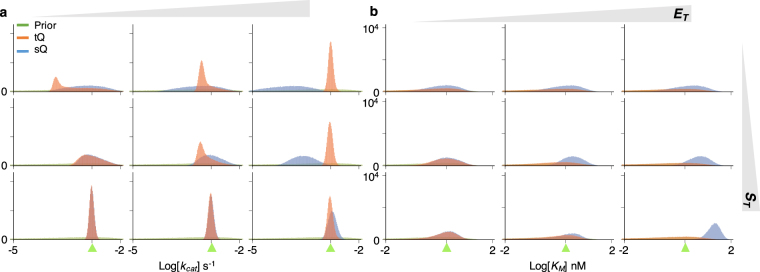
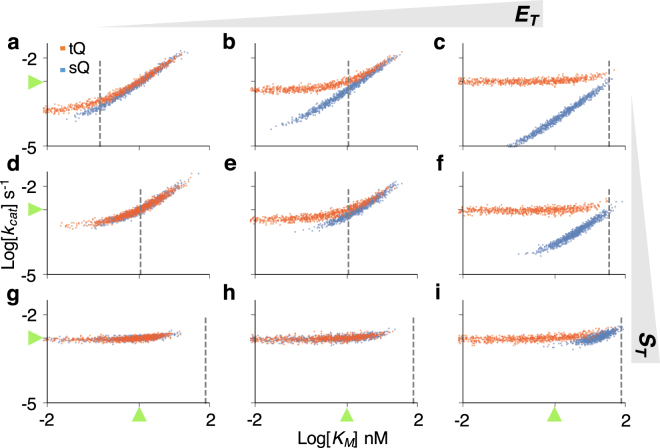
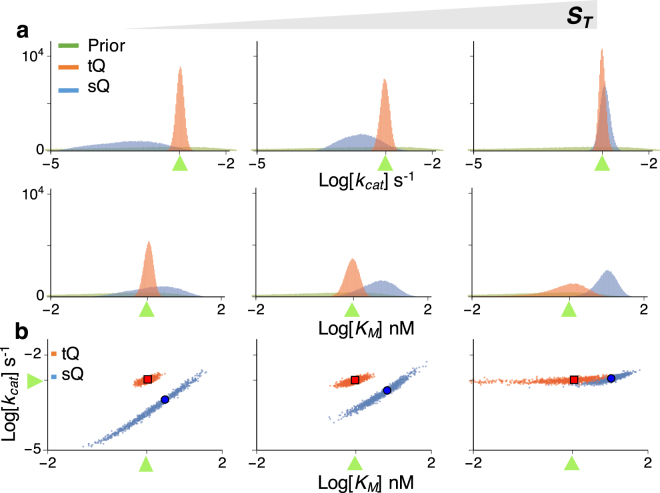
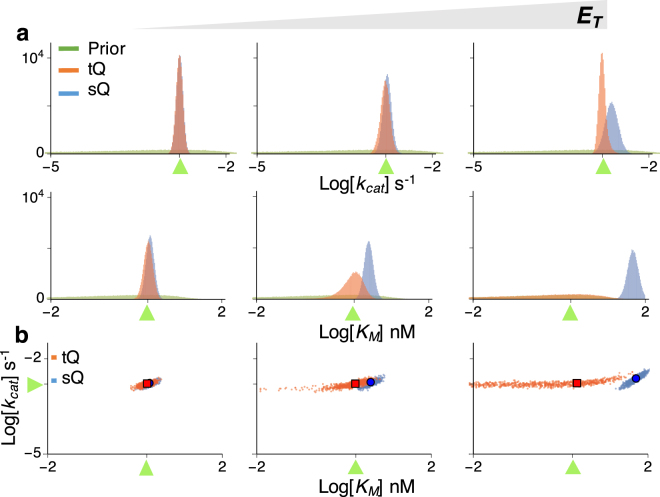
Examining enzyme kinetics is critical for understanding cellular systems and for using enzymes in industry. The Michaelis-Menten equation has been widely used for over a century to estimate the enzyme kinetic parameters from reaction progress curves of substrates, which is known as the progress curve assay. However, this canonical approach works in limited conditions, such as when there is a large excess of substrate over enzyme. Even when this condition is satisfied, the identifiability of parameters is not always guaranteed, and often not verifiable in practice. To overcome such limitations of the canonical approach for the progress curve assay, here we propose a Bayesian approach based on an equation derived with the total quasi-steady-state approximation. In contrast to the canonical approach, estimates obtained with this proposed approach exhibit little bias for any combination of enzyme and substrate concentrations. Importantly, unlike the canonical approach, an optimal experiment to identify parameters with certainty can be easily designed without any prior information. Indeed, with this proposed design, the kinetic parameters of diverse enzymes with disparate catalytic efficiencies, such as chymotrypsin, fumarase, and urease, can be accurately and precisely estimated from a minimal amount of timecourse data. A publicly accessible computational package performing such accurate and efficient Bayesian inference for enzyme kinetics is provided.
研究酶动力学对于理解细胞系统以及在工业中使用酶至关重要。米氏方程(Michaelis-Menten equation)已经被广泛应用了一个多世纪,用于根据底物的反应进度曲线来估计酶动力学参数,这被称为进度曲线分析。然而,这种经典方法在有限的条件下适用,例如当底物对酶有大量过剩时。即使在满足此条件的情况下,参数的可识别性也不一定得到保证,并且在实践中通常也无法验证。为了克服经典方法在进度曲线分析中的局限性,我们在此提出了一种基于全准稳态近似推导的贝叶斯方法。与经典方法不同,使用此方法得到的估计值对于任何酶和底物浓度组合的偏差都很小。重要的是,与经典方法不同,无需任何先验信息,就可以轻松设计出能够确定地识别参数的最佳实验。实际上,通过这种设计,可以从最小量的时间序列数据中准确而精确地估计出各种具有不同催化效率的酶(如糜蛋白酶、延胡索酸酶和脲酶)的动力学参数。提供了一个可公开访问的计算软件包,用于执行这种针对酶动力学的准确且高效的贝叶斯推断。