Benvenga Salvatore, Capodicasa Giovanni, Perelli Sarah
Department of Clinical and Experimental Medicine, University of Messina, Messina, Italy.
Master Program on Childhood, Adolescent and Women's Endocrine Health, University of Messina, Messina, Italy.
Front Endocrinol (Lausanne). 2017 Nov 20;8:321. doi: 10.3389/fendo.2017.00321. eCollection 2017.
l-Thyroxine (l-T4) therapy of central hypothyroidism (CH) is guided by measurements of serum free thyroxine (FT4), which should be above the midnormal range value (MNRV). In some countries, novel formulations of oral l-T4 (liquid or softgel) are available further to the classic tablets. The intestinal absorption of either novel formulation is greater than tablets in patients with primary hypothyroidism.
To evaluate whether new oral formulations of l-T4 could be considered optimal in patients with CH who do not reach the FT4 target using tablet l-T4.
Our observation of six patients with isolated CH and serum FT4 below MNRV under stable adequate doses of tablet l-T4 (median 1.51 μg/kg bw/day), prompted us to switch them to liquid ( = 4) or softgel ( = 3) l-T4 at the same dose, and verify whether FT4 increased above MNRV. A seventh patient with FT4 above MNRV was enrolled because she wanted a "." Postswitch FT4 was measured at least twice with the same kit as preswitch FT4.
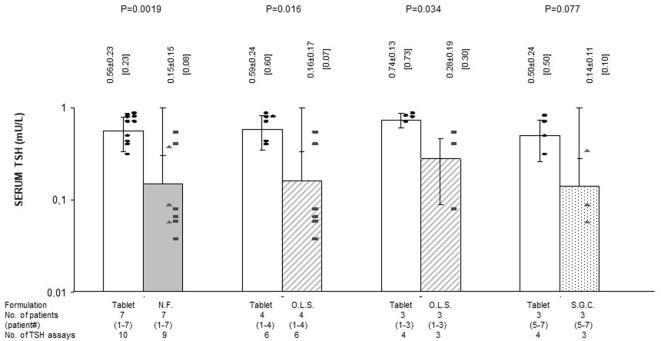
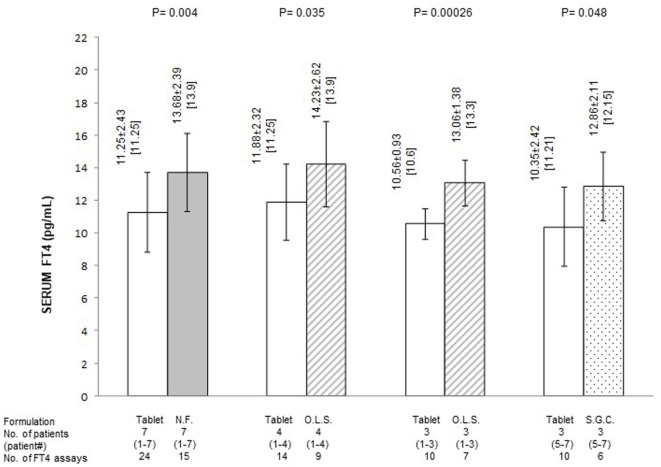
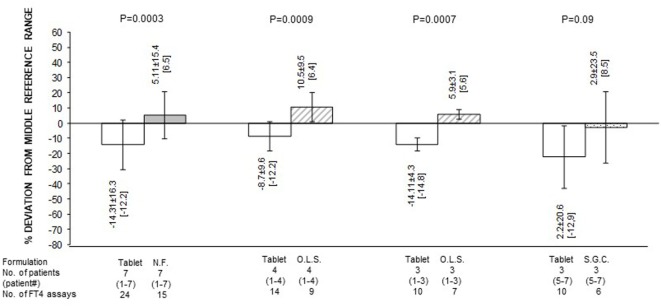
In the first six patients, postswitch FT4 averaged 13.0 ± 1.6 pg/ml compared to 10.4 ± 1.8 preswitch FT4 ( = 0.00026), with 11/13 (85%) measurements above MNRV compared to 0/20. In the liquid or softgel l-T4 group, postswitch FT4 averaged 13.1 ± 1.6 vs. 10.6 ± 0.9 pg/ml preswitch ( = 0.0004) or 12.9 ± 2.1 vs. 10.3 ± 2.4 ( = 0.048), respectively. In the seventh patient (switched to liquid l-T4), averages were 18.3 vs. 15.2 pg/ml, and proportions 4/4 vs. 2/2.
In CH patients, oral liquid or softgel l-T4 administered at the same doses as tablet l-T4 ensures target serum FT4 levels above MNRV that tablet l-T4 may miss. In turn, this performance suggests the more favorable pharmacokinetics profile of either novel formulation compared with the tablet formulation.
中枢性甲状腺功能减退症(CH)的左旋甲状腺素(l-T4)治疗以血清游离甲状腺素(FT4)的测量结果为指导,FT4应高于正常范围中位值(MNRV)。在一些国家,除了传统片剂外,还有新型口服l-T4制剂(液体或软胶囊)。在原发性甲状腺功能减退症患者中,这两种新型制剂的肠道吸收均优于片剂。
评估对于使用l-T4片剂未达到FT4目标的CH患者,新型口服l-T4制剂是否可被视为最佳选择。
我们观察了6例孤立性CH且血清FT4低于MNRV的患者,他们在稳定且足够剂量的l-T4片剂(中位剂量1.51μg/kg体重/天)治疗下,促使我们将他们换用相同剂量的液体l-T4(4例)或软胶囊l-T4(3例),并验证FT4是否升高至MNRV以上。纳入了第7例FT4高于MNRV的患者,因为她想要一种“……”。换用后FT4至少用与换用前相同的试剂盒测量两次。
在前6例患者中,换用后FT4平均为13.0±1.6pg/ml,而换用前为10.4±1.8pg/ml(P = 0.00026),13次测量中有11次(85%)高于MNRV,而换用前20次测量均未达到。在液体或软胶囊l-T4组中,换用后FT4平均分别为13.1±1.6与换用前10.6±0.9pg/ml(P = 0.0004),或12.9±2.1与10.3±2.4(P = 0.048)。在第7例患者(换用液体l-T4)中,平均值分别为18.3与15.2pg/ml,比例分别为4/4与2/2。
在CH患者中,以与l-T4片剂相同的剂量给予口服液体或软胶囊l-T4可确保血清FT4水平达到目标值,高于MNRV,而l-T4片剂可能无法达到该目标。相应地,这一表现表明这两种新型制剂的药代动力学特征比片剂更有利。