Pijpers Imke A B, Abdelmohsen Loai K E A, Williams David S, van Hest Jan C M
Eindhoven University of Technology, P.O. Box 513 (STO 3.31), 5600MB Eindhoven, The Netherlands.
Department of Chemistry, Swansea University, Swansea SA2 8PP, United Kingdom.
ACS Macro Lett. 2017 Nov 21;6(11):1217-1222. doi: 10.1021/acsmacrolett.7b00723. Epub 2017 Oct 19.
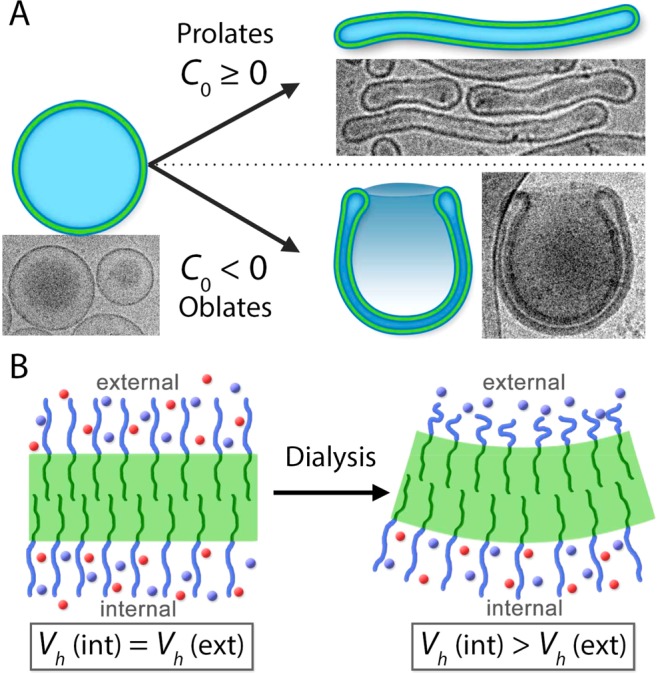
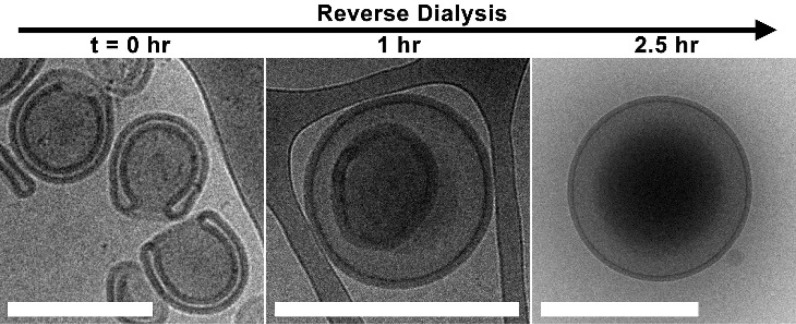
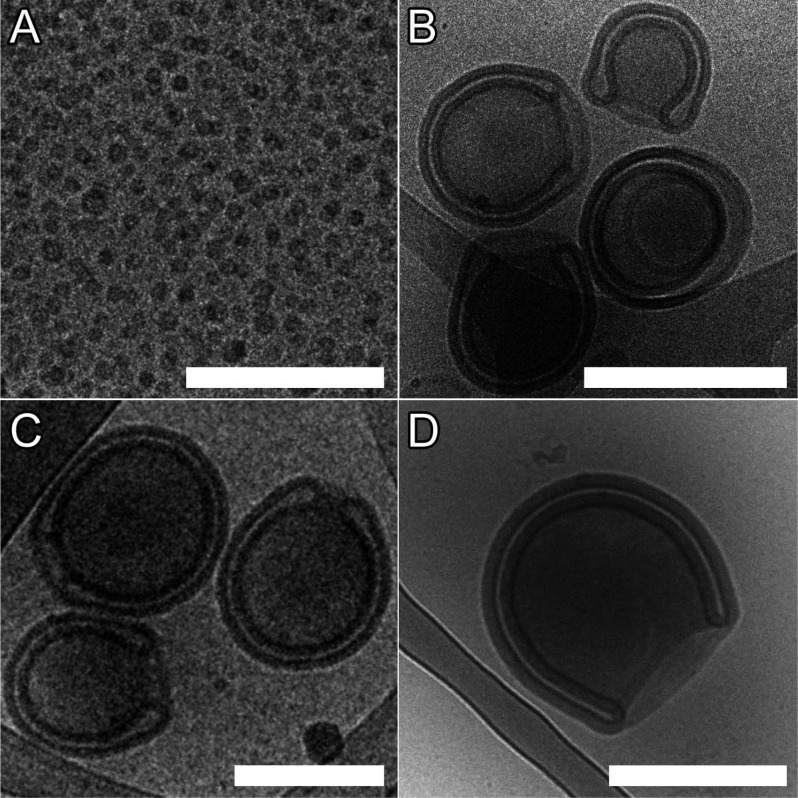
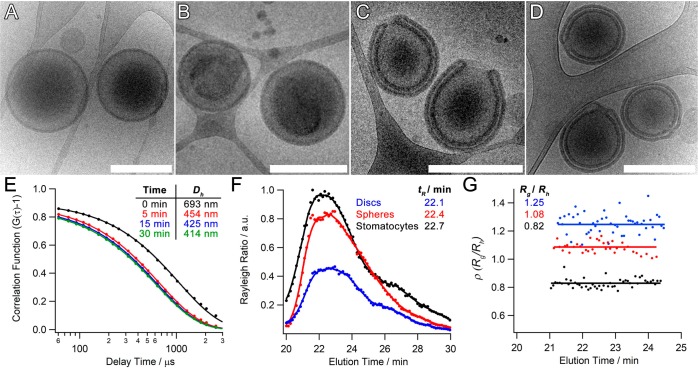
Biodegradable nanoarchitectures, with well-defined morphological features, are of great importance for nanomedical research; however, understanding (and thereby engineering) their formation is a substantial challenge. Herein, we uncover the supramolecular potential of PEG-PDLLA copolymers by exploring the physicochemical determinants that result in the transformation of spherical polymersomes into stomatocytes. To this end, we have engineered blended polymersomes (comprising copolymers with varying lengths of PEG), which undergo solvent-dependent reorganization inducing negative spontaneous membrane curvature. Under conditions of anisotropic solvent composition across the PDLLA membrane, facilitated by the dialysis methodology, we demonstrate osmotically induced stomatocyte formation as a consequence of changes in PEG solvation, inducing negative spontaneous membrane curvature. Controlled formation of unprecedented, biodegradable stomatocytes represents the unification of supramolecular engineering with the theoretical understanding of shape transformation phenomena.
具有明确形态特征的可生物降解纳米结构对于纳米医学研究非常重要;然而,理解(并因此设计)它们的形成是一项重大挑战。在此,我们通过探索导致球形聚合物囊泡转变为气孔细胞的物理化学决定因素,揭示了PEG-PDLLA共聚物的超分子潜力。为此,我们设计了混合聚合物囊泡(由具有不同PEG长度的共聚物组成),它们会经历依赖于溶剂的重组,诱导负的自发膜曲率。在通过透析方法促进的跨PDLLA膜的各向异性溶剂组成条件下,我们证明了由于PEG溶剂化的变化导致的渗透压诱导气孔细胞形成,从而诱导负的自发膜曲率。前所未有的可生物降解气孔细胞的可控形成代表了超分子工程与形状转变现象的理论理解的统一。