Kalkman Hans O, Feuerbach Dominik
Gänsbühlgartenweg 7, CH4132 Muttenz, Switzerland.
Novartis Pharma AG, CH4002 Basel, Switzerland.
Pharmaceuticals (Basel). 2017 Dec 9;10(4):95. doi: 10.3390/ph10040095.
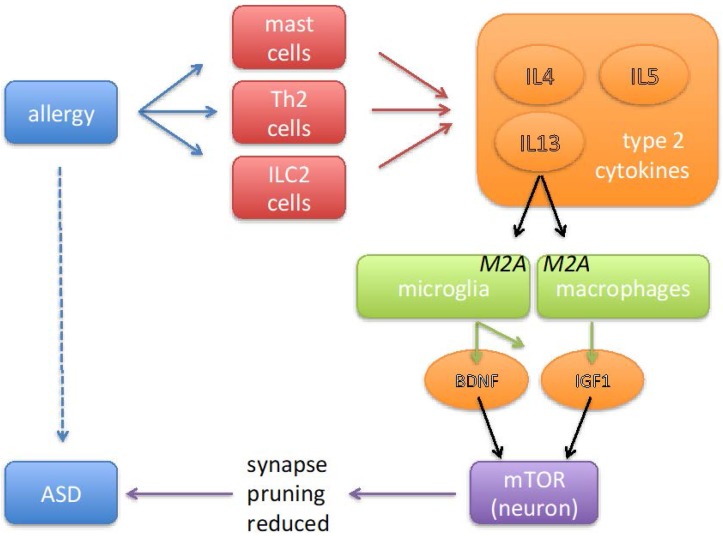
Atopic diseases are frequently co-morbid with autism spectrum disorders (ASD). Allergic responses are associated with an activation of mast cells, innate lymphoid cells, and Th2 cells. These cells produce type-2 cytokines (IL4 and IL13), which stimulate microglia and macrophages to adopt a phenotype referred to as 'alternative activation' or 'M2A'. M2A-polarized macrophages and microglia play a physiological role in tissue repair by secreting growth factors such as brain-derived neurotrophic factor (BDNF) and insulin-like growth factor-1. In ASD there is evidence for increased type-2 cytokines, microglia activation, M2A polarization, and increased levels of growth factors. In neurons, these growth factors drive a signal transduction pathway that leads to activation of the enzyme mammalian Target of Rapamycin (mTOR), and thereby to the inhibition of autophagy. Activation of mTOR is an effect that is also common to several of the genetic forms of autism. In the central nervous system, redundant synapses are removed via an autophagic process. Activation of mTOR would diminish the pruning of redundant synapses, which in the context of ASD is likely to be undesired. Based on this line of reasoning, atopic diseases like food allergy, eczema or asthma would represent risk factors for autism spectrum disorders.
特应性疾病常与自闭症谱系障碍(ASD)共病。过敏反应与肥大细胞、固有淋巴细胞和Th2细胞的激活有关。这些细胞产生2型细胞因子(IL4和IL13),刺激小胶质细胞和巨噬细胞呈现一种称为“替代性激活”或“M2A”的表型。M2A极化的巨噬细胞和小胶质细胞通过分泌脑源性神经营养因子(BDNF)和胰岛素样生长因子-1等生长因子在组织修复中发挥生理作用。在ASD中,有证据表明2型细胞因子增加、小胶质细胞激活、M2A极化以及生长因子水平升高。在神经元中,这些生长因子驱动一条信号转导通路,导致雷帕霉素哺乳动物靶点(mTOR)酶的激活,从而抑制自噬。mTOR的激活也是几种自闭症遗传形式共有的一种效应。在中枢神经系统中,多余的突触通过自噬过程被清除。mTOR的激活会减少多余突触的修剪,在ASD的背景下,这可能是不理想的。基于这一推理思路,食物过敏、湿疹或哮喘等特应性疾病可能是自闭症谱系障碍的危险因素。