Neurobiology, Neurodegeneration, and Repair Laboratory (N-NRL), National Eye Institute (NEI), National Institutes of Health, Bldg 6/338, 6 Center Drive, Bethesda, MD 20814, USA.
Trans-NIH Shared Resources on Biomedical Engineering and Physical Sciences (BEPS), National Institutes of Biomedical Imaging and Bioengineering (NIBIB), National Institutes of Health, Bldg 13/3N18B, 13 South Drive, Bethesda, MD 20814, USA.
Stem Cell Reports. 2018 Jan 9;10(1):300-313. doi: 10.1016/j.stemcr.2017.11.001. Epub 2017 Dec 7.
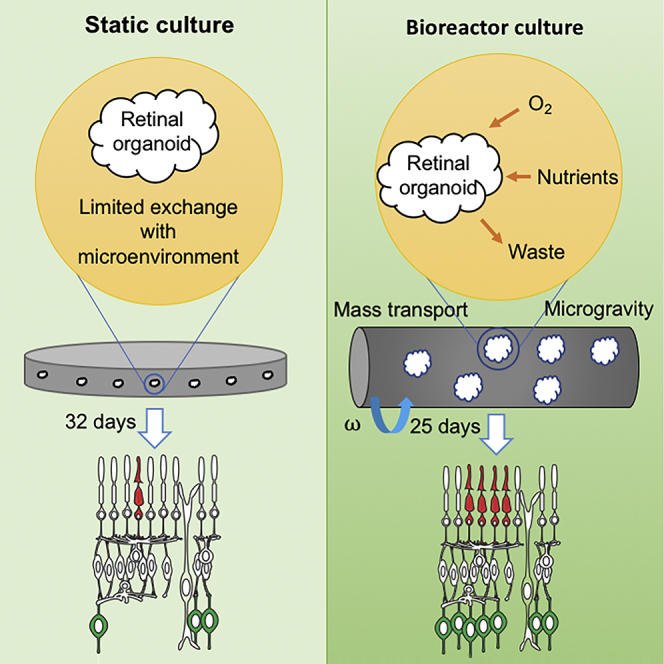
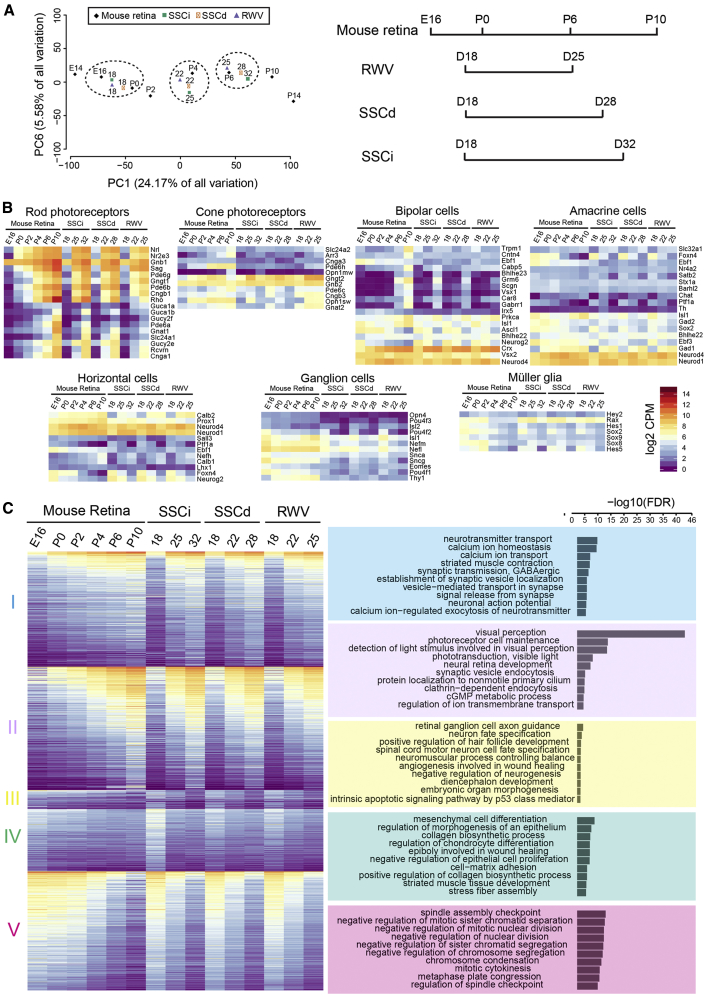
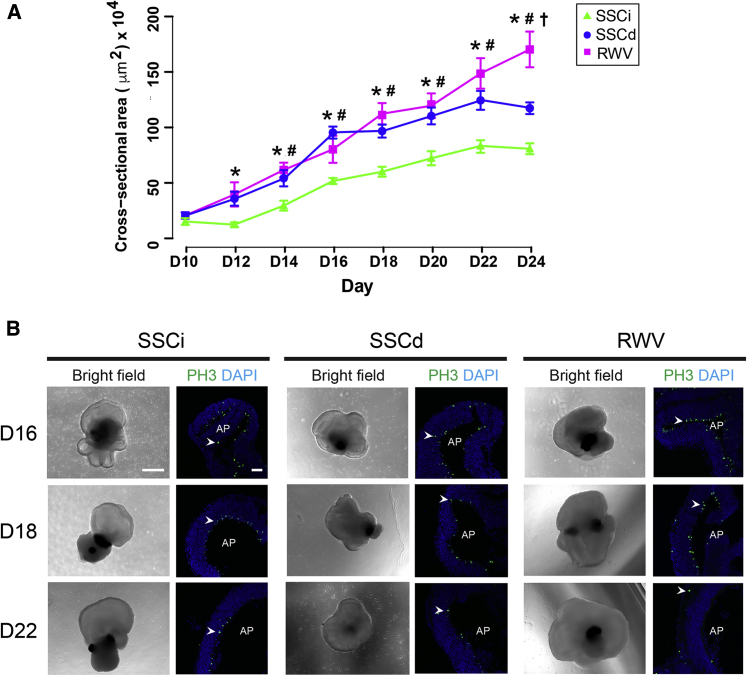
Pluripotent stem cells can be differentiated into 3D retinal organoids, with major cell types self-patterning into a polarized, laminated architecture. In static cultures, organoid development may be hindered by limitations in diffusion of oxygen and nutrients. Herein, we report a bioprocess using rotating-wall vessel (RWV) bioreactors to culture retinal organoids derived from mouse pluripotent stem cells. Organoids in RWV demonstrate enhanced proliferation, with well-defined morphology and improved differentiation of neurons including ganglion cells and S-cone photoreceptors. Furthermore, RWV organoids at day 25 (D25) reveal similar maturation and transcriptome profile as those at D32 in static culture, closely recapitulating spatiotemporal development of postnatal day 6 mouse retina in vivo. Interestingly, however, retinal organoids do not differentiate further under any in vitro condition tested here, suggesting additional requirements for functional maturation. Our studies demonstrate that bioreactors can accelerate and improve organoid growth and differentiation for modeling retinal disease and evaluation of therapies.
多能干细胞可分化为 3D 视网膜类器官,其中主要细胞类型可自行排列成具有极性的层状结构。在静态培养中,由于氧气和营养物质扩散的限制,类器官的发育可能受到阻碍。在此,我们报告了一种使用旋转壁式生物反应器(RWV)培养从小鼠多能干细胞中分化而来的视网膜类器官的生物工艺。RWV 中的类器官表现出增强的增殖能力,具有明确的形态和更好的神经元分化,包括神经节细胞和 S 锥光感受器。此外,RWV 类器官在 D25 时表现出与静态培养中 D32 时相似的成熟度和转录组特征,非常接近体内出生后第 6 天小鼠视网膜的时空发育。有趣的是,然而,在本研究中测试的任何体外条件下,视网膜类器官都不会进一步分化,这表明功能成熟还需要其他条件。我们的研究表明,生物反应器可加速和改善类器官的生长和分化,用于模拟视网膜疾病和评估治疗方法。