Shi Jing, Ni Jingnian, Lu Tao, Zhang Xuekai, Wei Mingqing, Li Ting, Liu Weiwei, Wang Yongyan, Shi Yuanyuan, Tian Jinzhou
BUCM Neurology Centre at Dongzhimen Hospital, Beijing University of Chinese Medicine, No. 5 Haiyuncang Street, Dongcheng, Bejing, 100700, China.
School of Life Sciences, Beijing University of Chinese Medicine, No. 11 East road, North 3rd Ring Road, Beijing, 100029, China.
BMC Complement Altern Med. 2017 Dec 13;17(1):533. doi: 10.1186/s12906-017-2040-5.
Conventional therapy (CT) such as donepezil and memantine are well-known short-term treatments for the symptoms of Alzheimer's disease (AD). The efficacy of them, however, drops below baseline level after 9 months. In China, herbal therapy as a complementary therapy is very popular. Should conventional therapy combined with herbal therapy (CT + H) make add-on benefit?
In this retrospective cohort study, 344 outpatients diagnosed as probable dementia due to AD were collected, with the treatment of either CT + H or CT alone in clinical settings. All the patients were examined with coronary MRI scan. Cognitive functions were obtained by mini-mental state examination (MMSE) every 3 months with the longest follow-up of 24 months.
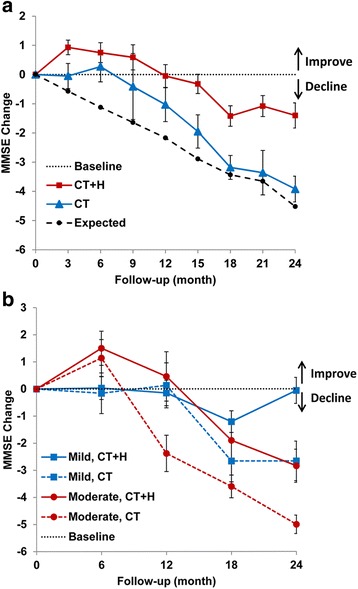
Most of the patients were initially diagnosed with mild (MMSE = 21-26, n = 177) and moderate (MMSE = 10-20, n = 137) dementia. At 18 months, CT+ H patients scored on average 1.76 (P = 0.002) better than CT patients, and at 24 months, patients scored on average 2.52 (P < 0.001) better. At 24 months, the patients with improved cognitive function (△MMSE ≥ 0) in CT + H was more than CT alone (33.33% vs 7.69%, P = 0.020). Interestingly, patients with mild AD received the most robust benefit from CT + H therapy. The deterioration of the cognitive function was largely prevented at 24 months (ΔMMSE = -0.06), a significant improvement from CT alone (ΔMMSE = -2.66, P = 0.005).
Compared to CT alone, CT + H significantly benefited AD patients. A symptomatic effect of CT + H was more pronounced with time. Cognitive decline was substantially decelerated in patients with moderate severity, while the cognitive function was largely stabilized in patients with mild severity over two years. These results imply that Chinese herbal medicines may provide an alternative and additive treatment for AD.
多奈哌齐和美金刚等传统疗法是治疗阿尔茨海默病(AD)症状的知名短期疗法。然而,9个月后它们的疗效会降至基线水平以下。在中国,草药疗法作为一种辅助疗法非常受欢迎。传统疗法与草药疗法联合使用(CT + H)是否会带来额外益处?
在这项回顾性队列研究中,收集了344名被诊断为可能因AD导致痴呆的门诊患者,他们在临床环境中接受了CT + H或单独CT治疗。所有患者均接受了冠状动脉MRI扫描。每3个月通过简易精神状态检查(MMSE)评估认知功能,最长随访24个月。
大多数患者最初被诊断为轻度(MMSE = 21 - 26,n = 177)和中度(MMSE = 10 - 20,n = 137)痴呆。在18个月时,CT + H组患者的平均得分比CT组高1.76分(P = 0.002),在24个月时,患者平均得分高2.52分(P < 0.001)。在24个月时,CT + H组认知功能改善(△MMSE≥0)的患者多于单独使用CT组(33.33%对7.69%,P = 0.020)。有趣的是,轻度AD患者从CT + H疗法中获益最大。在24个月时,认知功能的恶化在很大程度上得到了预防(ΔMMSE = -0.06),与单独使用CT相比有显著改善(ΔMMSE = -2.66,P = 0.005)。
与单独使用CT相比,CT + H使AD患者显著获益。CT + H的症状性效果随时间更加明显。中度严重程度患者的认知衰退大幅减缓,而轻度严重程度患者的认知功能在两年内基本稳定。这些结果表明,中药可能为AD提供一种替代和补充治疗方法。