Shi Jing, Wei Mingqing, Tian Jinzhou, Snowden Julie, Zhang Xuekai, Ni Jingnian, Li Ting, Jian Wenjia, Ma Congcong, Tong Yanping, Liu Jianping, Liu Tonghua, Wang Pengwen, Wang Yongyan
The 3rd Department of Neurology, Dongzhimen Hospital, Beijing University of Chinese Medicine, Beijing 100700, China.
BMC Psychiatry. 2014 Mar 10;14:71. doi: 10.1186/1471-244X-14-71.
Decline in verbal episodic memory is a core feature of amnestic mild cognitive impairment (aMCI). The delayed story recall (DSR) test from the Adult Memory and Information Processing Battery (AMIPB) discriminates MCI from normal aging and predicts its conversion to Alzheimer's dementia. However, there is no study that validates the Chinese version of the DSR and reports cut-off scores in the Chinese population.
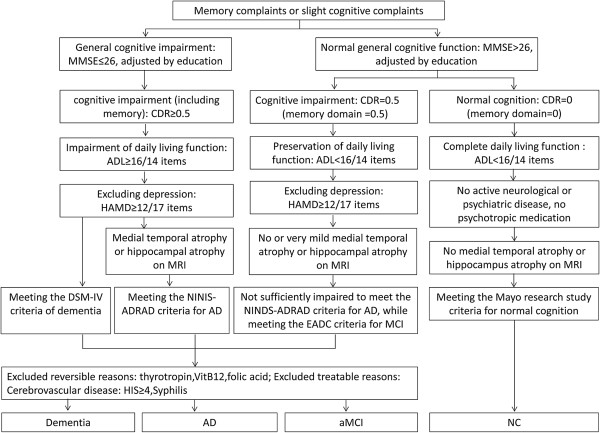
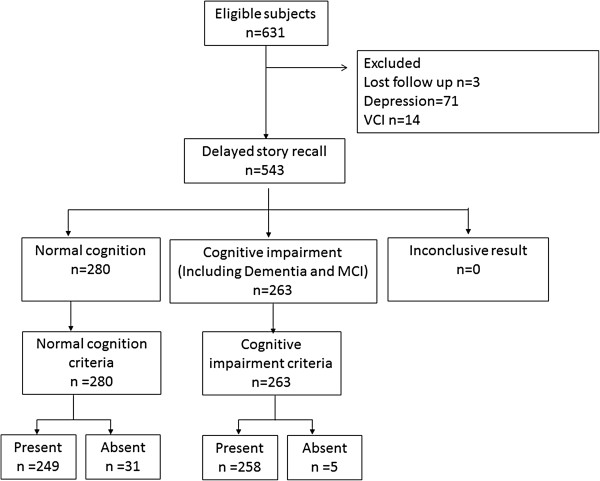
A total of 631 subjects were screened in the memory clinics of Dongzhimen Hospital, Beijing University of Chinese Medicine, China. 249 were considered to have normal cognition (NC), 134 met diagnostic criteria for MCI according to the MCI Working Group of the European Consortium on Alzheimer's Disease, and 97 met criteria for probable Alzheimer's disease (AD) according to the NINCDS/ADRDA criteria, 14 exhibited vascular dementia (VaD), and 50 had a diagnosis of another type of dementia. Receiver operating characteristic (ROC) curve analyses were used to calculate the story recall cutoff score for detecting MCI and AD. Normative data in the NC group were obtained as a function of age and education.
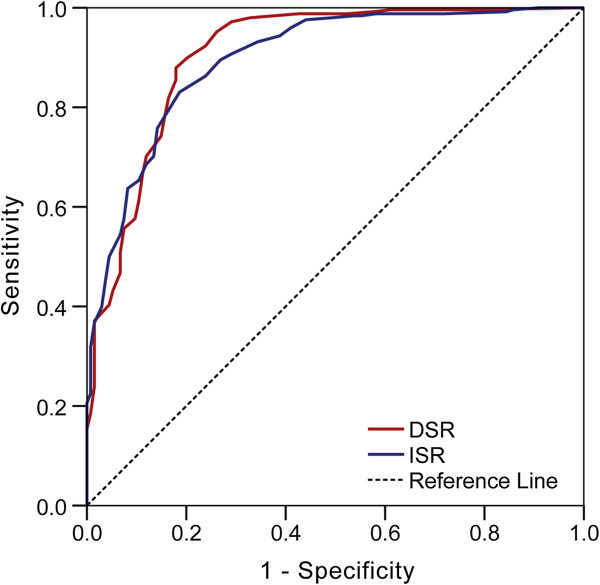
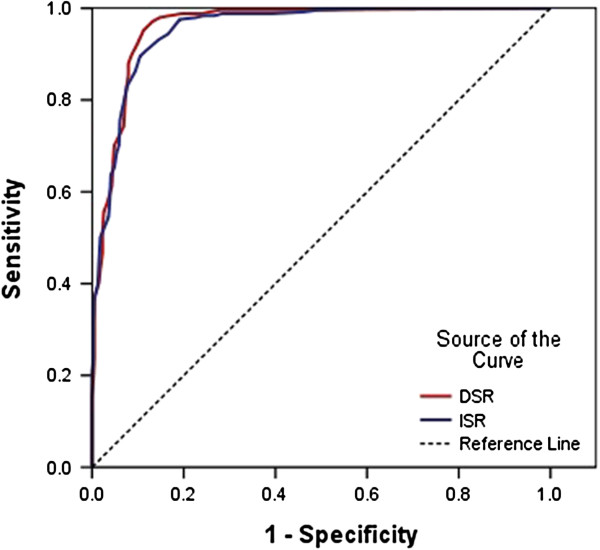
In this Chinese sample, the normative mean DSR score was 28.10 ± 8.54 in the 50-64 year-old group, 26.22 ± 8.38 in the 65-74 year-old group, and 24.42 ± 8.38 in the 75-85 year-old group. DSR performance was influenced by age and education. The DSR test had high sensitivity (0.899) and specificity (0.799) in the detection of MCI from NC using a cut-off score of 15.5. When the cutoff score was 10.5, the DSR test obtained optimal sensitivity (0.980) and specificity (0.938) in the discrimination of AD from NC. Cutoff scores and diagnostic values were calculated stratified by age and education.
The Chinese version of the DSR can be used as a screening tool to detect MCI and AD with high sensitivity and specificity, and it could be used to identify people at high risk of cognitive impairment.
言语情景记忆衰退是遗忘型轻度认知障碍(aMCI)的核心特征。成人记忆与信息处理成套测验(AMIPB)中的延迟故事回忆(DSR)测试可区分MCI与正常衰老,并预测其向阿尔茨海默病痴呆的转化。然而,尚无研究验证DSR的中文版并报告中国人群的截断分数。
在中国北京中医药大学东直门医院记忆门诊共筛查了631名受试者。249名被认为认知正常(NC),134名根据欧洲阿尔茨海默病联盟MCI工作组的标准符合MCI诊断标准,97名根据NINCDS/ADRDA标准符合可能的阿尔茨海默病(AD)标准,14名表现为血管性痴呆(VaD),50名被诊断为其他类型的痴呆。采用受试者工作特征(ROC)曲线分析来计算检测MCI和AD的故事回忆截断分数。NC组的常模数据根据年龄和教育程度得出。
在这个中国样本中,50 - 64岁组DSR的常模平均分数为28.10±8.54,65 - 74岁组为26.22±8.38,75 - 85岁组为24.4,2±8.38。DSR表现受年龄和教育程度影响。使用截断分数15.5时,DSR测试在从NC中检测MCI方面具有高敏感性(0.899)和特异性(0.799)。当截断分数为10.5时,DSR测试在区分AD与NC方面获得了最佳敏感性(0.980)和特异性(0.938)。根据年龄和教育程度分层计算截断分数和诊断值。
DSR中文版可作为一种筛查工具,以高敏感性和特异性检测MCI和AD,并可用于识别认知障碍高危人群。