Henrick Bethany M, Yao Xiao-Dan, Nasser Laila, Roozrogousheh Ava, Rosenthal Kenneth L
Department of Food Science and Technology, University of California, Davis, Davis, CA, United States.
Foods for Health Institute, University of California, Davis, Davis, CA, United States.
Front Immunol. 2017 Nov 29;8:1631. doi: 10.3389/fimmu.2017.01631. eCollection 2017.
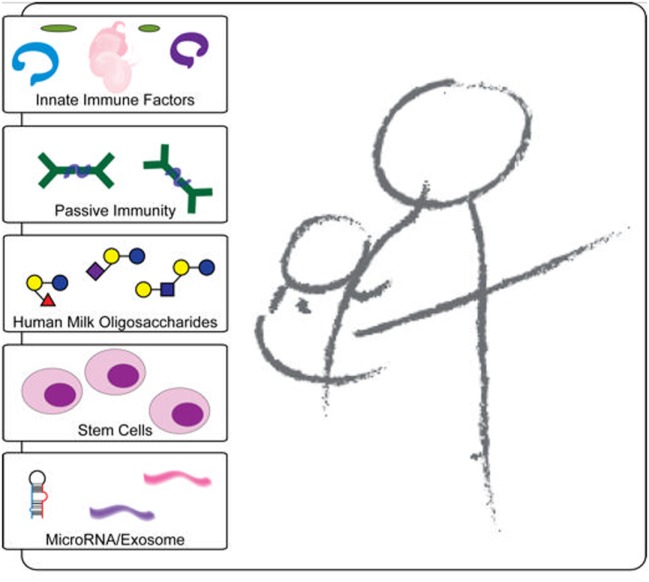
The majority of infants' breastfeeding from their HIV-infected mothers do not acquire HIV-1 infection despite exposure to cell-free virus and cell-associated virus in HIV-infected breast milk. Paradoxically, exclusive breastfeeding regardless of the HIV status of the mother has led to a significant decrease in mother-to-child transmission (MTCT) compared with non-exclusive breastfeeding. Although it remains unclear how these HIV-exposed infants remain uninfected despite repeated and prolonged exposure to HIV-1, the low rate of transmission is suggestive of a multitude of protective, short-lived bioactive innate immune factors in breast milk. Indeed, recent studies of soluble factors in breast milk shed new light on mechanisms of neonatal HIV-1 protection. This review highlights the role and significance of innate immune factors in HIV-1 susceptibility and infection. Prevention of MTCT of HIV-1 is likely due to multiple factors, including innate immune factors such as lactoferrin and elafin among many others. In pursuing this field, our lab was the first to show that soluble toll-like receptor 2 (sTLR2) directly inhibits HIV infection, integration, and inflammation. More recently, we demonstrated that sTLR2 directly binds to selective HIV-1 proteins, including p17, gp41, and p24, leading to significantly reduced NFκB activation, interleukin-8 production, CCR5 expression, and HIV infection in a dose-dependent manner. Thus, a clearer understanding of soluble milk-derived innate factors with known antiviral functions may provide new therapeutic insights to reduce vertical HIV-1 transmission and will have important implications for protection against HIV-1 infection at other mucosal sites. Furthermore, innate bioactive factors identified in human milk may serve not only in protecting infants against infections and inflammation but also the elderly; thus, opening the door for novel innate immune therapeutics to protect newborns, infants, adults, and the elderly.
尽管感染艾滋病毒的母亲的婴儿在母乳喂养时接触到了艾滋病毒感染母乳中的游离病毒和细胞相关病毒,但大多数婴儿并未感染HIV-1。矛盾的是,与非纯母乳喂养相比,无论母亲的艾滋病毒感染状况如何,纯母乳喂养都导致母婴传播(MTCT)显著减少。尽管目前尚不清楚这些接触艾滋病毒的婴儿在反复长期接触HIV-1后仍未感染的原因,但低传播率表明母乳中存在多种具有保护作用的、短暂的生物活性先天免疫因子。事实上,最近对母乳中可溶性因子的研究为新生儿HIV-1保护机制提供了新的线索。本综述强调了先天免疫因子在HIV-1易感性和感染中的作用及意义。HIV-1母婴传播的预防可能归因于多种因素,包括乳铁蛋白和弹性蛋白酶等先天免疫因子。在该领域的研究中,我们实验室率先表明可溶性Toll样受体2(sTLR2)直接抑制HIV感染、整合及炎症反应。最近,我们证明sTLR2直接与选择性HIV-1蛋白结合,包括p17、gp41和p24,从而以剂量依赖方式显著降低NFκB激活、白细胞介素-8产生、CCR5表达及HIV感染。因此,更清楚地了解具有已知抗病毒功能的母乳来源的可溶性先天因子,可能为减少HIV-1垂直传播提供新的治疗思路,并对预防其他黏膜部位的HIV-1感染具有重要意义。此外,在人乳中鉴定出的先天生物活性因子不仅可保护婴儿免受感染和炎症侵害,对老年人也有保护作用;因此,为保护新生儿、婴儿、成年人及老年人的新型先天免疫疗法打开了大门。