Universidade Federal de São Paulo (UNIFESP), Departamento de Ciências do Movimento Humano, Santos, SP, Brasil.
Universidade de São Paulo (USP), Instituto de Psiquiatria, São Paulo, SP, Brasil.
Braz J Phys Ther. 2018 Jan-Feb;22(1):70-76. doi: 10.1016/j.bjpt.2017.10.006. Epub 2017 Nov 8.
To evaluate the stability, postural adjustments and contributions of sensory information for postural control in children.
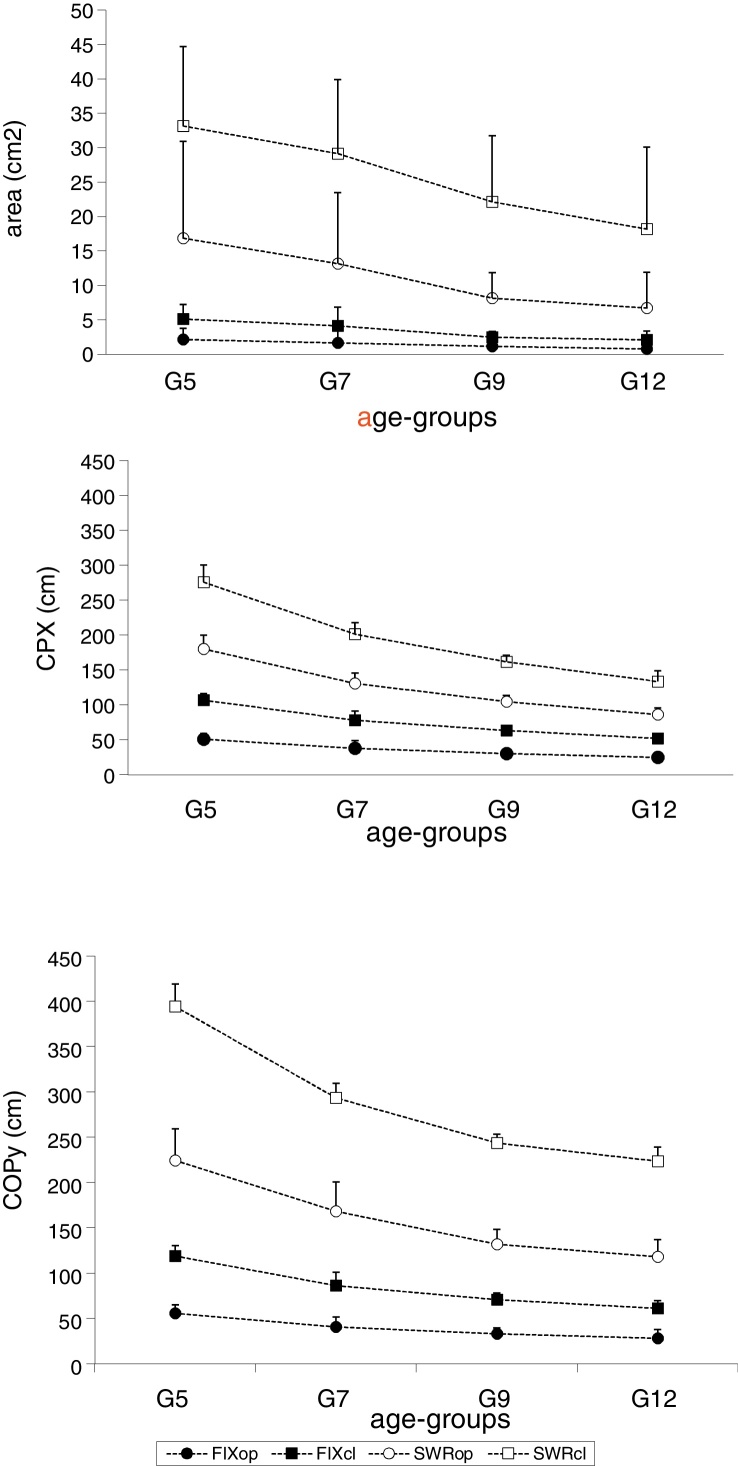
40 boys and 40 girls were equally divided into groups of 5, 7, 9 and 12 years (G5, G7, G9 and G12). All children were submitted to dynamic posturography using a modified sensory organization test, using four sensory conditions: combining stable or sway referencing platform with eyes opened, or closed. The area and displacements of the center of pressure were used to determine stability, while the adjustments were used to measure the speed of the center of pressure displacements. These measurements were compared between groups and test conditions.
Stability tends to increase with age and to decrease with sensory manipulation with significant differences between G5 and G7 in different measures. G7 differed from G12 under the conditions of stable and sway platform with eyes open. G9 did not differ from G12. Similar behavior was observed for adjustments, especially in anterior-posterior directions.
Postural stability and adjustments were associated with age and were influenced by sensory manipulation. The ability to perform anterior-posterior adjustments was more evident and sensory maturation occurred firstly on the visual system, then proprioceptive system, and finally, the vestibular system, reaching functional maturity at nine years of age. Seven-year-olds seem to go through a period of differentiated singularity in postural control.
评估儿童姿势控制的稳定性、姿势调整和感觉信息的贡献。
将 40 名男孩和 40 名女孩平均分为 5 岁(G5)、7 岁(G7)、9 岁(G9)和 12 岁(G12)组。所有儿童均接受改良感觉组织测试的动态姿势描记术,采用四种感觉条件:睁眼或闭眼时结合稳定或摆动参考平台。使用压力中心的面积和位移来确定稳定性,而调整用于测量压力中心位移的速度。在组间和测试条件之间比较这些测量值。
稳定性随年龄增长而增加,随感觉操作而降低,不同测量值中 G5 和 G7 之间存在显著差异。在稳定和摆动平台睁眼条件下,G7 与 G12 不同。G9 与 G12 无差异。调整的行为也类似,尤其是在前-后方向。
姿势稳定性和调整与年龄有关,受感觉操作的影响。进行前-后调整的能力更为明显,感觉成熟首先发生在视觉系统,然后是本体感觉系统,最后是前庭系统,在 9 岁时达到功能成熟。7 岁儿童似乎经历了一个姿势控制的特殊分化期。