Winterhalter Sibylle, Behrens Uwe Diedrich, Salchow Daniel, Joussen Antonia M, Pleyer Uwe
Department of Ophthalmology, Campus Virchow- Klinikum, Charité - University Medicine Berlin, corporate member of Freie Universität Berlin, Humboldt- Universität zu Berlin and Berlin Institute of Health, Berlin, Germany.
Coordination Center for Clinical Studies, Campus Virchow- Klinikum, Charité - University Medicine Berlin, corporate member of Freie Universität Berlin, Humboldt- Universität zu Berlin and Berlin Institute of Health, Berlin, Germany.
BMC Ophthalmol. 2017 Dec 16;17(1):252. doi: 10.1186/s12886-017-0648-3.
To evaluate the efficacy and safety of dexamethasone (DEX) implants in paediatric patients with noninfectious intermediate or posterior uveitis.
Prospective single center exploratory case series. Children and adolescents, 6 to 17 years old, with a vitreous haze score of ≥1.5+ or cystoid macular edema (CME) of >300 μm were enrolled. Vitreous haze score at month 2 was chosen as primary endpoint. Best corrected visual acuity (BCVA), central retinal thickness (CRT) and concomitant medication at month 6 were defined as secondary endpoints. Intraocular pressure (IOP) and cataract formation were determined as safety endpoints.
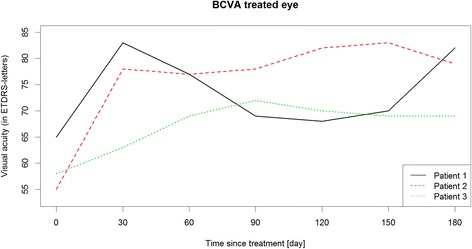
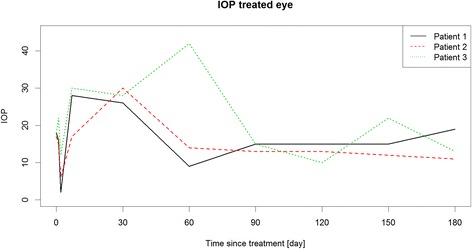
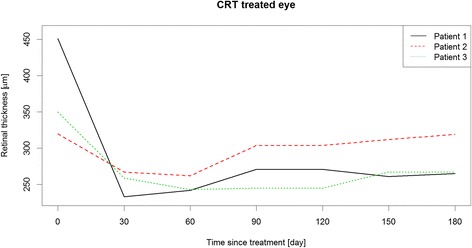
Three out of 6 eligible patients participated in the case series. At month 2, vitreous haze was reduced from a score of 1.5+ to 0.5+ and 0 and BCVA improved by ≥3 lines, ≥4 lines and ≥2 lines of Early Treatment of Diabetic Retinopathy (ETDRS)-letters, respectively. Visual acuity gain was accompanied by a CRT reduction of -186 μm and -83 μm in the first and third patient, in whom CME was the indication for DEX implantation. A reduction of concomitant medication was achieved in 1 patient. IOP increase was seen in all 3 patients, but could be treated sufficiently with primarily IOP lowering medications and without need for glaucoma surgery. Cataract progression did not occur.
DEX implants led to an improvement in all endpoints, especially BCVA. This study confirms that IOP rises may also occur in the paediatric population and should be monitored and treated appropriately.
European Union Drug Regulating Authorities Clinical Trials (EudraCT)- nr: 2013-000541-39.
评估地塞米松(DEX)植入物在患有非感染性中间葡萄膜炎或后葡萄膜炎的儿科患者中的疗效和安全性。
前瞻性单中心探索性病例系列研究。纳入6至17岁、玻璃体混浊评分≥1.5+或黄斑囊样水肿(CME)>300μm的儿童和青少年。选择第2个月时的玻璃体混浊评分作为主要终点。将第6个月时的最佳矫正视力(BCVA)、中心视网膜厚度(CRT)和伴随用药定义为次要终点。将眼压(IOP)和白内障形成确定为安全性终点。
6名符合条件的患者中有3名参与了该病例系列研究。在第2个月时,玻璃体混浊评分从1.5+分别降至0.5+和0,BCVA分别提高了≥3行、≥4行和≥2行糖尿病视网膜病变早期治疗(ETDRS)字母行。在第1例和第3例患者中,视力提高伴随着CRT分别降低了-186μm和-83μm,这两名患者中CME是植入DEX的指征。1例患者实现了伴随用药的减少。所有3例患者均出现眼压升高,但主要通过降低眼压的药物进行充分治疗,无需进行青光眼手术。未发生白内障进展。
DEX植入物使所有终点指标均得到改善,尤其是BCVA。本研究证实,儿科人群中也可能出现眼压升高,应进行适当监测和治疗。
欧盟药品监管当局临床试验(EudraCT)-编号:2013-000541-39。