Wellcome Trust Centre for Interventional and Surgical Sciences, University College London, London, United Kingdom; Wellcome Trust Centre for Neuroimaging, University College London, London, United Kingdom; Institute of Cognitive Neuroscience, University College London, London, United Kingdom.
Siemens Molecular Imaging, Oxford, United Kingdom.
Neuroimage. 2018 Apr 1;169:462-472. doi: 10.1016/j.neuroimage.2017.12.019. Epub 2017 Dec 14.
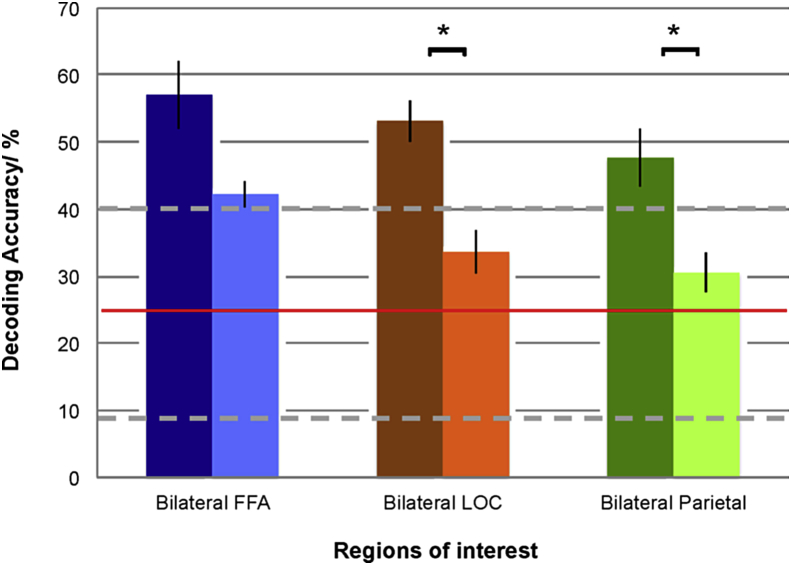
Brain-computer-interfaces (BCI) provide a means of using human brain activations to control devices for communication. Until now this has only been demonstrated in primary motor and sensory brain regions, using surgical implants or non-invasive neuroimaging techniques. Here, we provide proof-of-principle for the use of higher-order brain regions involved in complex cognitive processes such as attention. Using realtime fMRI, we implemented an online 'winner-takes-all approach' with quadrant-specific parameter estimates, to achieve single-block classification of brain activations. These were linked to the covert allocation of attention to real-world images presented at 4-quadrant locations. Accuracies in three target regions were significantly above chance, with individual decoding accuracies reaching upto 70%. By utilising higher order mental processes, 'cognitive BCIs' access varied and therefore more versatile information, potentially providing a platform for communication in patients who are unable to speak or move due to brain injury.
脑机接口(BCI)提供了一种利用人类大脑活动来控制设备进行通信的手段。到目前为止,这仅在使用手术植入物或非侵入性神经影像学技术的主要运动和感觉脑区中得到了证明。在这里,我们提供了使用涉及注意力等复杂认知过程的更高阶脑区的原理证明。我们使用实时 fMRI 实现了具有象限特异性参数估计的在线“胜者全拿”方法,以实现大脑活动的单块分类。这些与对呈现在 4 象限位置的真实世界图像的注意力的隐蔽分配相关联。三个目标区域的准确率明显高于随机水平,个体解码准确率高达 70%。通过利用更高阶的心理过程,“认知 BCI”可以访问不同的信息,因此更具通用性,这可能为因脑损伤而无法说话或移动的患者提供了一种沟通平台。