Global Obesity Prevention Center (GOPC), Johns Hopkins University, Baltimore, Maryland; Department of International Health, Johns Hopkins Bloomberg School of Public Health, Baltimore, Maryland.
Global Obesity Prevention Center (GOPC), Johns Hopkins University, Baltimore, Maryland; Department of International Health, Johns Hopkins Bloomberg School of Public Health, Baltimore, Maryland.
Am J Prev Med. 2018 Feb;54(2):197-204. doi: 10.1016/j.amepre.2017.11.003. Epub 2017 Dec 14.
A number of locations have been considering sugar-sweetened beverage point-of-purchase warning label policies to help address rising adolescent overweight and obesity prevalence.
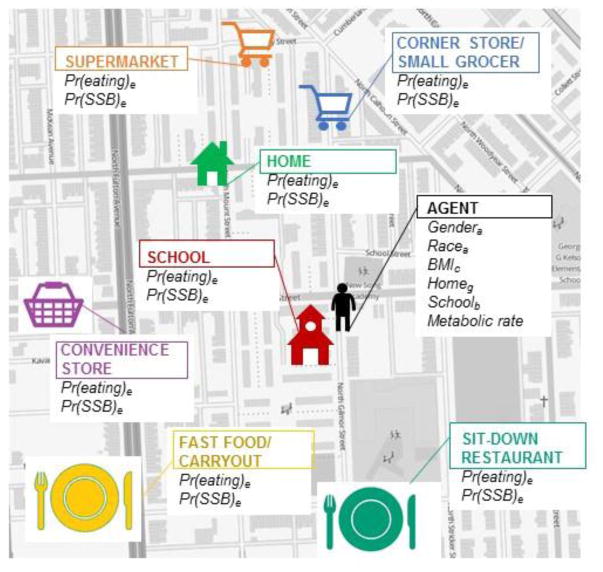
To explore the impact of such policies, in 2016 detailed agent-based models of Baltimore, Philadelphia, and San Francisco were developed, representing their populations, school locations, and food sources, using data from various sources collected between 2005 and 2014. The model simulated, over a 7-year period, the mean change in BMI and obesity prevalence in each of the cities from sugar-sweetened beverage warning label policies.
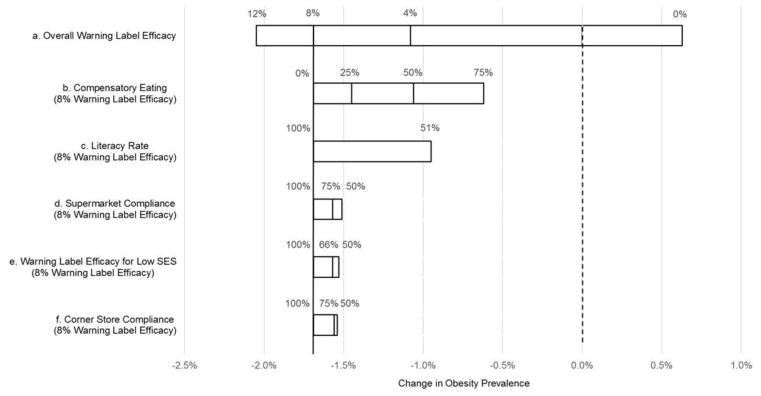
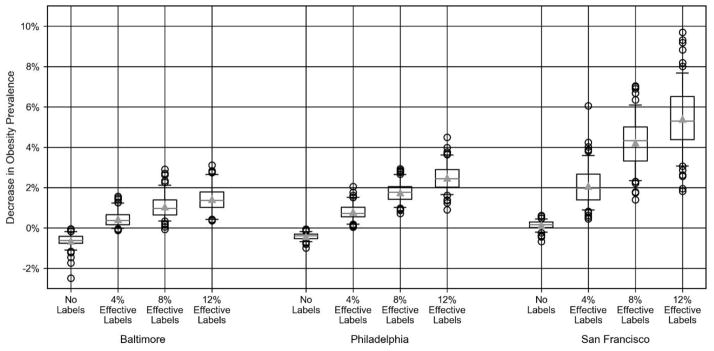
Data analysis conducted between 2016 and 2017 found that implementing sugar-sweetened beverage warning labels at all sugar-sweetened beverage retailers lowered obesity prevalence among adolescents in all three cities. Point-of-purchase labels with 8% efficacy (i.e., labels reducing probability of sugar-sweetened beverage consumption by 8%) resulted in the following percentage changes in obesity prevalence: Baltimore: -1.69% (95% CI= -2.75%, -0.97%, p<0.001); San Francisco: -4.08% (95% CI= -5.96%, -2.2%, p<0.001); Philadelphia: -2.17% (95% CI= -3.07%, -1.42%, p<0.001).
Agent-based simulations showed how warning labels may decrease overweight and obesity prevalence in a variety of circumstances with label efficacy and literacy rate identified as potential drivers. Implementing a warning label policy may lead to a reduction in obesity prevalence. Focusing on warning label design and store compliance, especially at supermarkets, may further increase the health impact.
为了解决青少年超重和肥胖率上升的问题,许多地方都在考虑对含糖饮料实行销售点警示标签政策。
为了探索这些政策的影响,2016 年,我们开发了详细的基于代理的巴尔的摩、费城和旧金山模型,这些模型代表了它们的人口、学校位置和食物来源,使用了 2005 年至 2014 年期间从各种来源收集的数据。该模型在 7 年内模拟了每个城市的 BMI 和肥胖患病率因含糖饮料警示标签政策而发生的变化。
2016 年至 2017 年期间进行的数据分析发现,在所有销售含糖饮料的零售商处实施含糖饮料警示标签降低了这三个城市青少年的肥胖率。功效为 8%的销售点标签(即标签降低含糖饮料消费概率 8%)使肥胖率发生以下百分比变化:巴尔的摩:-1.69%(95%CI=-2.75%,-0.97%,p<0.001);旧金山:-4.08%(95%CI=-5.96%,-2.2%,p<0.001);费城:-2.17%(95%CI=-3.07%,-1.42%,p<0.001)。
基于代理的模拟表明,在标签功效和知晓率被确定为潜在驱动力的各种情况下,警示标签如何可能降低超重和肥胖的流行率。实施警示标签政策可能会导致肥胖率的降低。关注警示标签的设计和商店的合规性,特别是在超市,可能会进一步提高健康影响。