Liu Zhuanzhuan, Zhang Zhenhong, Lai Zetian, Zhou Tengfei, Jia Zhirong, Gu Jinbao, Wu Kun, Chen Xiao-Guang
Department of Pathogen Biology, Guangdong Provincial Key Laboratory of Tropical Disease Research, School of Public Health, Southern Medical University, Guangzhou, China.
Front Microbiol. 2017 Dec 1;8:2337. doi: 10.3389/fmicb.2017.02337. eCollection 2017.
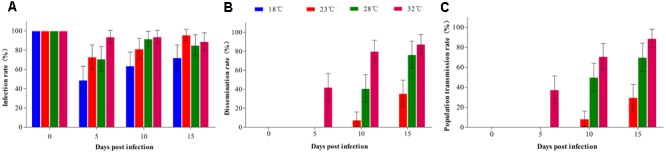
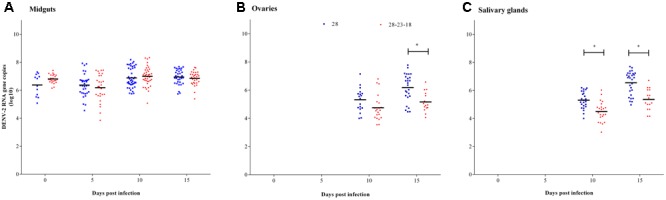
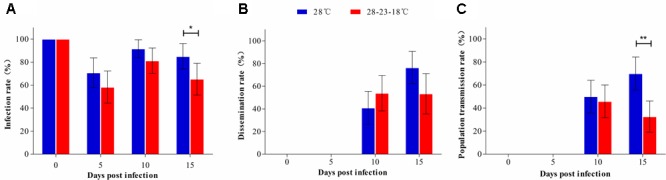
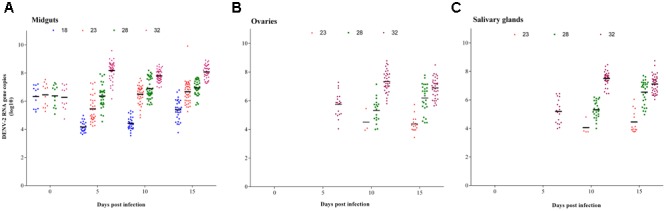
Dengue is a mosquito-borne disease that has been an epidemic in China for many years. is the dominant mosquito species and the main vector of dengue in China. Epidemiologically, dengue mainly occurs in Guangdong Province; it does not occur or rarely occurs in other areas of mainland China. This distribution may be associated with climate, mosquito density, and other factors in different regions; however, the effect of temperature on the vector competence of for dengue viruses (DENV) remains unclear. In this study, was orally infected with dengue virus 2 (DENV-2) and reared at constant temperatures (18, 23, 28, and 32°C) and a fluctuating temperature (28-23-18°C). The infection status of the midguts, ovaries, and salivary glands of each mosquito was detected by polymerase chain reaction (PCR) at 0, 5, 10, and 15 days post-infection (dpi). DENV-2 RNA copies from positive tissues were quantified by quantitative real time PCR (qRT-PCR). At 18°C, DENV-2 proliferated slowly in the midgut of , and the virus could not spread to the salivary glands. At 23 and 28°C, DENV-2 was detected in the ovaries and salivary glands at 10 dpi. The rates of infection, dissemination, population transmission, and DENV-2 copies at 28°C were higher than those at 23°C at any time point. At 32°C, the extrinsic incubation period (EIP) for DENV-2 in was only 5 dpi, and the vector competence was the highest among all the temperatures. Compared with 28°C, at 28-23-18°C, the positive rate and the amount of DENV-2 in the salivary glands were significantly lower. Therefore, temperature is an important factor affecting the vector competence of for DENV-2. Within the suitable temperature range, the replication of DENV-2 in accelerated, and the EIP was shorter with a higher temperature. Our results provide a guide for vector control and an experimental basis for differences in the spatial distribution of dengue cases.
登革热是一种由蚊子传播的疾病,多年来在中国呈流行态势。[蚊子种类名称]是中国主要的蚊子种类,也是登革热的主要传播媒介。从流行病学角度来看,登革热主要发生在广东省,在中国大陆的其他地区不发生或很少发生。这种分布可能与不同地区的气候、蚊子密度等因素有关;然而,温度对[蚊子种类名称]传播登革病毒(DENV)能力的影响仍不清楚。在本研究中,[蚊子种类名称]经口服感染登革病毒2(DENV - 2),并在恒定温度(18、23、28和32°C)以及波动温度(28 - 23 - 18°C)下饲养。在感染后0、5、10和15天,通过聚合酶链反应(PCR)检测每只蚊子中肠、卵巢和唾液腺的感染状况。通过定量实时PCR(qRT - PCR)对阳性组织中的DENV - 2 RNA拷贝进行定量。在18°C时,DENV - 2在[蚊子种类名称]的中肠中增殖缓慢,且病毒无法传播到唾液腺。在23和28°C时,在感染后10天在卵巢和唾液腺中检测到DENV - 2。在任何时间点,28°C时的感染率、传播率、种群传播率和DENV - 2拷贝数均高于23°C时。在32°C时,[蚊子种类名称]中DENV - 2的外在潜伏期(EIP)仅为感染后5天,且在所有温度中传播能力最高。与28°C相比,在28 - 23 - 18°C时,唾液腺中DENV - 2的阳性率和数量显著降低。因此,温度是影响[蚊子种类名称]传播DENV - 2能力的重要因素。在适宜温度范围内,DENV - 2在[蚊子种类名称]中的复制加速,且温度越高EIP越短。我们的研究结果为媒介控制提供了指导,并为登革热病例空间分布差异提供了实验依据。