DuVal Ashley, Gezan Salvador A, Mustiga Guiliana, Stack Conrad, Marelli Jean-Philippe, Chaparro José, Livingstone Donald, Royaert Stefan, Motamayor Juan C
Mars Inc., Miami, FL, United States.
Horticultural Sciences Department, University of Florida, Gainesville, FL, United States.
Front Plant Sci. 2017 Dec 1;8:2059. doi: 10.3389/fpls.2017.02059. eCollection 2017.
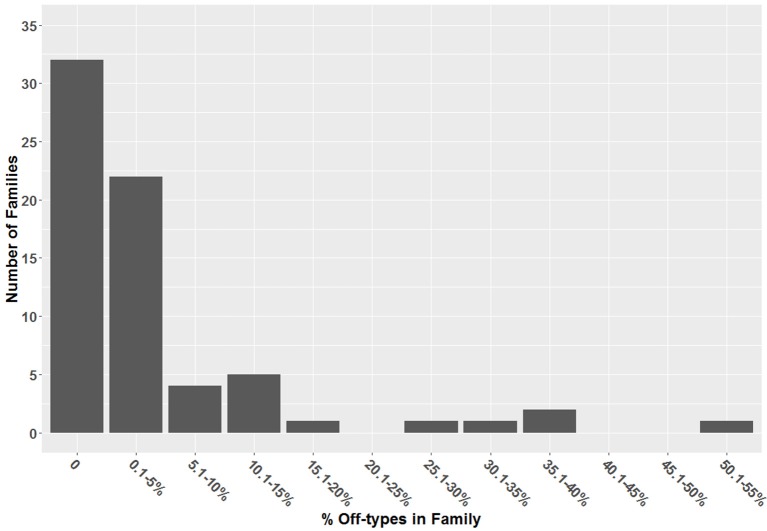
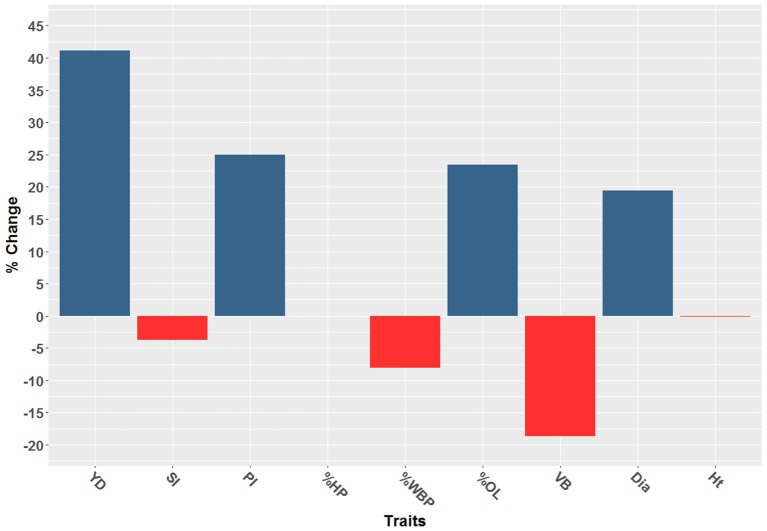
Breeding programs of cacao ( L.) trees share the many challenges of breeding long-living perennial crops, and genetic progress is further constrained by both the limited understanding of the inheritance of complex traits and the prevalence of technical issues, such as mislabeled individuals (off-types). To better understand the genetic architecture of cacao, in this study, 13 years of phenotypic data collected from four progeny trials in Bahia, Brazil were analyzed jointly in a multisite analysis. Three separate analyses (multisite, single site with and without off-types) were performed to estimate genetic parameters from statistical models fitted on nine important agronomic traits (yield, seed index, pod index, % healthy pods, % pods infected with witches broom, % of pods other loss, vegetative brooms, diameter, and tree height). Genetic parameters were estimated along with variance components and heritabilities from the multisite analysis, and a trial was fingerprinted with low-density SNP markers to determine the impact of off-types on estimations. Heritabilities ranged from 0.37 to 0.64 for yield and its components and from 0.03 to 0.16 for disease resistance traits. A weighted index was used to make selections for clonal evaluation, and breeding values estimated for the parental selection and estimation of genetic gain. The impact of off-types to breeding progress in cacao was assessed for the first time. Even when present at <5% of the total population, off-types altered selections by 48%, and impacted heritability estimations for all nine of the traits analyzed, including a 41% difference in estimated heritability for yield. These results show that in a mixed model analysis, even a low level of pedigree error can significantly alter estimations of genetic parameters and selections in a breeding program.
可可树(Theobroma cacao L.)的育种计划面临着多年生作物育种的诸多挑战,复杂性状遗传的有限认知以及技术问题(如个体误标记(异常类型))的普遍存在进一步限制了遗传进展。为了更好地理解可可的遗传结构,本研究对从巴西巴伊亚州四个子代试验中收集的13年表型数据进行了多地点联合分析。进行了三项独立分析(多地点、有和没有异常类型的单地点分析),以从拟合九个重要农艺性状(产量、种子指数、豆荚指数、健康豆荚百分比、感染女巫扫帚病的豆荚百分比、其他损失的豆荚百分比、营养扫帚、直径和树高)的统计模型中估计遗传参数。通过多地点分析估计了遗传参数以及方差分量和遗传力,并用低密度SNP标记对一个试验进行了指纹识别,以确定异常类型对估计的影响。产量及其组成部分的遗传力范围为0.37至0.64,抗病性状的遗传力范围为0.03至0.16。使用加权指数进行克隆评价选择,并估计育种值以进行亲本选择和遗传增益估计。首次评估了异常类型对可可育种进展的影响。即使异常类型占总人口的比例不到5%,也会使选择改变48%,并影响所分析的所有九个性状的遗传力估计,包括产量估计遗传力的41%差异。这些结果表明,在混合模型分析中,即使系谱错误水平较低,也会显著改变育种计划中遗传参数的估计和选择。