Lee Seong Dae, Son Taeil, Lee Jae-Bum, Chang Yeon Soo
Department of Surgery, Daehang Hospital, Seoul, Korea.
Department of Surgery, Eulji Medical Center, Eulji University College of Medicine, Seoul, Korea.
Ann Surg Treat Res. 2017 Dec;93(6):322-330. doi: 10.4174/astr.2017.93.6.322. Epub 2017 Dec 1.
Prosthetic mesh is widely used for inguinal hernia repair; however, pain and stiffness can develop. This study was a prospective, multicenter, single-blind, randomized trial to assess postoperative pain and quality of life according to mesh type after inguinal hernia repair.
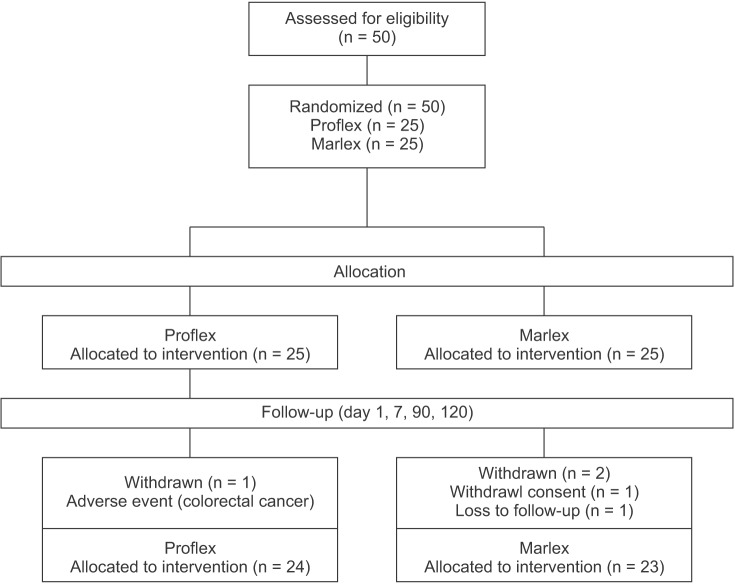
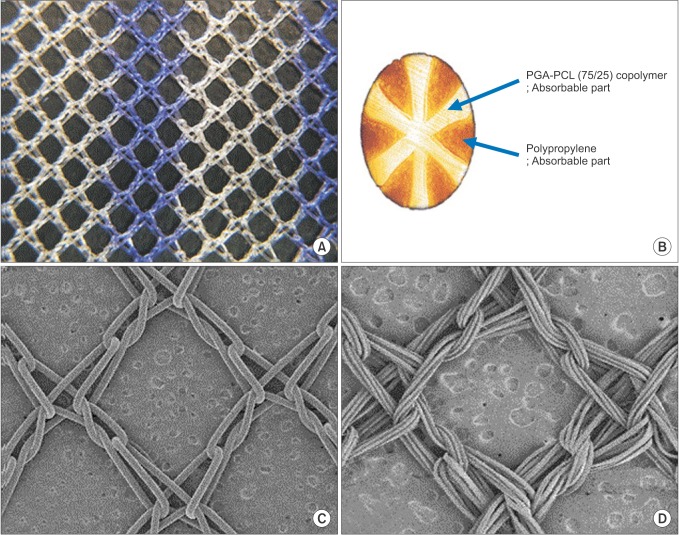
Forty-seven patients who underwent Lichtenstein repair for unilateral inguinal hernia with prosthetic mesh were enrolled and randomly allocated to the partially-absorbable lightweight mesh (LW group, n = 24) or heavyweight mesh group (HW group, n = 23). Data were collected using a visual analogue scale (VAS), Carolinas Comfort Scale (CCS), and Activities Assessment Scale (AAS) at screening and postoperative day 1, 7, 90, and 120; foreign body sensation, sense of stiffness, and sense of pull during activity were also evaluated.
There were no significant differences in patients' demographics and clinical characteristics between groups. The VAS at day 90 was significantly lower in the LW group (0.46 ± 0.78 . 0.96 ± 0.82, P = 0.027). The CCS and AAS were significantly lower in the LW group at day 1 (51.33 ± 20.29 . 64.65 ± 22.64, P = 0.047 and 39.83 ± 9.88 . 46.43 ± 7.82, P = 0.015, respectively). Foreign body sensation was significantly lower in the LW group at day 120 (4.2% . 30.4 %, P = 0.023), as was sense of stiffness (P = 0.023). The sense of pull during activity was lower in the LW group at day 90 and 120 (P = 0.012 and P = 0.022, respectively). There was no recurrence or serious complication during follow-up.
Partially-absorbable lightweight prosthetic mesh can be used for inguinal hernia repair safely and improve functional outcomes and quality of life after surgery.
人工合成补片广泛应用于腹股沟疝修补术;然而,术后可能会出现疼痛和僵硬。本研究是一项前瞻性、多中心、单盲、随机试验,旨在评估腹股沟疝修补术后根据补片类型的术后疼痛及生活质量。
47例行利氏修补术并用人工合成补片修复单侧腹股沟疝的患者被纳入研究,并随机分为部分可吸收轻质补片组(LW组,n = 24)和重质补片组(HW组,n = 23)。在筛查时以及术后第1、7、90和120天,使用视觉模拟评分法(VAS)、卡罗莱纳舒适度量表(CCS)和活动评估量表(AAS)收集数据;还评估了异物感、僵硬感以及活动时的牵拉感。
两组患者的人口统计学和临床特征无显著差异。LW组术后90天的VAS显著更低(0.46±0.78对0.96±0.82,P = 0.027)。LW组术后第1天的CCS和AAS显著更低(分别为51.33±20.29对64.65±22.64,P = 0.047;39.83±9.88对46.43±7.82,P = 0.015)。LW组术后120天的异物感显著更低(4.2%对30.4%,P = 0.023),僵硬感也是如此(P = 0.023)。LW组术后90天和120天活动时的牵拉感更低(分别为P = 0.012和P = 0.022)。随访期间无复发或严重并发症。
部分可吸收轻质人工合成补片可安全用于腹股沟疝修补术,并改善术后功能结局和生活质量。