Department of Psychology, Florida State University.
Florida Center for Reading Research, Florida State University.
Dev Psychol. 2018 Apr;54(4):631-647. doi: 10.1037/dev0000477. Epub 2017 Dec 18.
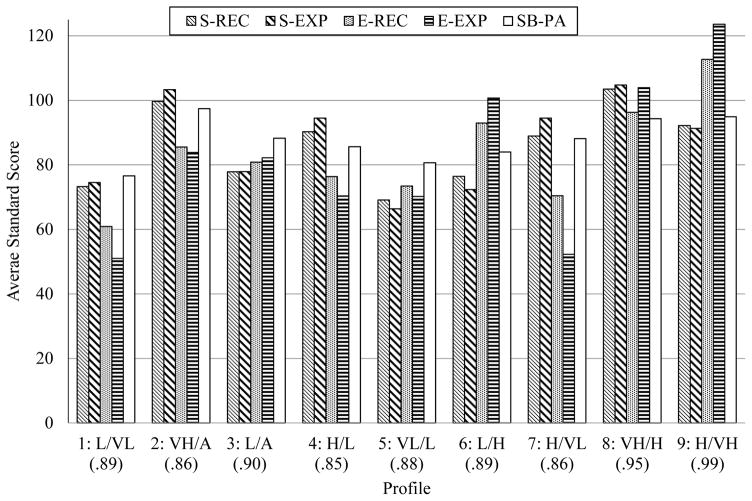
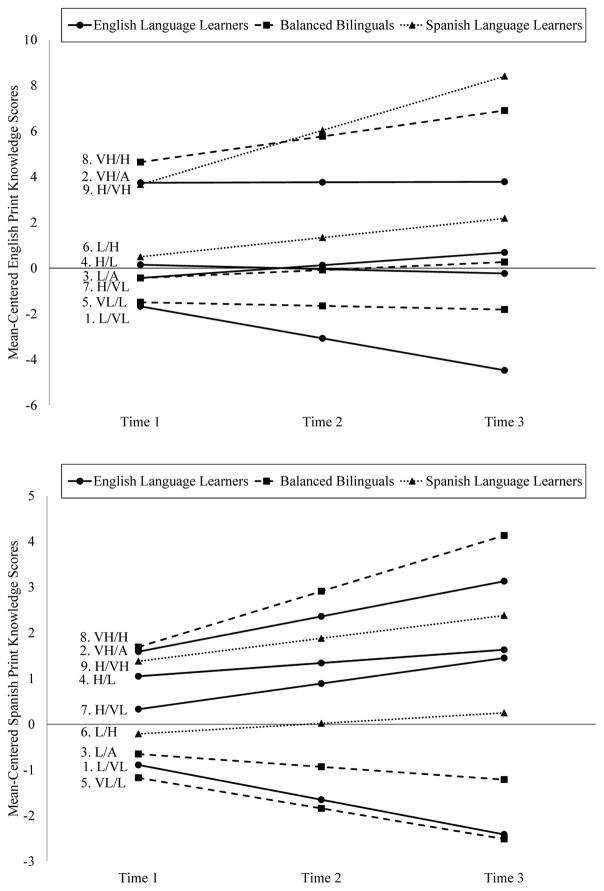
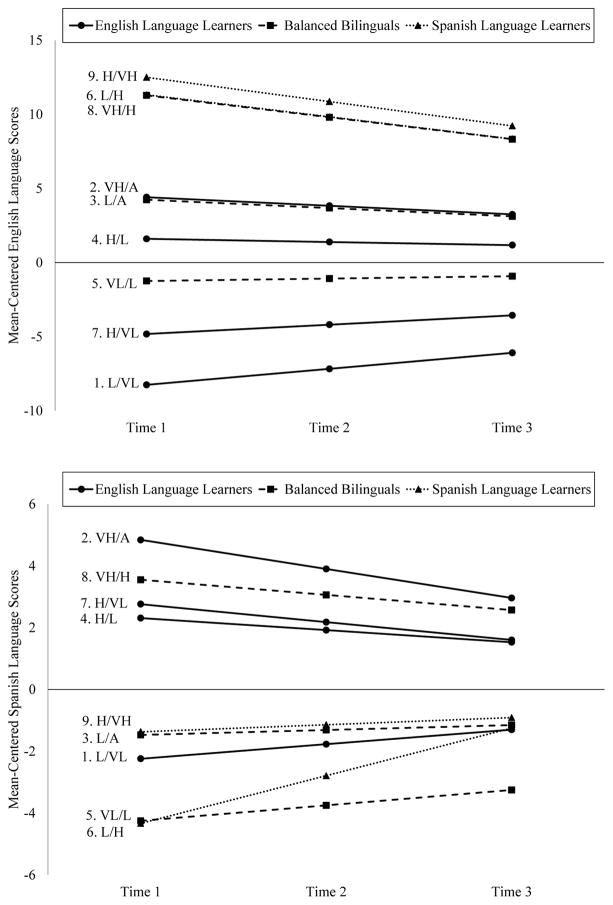
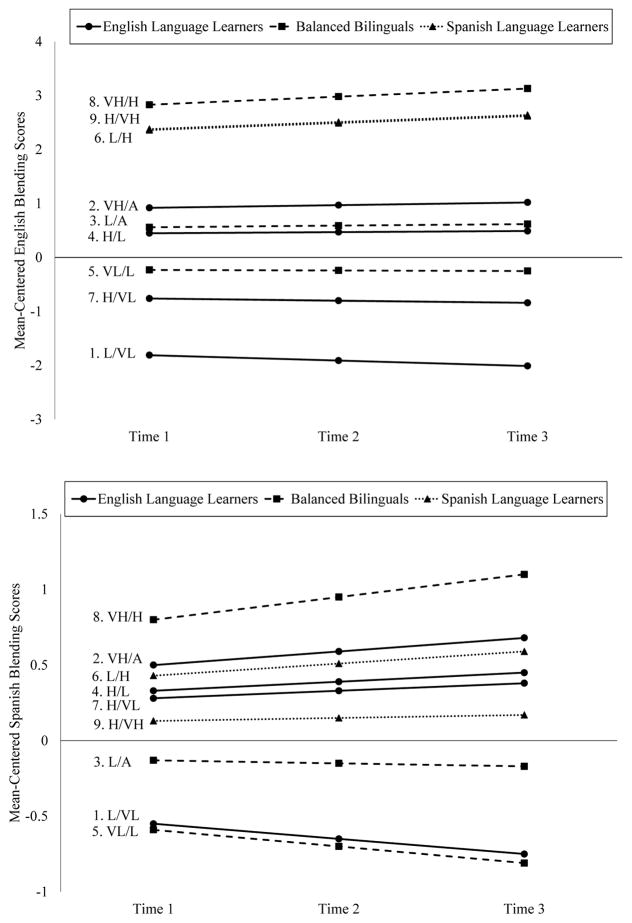
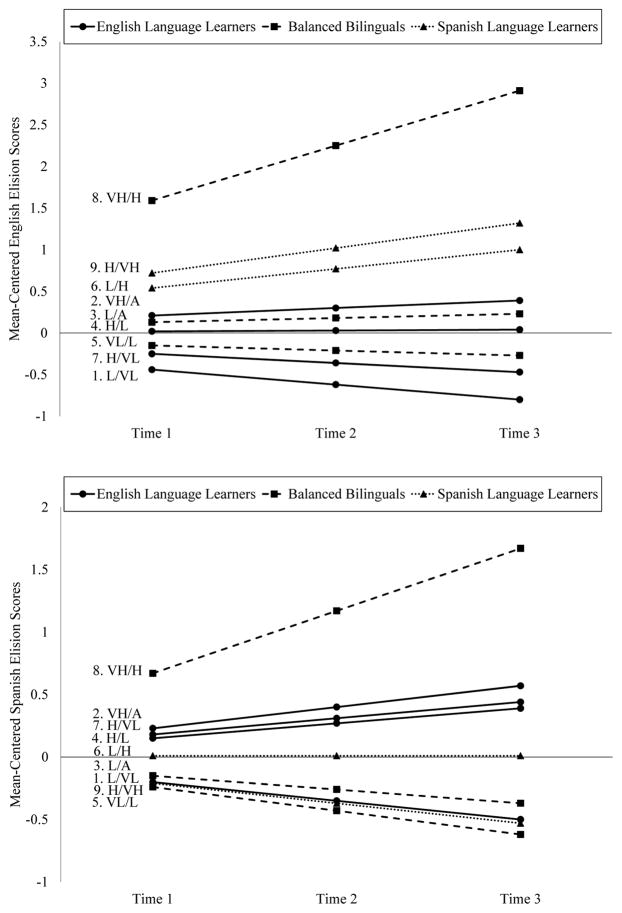
Despite acknowledgment that language-minority children come from a wide variety of home language backgrounds and have a wide range of proficiency in their first (L1) and second (L2) languages, it is unknown whether differences across language-minority children in relative and absolute levels of proficiency in L1 and L2 predict subsequent development of literacy-related skills. The purpose of this study was to identify subgroups of language-minority children and evaluate whether differences in level and rate of growth of early literacy skills differed across subgroups. Five-hundred and twenty-six children completed measures of Spanish and English language and early literacy skills at the beginning, middle, and end of the preschool year. Latent growth models indicated that children's early literacy skills were increasing over the course of the preschool year. Latent profile analysis indicated that language-minority children could be classified into nine distinct groups, each with unique patterns of absolute and relative levels of proficiency in L1 and L2. Results of three-step mixture models indicated that profiles were closely associated with level of early literacy skills at the beginning of the preschool year. Initial level of early literacy skills was positively associated with growth in code-related skills (i.e., print knowledge, phonological awareness) and inversely associated with growth in language skills. These findings suggest that language-minority children are a diverse group with regard to their L1 and L2 proficiencies and that growth in early literacy skills is most associated with level of proficiency in the same language. (PsycINFO Database Record
尽管人们承认,语言少数群体的儿童来自各种家庭语言背景,并且他们的第一语言(L1)和第二语言(L2)的熟练程度也各不相同,但目前尚不清楚语言少数群体儿童在 L1 和 L2 的相对和绝对熟练程度上的差异是否会预测随后的读写相关技能的发展。本研究的目的是确定语言少数群体儿童的亚组,并评估早期读写技能的水平和增长速度在亚组之间是否存在差异。526 名儿童在学前年初、中、末完成了西班牙语和英语语言及早期读写技能的测试。潜在增长模型表明,儿童的早期读写技能在整个学前期间都在不断提高。潜在剖面分析表明,语言少数群体儿童可以分为九个不同的群体,每个群体在 L1 和 L2 的绝对和相对熟练程度上都有独特的模式。三步混合模型的结果表明,这些群体与学前年初的早期读写技能水平密切相关。早期读写技能的初始水平与与代码相关的技能(即印刷知识、语音意识)的增长呈正相关,与语言技能的增长呈负相关。这些发现表明,语言少数群体儿童在 L1 和 L2 的熟练程度上存在差异,并且早期读写技能的增长与同一语言的熟练程度最相关。