Division of Rehabilitation and Ageing, School of Medicine, University of Nottingham, Nottingham, UK.
Department of Healthcare for Older People, Queens Medical Centre, Nottingham University Hospitals NHS Trust, Nottingham, UK.
Age Ageing. 2018 Jan 1;47(1):17-25. doi: 10.1093/ageing/afx079.
the complex management for patients presenting to hospital with vertebral fragility fractures provides justification for the development of specific services for them. A systematic review was undertaken to determine the incidence of hospital admission, patient characteristics and health outcomes of vertebral fragility fracture patients to inform the development of such a service.
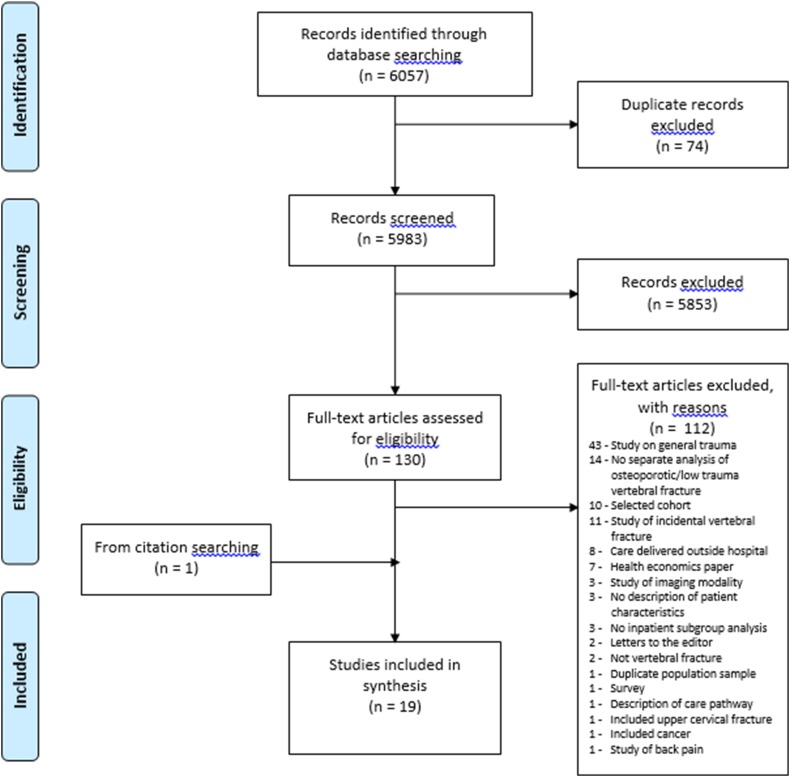
non-randomised studies of vertebral fragility fracture in hospital were included. Searches were conducted using electronic databases and citation searching of the included papers.
a total of 19 studies were included. The incidence of hospital admission varied from 2.8 to 19.3 per 10,000/year. The average patient age was 81 years, the majority having presented with a fall. A diagnosis of osteoporosis or previous fragility fracture was reported in around one-third of patients. Most patients (75% men and 78% women) had five or more co-pathologies. Most patients were managed non-operatively with a median hospital length of stay of 10 days. One-third of patients were started on osteoporosis treatment. Inpatient and 1-year mortality was between 0.9 and 3.5%, and 20 and 27%, respectively, between 34 and 50% were discharged from hospital to a care facility. Many patients were more dependent with activities of daily living on discharge compared to their pre-admission level. Older age and increasing comorbidities was associated with longer hospital stay and higher mortality.
these findings indicate that specific hospital services for patients with vertebral fragility fractures should take into consideration local hospitalisation rates for the condition, and should be multifaceted-providing access to diagnostic, therapeutic, surgical and rehabilitation interventions.
患有椎体脆性骨折的患者需要复杂的管理,这为专门为他们设立服务提供了依据。本系统评价旨在确定因椎体脆性骨折住院患者的入院率、患者特征和健康结局,以指导此类服务的发展。
纳入了医院椎体脆性骨折的非随机研究。使用电子数据库和纳入文献的引文检索进行了检索。
共纳入了 19 项研究。住院患者入院率为每 10000 人/年 2.8-19.3。患者平均年龄为 81 岁,多数因跌倒而就诊。约三分之一的患者被诊断为骨质疏松症或先前有脆性骨折。大多数患者(男性 75%,女性 78%)有 5 种或更多合并症。大多数患者采用非手术治疗,中位住院时间为 10 天。三分之一的患者开始接受骨质疏松症治疗。住院和 1 年死亡率分别为 0.9-3.5%和 20-27%,34-50%的患者出院后入住护理机构。与入院前相比,许多患者出院后日常生活活动的依赖性更高。年龄较大和合并症增多与住院时间延长和死亡率升高相关。
这些结果表明,椎体脆性骨折患者的专门医院服务应考虑当地该疾病的住院率,并应多方面提供诊断、治疗、手术和康复干预措施。