Key Laboratory of Systems Biomedicine (Ministry of Education), Shanghai Center for Systems Biomedicine, Shanghai JiaoTong University, 800 Dongchuan Road, Shanghai 200240, China.
Technical Center of Erlianhot Entry-exit Inspection and Quarantine Bureau, 1266 Qianjin North Road, Erlianhot, Inner Mongolia, China.
Nucleic Acids Res. 2018 Jan 25;46(2):568-581. doi: 10.1093/nar/gkx1261.
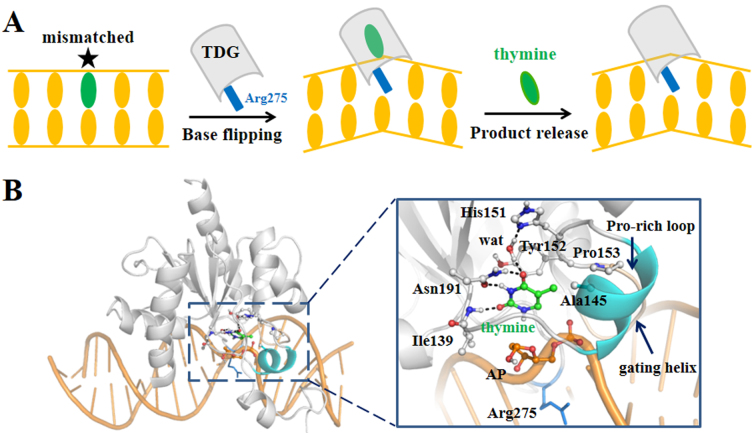
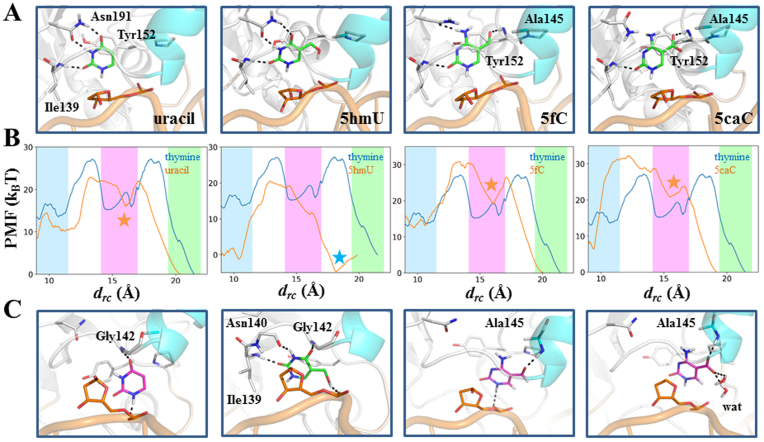
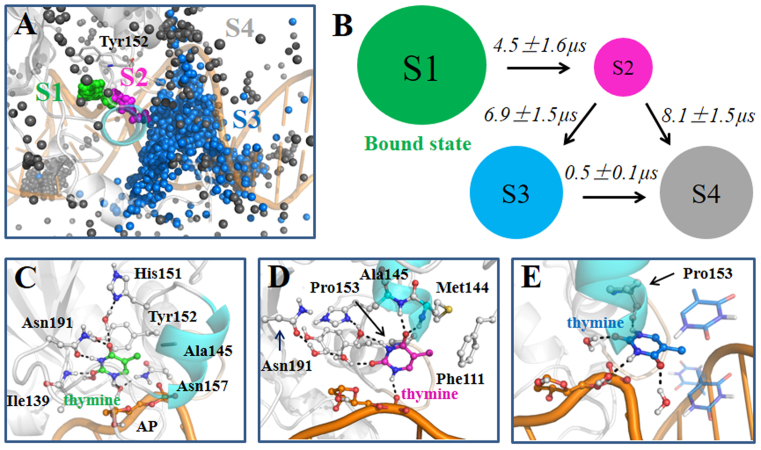
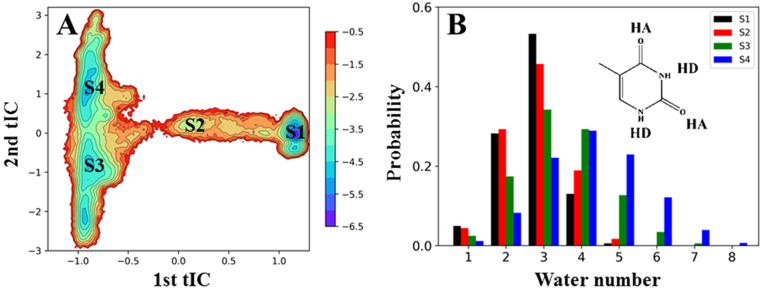
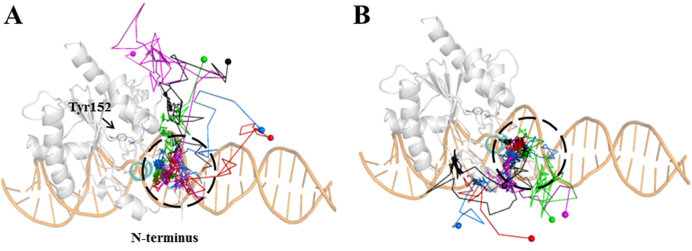
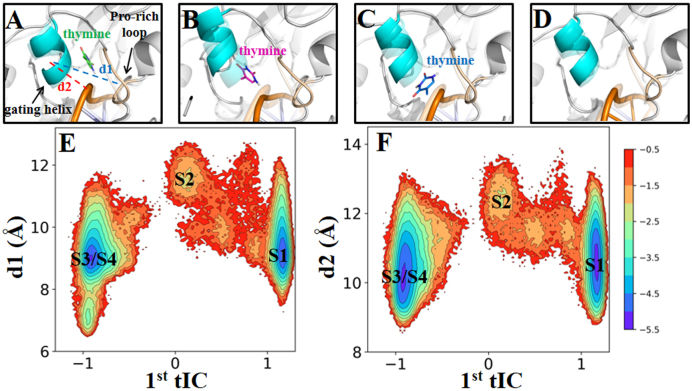
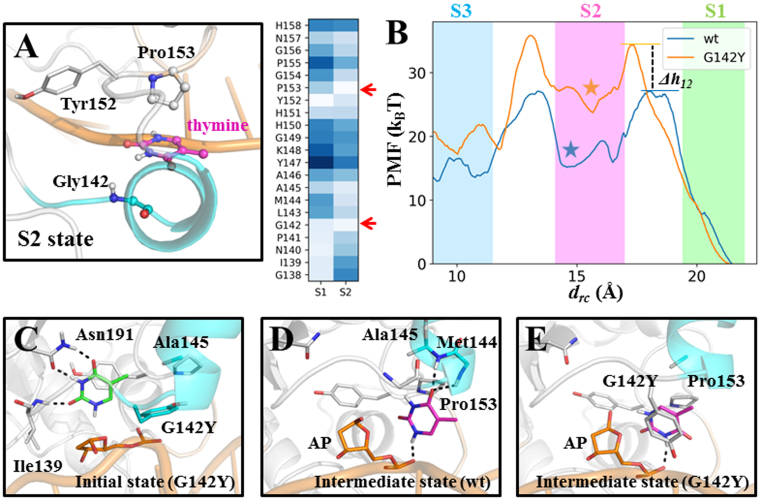
Thymine DNA glycosylase (TDG) initiates base excision repair by cleaving the N-glycosidic bond between the sugar and target base. After catalysis, the release of excised base is a requisite step to terminate the catalytic cycle and liberate the TDG for the following enzymatic reactions. However, an atomistic-level understanding of the dynamics of the product release process in TDG remains unknown. Here, by employing molecular dynamics simulations combined with the Markov State Model, we reveal the dynamics of the thymine release after the excision at microseconds timescale and all-atom resolution. We identify several key metastable states of the thymine and its dominant releasing pathway. Notably, after replacing the TDG residue Gly142 with tyrosine, the thymine release is delayed compared to the wild-type (wt) TDG, as supported by our potential of mean force (PMF) calculations. These findings warrant further experimental tests to potentially trap the excised base in the active site of TDG after the catalysis, which had been unsuccessful by previous attempts. Finally, we extended our studies to other TDG products, including the uracil, 5hmU, 5fC and 5caC bases in order to compare the product release for different targeting bases in the TDG-DNA complex.
胸腺嘧啶 DNA 糖基化酶 (TDG) 通过切割糖和靶碱基之间的 N-糖苷键,启动碱基切除修复。催化后,切除碱基的释放是终止催化循环并释放 TDG 以进行后续酶反应的必要步骤。然而,TDG 中产物释放过程的原子水平动力学仍然未知。在这里,我们通过结合分子动力学模拟和马氏态模型,在微秒时间尺度和全原子分辨率下揭示了胸腺嘧啶切除后的释放动力学。我们确定了胸腺嘧啶及其主要释放途径的几个关键亚稳态。值得注意的是,与野生型 (wt) TDG 相比,将 TDG 残基 Gly142 替换为酪氨酸后,胸腺嘧啶的释放被延迟,这得到了我们的平均力势能 (PMF) 计算的支持。这些发现需要进一步的实验测试,以潜在地在催化后将切除的碱基捕获在 TDG 的活性位点中,这在前几次尝试中都没有成功。最后,我们将研究扩展到其他 TDG 产物,包括尿嘧啶、5hmU、5fC 和 5caC 碱基,以比较 TDG-DNA 复合物中不同靶碱基的产物释放。