Department of Medical Intensive Care Unit, the First Affiliated Hospital of Sun Yat-Sen University, Guangzhou, China.
Int J Chron Obstruct Pulmon Dis. 2017 Dec 5;12:3495-3501. doi: 10.2147/COPD.S151983. eCollection 2017.
Impaired renal function is often neglected in COPD patients. Considering that COPD patients usually have an ongoing prothrombotic state and systemic inflammation status, we investigated the association among them and explored the predictive value of a disintegrin and metalloproteinase with a thrombospondin type 1 motif, member 13 (ADAMTS-13), on concealed chronic renal failure (CRF) in COPD patients.
COPD patients were recruited from the First Affiliated Hospital of Sun Yat-Sen University between January 2015 and December 2016. Control was selected from contemporaneous hospitalized patients without COPD and matched by age and gender at a ratio of 1:1. Estimated glomerular filtration rate (eGFR) was calculated by using the Chronic Kidney Disease Epidemiology Collaboration formula, and all subjects were categorized as having normal renal function (eGFR ≥60 mL min 1.73 m) and having concealed CRF (normal serum creatinine while eGFR <60 mL min 1.73 m). Independent correlates of concealed CRF were investigated by logistic regression analysis, and receiver operating characteristic (ROC) curves were used to determine the predictive value of ADAMTS-13.
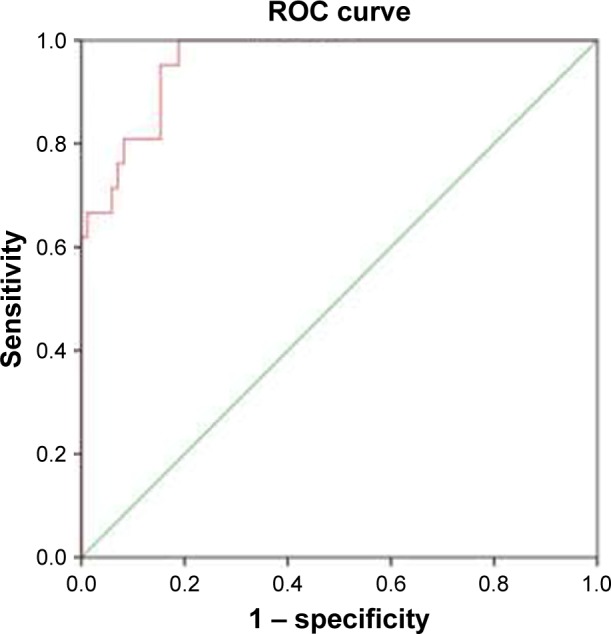
In total, 106 COPD and 106 non-COPD patients were finally recruited, and the incidences of concealed CRF were 19.81% and 7.55%, respectively. ADAMTS-13 (odds ratio [OR] =0.858, 95% CI =0.795-0.926), D-dimer (OR =1.095, 95% CI =1.027-1.169), and C-reactive protein (OR =1.252, 95% CI =1.058-1.480) were significantly associated with concealed CRF. Sensitivity and specificity at an ADAMTS-13 cutoff of 318.72 ng/mL were 100% and 81.2%, respectively. The area under the ROC curve was 0.959.
Prothrombotic state and systemic inflammation status might contribute to explaining the high incidence of concealed CRF in COPD, and plasma ADAMTS-13 levels may serve as a strong predictor.
慢性阻塞性肺疾病(COPD)患者常存在肾功能受损,但往往被忽视。考虑到 COPD 患者通常存在持续的血栓形成状态和全身炎症状态,我们研究了它们之间的关联,并探讨了解整合素金属蛋白酶 13(ADAMTS-13)对 COPD 患者隐匿性慢性肾衰竭(CRF)的预测价值。
本研究于 2015 年 1 月至 2016 年 12 月期间招募中山大学附属第一医院的 COPD 患者,并选择同期住院的非 COPD 患者作为对照,按年龄和性别 1:1 配对。采用慢性肾脏病流行病学协作公式计算估算肾小球滤过率(eGFR),所有患者分为肾功能正常(eGFR≥60 mL·min-1·1.73 m-2)和隐匿性 CRF(血清肌酐正常而 eGFR<60 mL·min-1·1.73 m-2)。采用 logistic 回归分析探讨隐匿性 CRF 的独立相关因素,并采用受试者工作特征(ROC)曲线确定 ADAMTS-13 的预测价值。
共纳入 106 例 COPD 患者和 106 例非 COPD 患者,隐匿性 CRF 的发生率分别为 19.81%和 7.55%。ADAMTS-13(比值比[OR] =0.858,95%置信区间[CI] =0.795-0.926)、D-二聚体(OR =1.095,95% CI =1.027-1.169)和 C 反应蛋白(OR =1.252,95% CI =1.058-1.480)与隐匿性 CRF 显著相关。ADAMTS-13 截断值为 318.72ng/mL 时的灵敏度和特异度分别为 100%和 81.2%,ROC 曲线下面积为 0.959。
血栓形成状态和全身炎症状态可能有助于解释 COPD 患者隐匿性 CRF 发生率较高的原因,而血浆 ADAMTS-13 水平可能是一个强有力的预测因子。