Department of Pharmacology, University of Nevada, Reno School of Medicine, 1664 North Virginia Street, Reno, NV 89557, USA.
Sci Adv. 2017 Dec 13;3(12):eaao2267. doi: 10.1126/sciadv.aao2267. eCollection 2017 Dec.
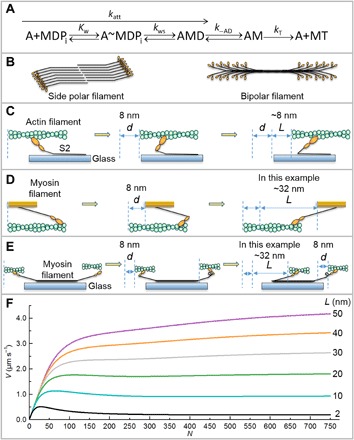
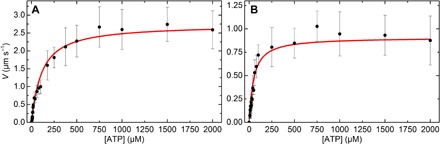
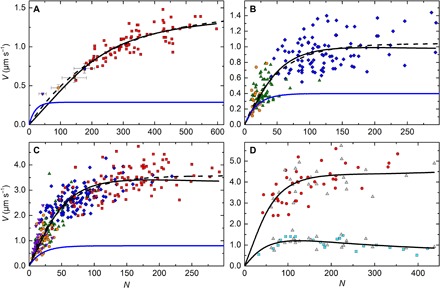
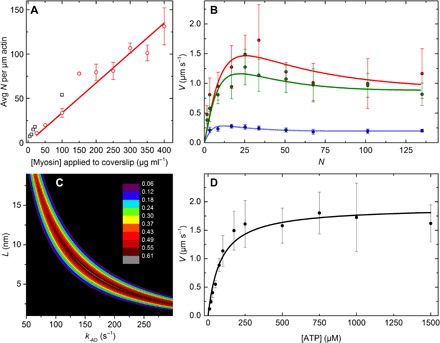
In vitro motility assays, where purified myosin and actin move relative to one another, are used to better understand the mechanochemistry of the actomyosin adenosine triphosphatase (ATPase) cycle. We examined the relationship between the relative velocity () of actin and myosin and the number of available myosin heads () or [ATP] for smooth (SMM), skeletal (SKM), and cardiac (CMM) muscle myosin filaments moving over actin as well as from actin filaments moving over a bed of monomeric SKM. These data do not fit well to a widely accepted model that predicts that is limited by myosin detachment from actin (/), where equals step size and equals time a myosin head remains attached to actin. To account for these data, we have developed a mixed-kinetic model where is influenced by both attachment and detachment kinetics. The relative contributions at a given vary with the probability that a head will remain attached to actin long enough to reach the end of its flexible S2 tether. Detachment kinetics are affected by /, where is related to the tether length. We show that is relatively long for SMM, SKM, and CMM filaments (59 ± 3 nm, 22 ± 9 nm, and 22 ± 2 nm, respectively). In contrast, is shorter (8 ± 3 nm) when myosin monomers are attached to a surface. This suggests that the behavior of the S2 domain may be an important mechanical feature of myosin filaments that influences unloaded shortening velocities of muscle.
在体外运动分析中,纯化的肌球蛋白和肌动蛋白相对运动,从而更好地理解肌球蛋白-肌动球蛋白腺苷三磷酸酶(ATPase)循环的机械化学。我们研究了相对速度()与可用肌球蛋白头数()或[ATP]之间的关系,用于观察平滑肌(SMM)、骨骼肌(SKM)和心肌(CMM)肌球蛋白丝在肌动蛋白上运动以及肌动蛋白丝在单体 SKM 床面运动的关系。这些数据与广泛接受的模型不符,该模型预测速度受到肌球蛋白从肌动蛋白上脱离的限制(/),其中等于步长,等于肌球蛋白头附着在肌动蛋白上的时间。为了解释这些数据,我们开发了一种混合动力学模型,其中速度受到附着和脱离动力学的影响。在给定的速度下,头部附着在肌动蛋白上的时间足以到达其柔性 S2 系绳末端的概率决定了相对贡献。脱离动力学受/影响,其中与系绳长度有关。我们发现 SMM、SKM 和 CMM 纤维的相对较长(59±3nm、22±9nm 和 22±2nm)。相比之下,当肌球蛋白单体附着在表面时,较短(8±3nm)。这表明 S2 结构域的行为可能是肌球蛋白纤维的一个重要机械特征,影响肌肉的无负荷缩短速度。