Department of Psychiatry, Radboud University Medical Center, Nijmegen, The Netherlands.
Behavioural Science Institute, Radboud University, Nijmegen, The Netherlands.
J Gen Intern Med. 2018 Apr;33(4):429-436. doi: 10.1007/s11606-017-4249-x. Epub 2017 Dec 18.
Burnout is highly prevalent in residents. No randomized controlled trials have been conducted measuring the effects of Mindfulness-Based Stress Reduction (MBSR) on burnout in residents.
To determine the effectiveness of MBSR in reducing burnout in residents.
A randomized controlled trial comparing MBSR with a waitlist control group.
Residents from all medical, surgical and primary care disciplines were eligible to participate. Participants were self-referred.
The MBSR consisted of eight weekly 2.5-h sessions and one 6-h silent day.
The primary outcome was the emotional exhaustion subscale of the Dutch version of the Maslach Burnout Inventory-Human Service Survey. Secondary outcomes included the depersonalization and reduced personal accomplishment subscales of burnout, worry, work-home interference, mindfulness skills, self-compassion, positive mental health, empathy and medical errors. Assessment took place at baseline and post-intervention approximately 3 months later.
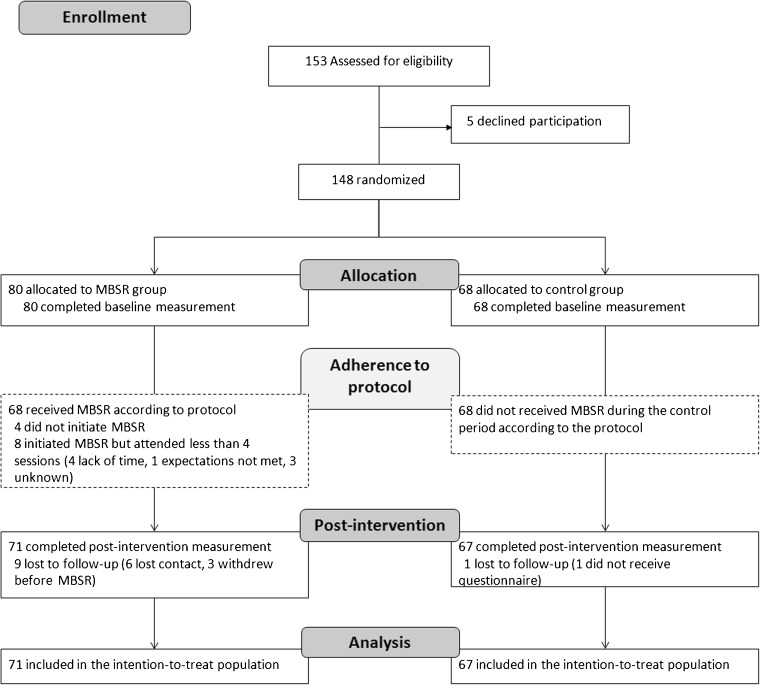
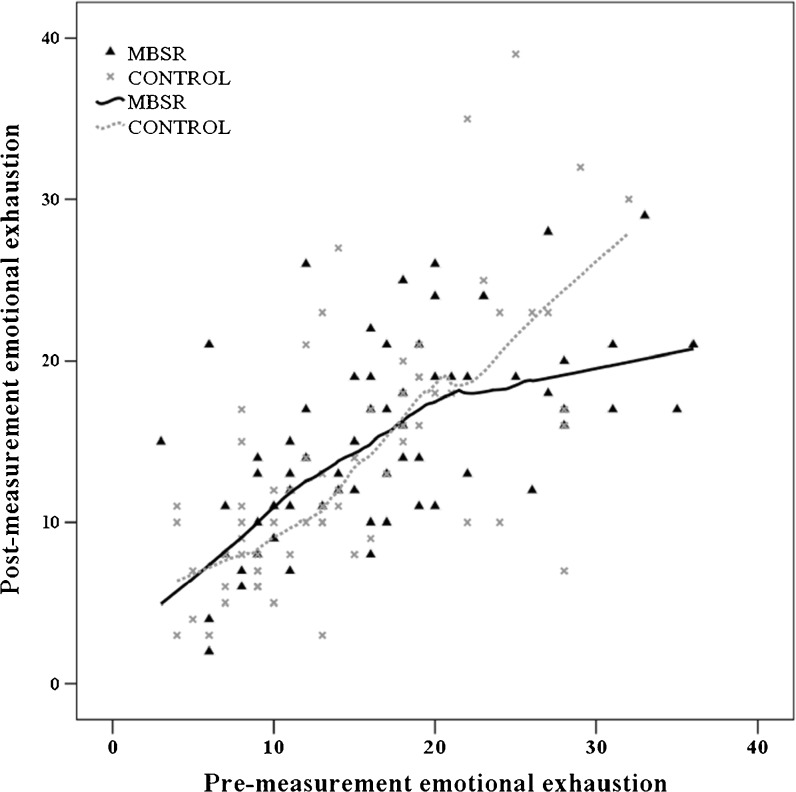
Of the 148 residents participating, 138 (93%) completed the post-intervention assessment. No significant difference in emotional exhaustion was found between the two groups. However, the MBSR group reported significantly greater improvements than the control group in personal accomplishment (p = 0.028, d = 0.24), worry (p = 0.036, d = 0.23), mindfulness skills (p = 0.010, d = 0.33), self-compassion (p = 0.010, d = 0.35) and perspective-taking (empathy) (p = 0.025, d = 0.33). No effects were found for the other measures. Exploratory moderation analysis showed that the intervention outcome was moderated by baseline severity of emotional exhaustion; those with greater emotional exhaustion did seem to benefit.
The results of our primary outcome analysis did not support the effectiveness of MBSR for reducing emotional exhaustion in residents. However, residents with high baseline levels of emotional exhaustion did appear to benefit from MBSR. Furthermore, they demonstrated modest improvements in personal accomplishment, worry, mindfulness skills, self-compassion and perspective-taking. More research is needed to confirm these results.
倦怠在住院医师中非常普遍。目前还没有随机对照试验来衡量正念减压(MBSR)对住院医师倦怠的影响。
确定 MBSR 对减少住院医师倦怠的效果。
一项比较 MBSR 与候补对照组的随机对照试验。
所有医学、外科和初级保健学科的住院医师都有资格参加。参与者是自我推荐的。
MBSR 包括每周 2.5 小时的 8 次课程和 1 次 6 小时的静默日。
主要结果是荷兰语 Maslach 倦怠量表-人力资源服务调查的情绪衰竭子量表。次要结果包括倦怠的去人性化和成就感降低子量表、担忧、工作与家庭干扰、正念技能、自我同情、积极的心理健康、同理心和医疗错误。评估在基线和大约 3 个月后的干预后进行。
在 148 名参加的住院医师中,有 138 名(93%)完成了干预后的评估。两组之间的情绪衰竭没有显著差异。然而,MBSR 组在个人成就感方面的报告明显优于对照组(p=0.028,d=0.24)、担忧(p=0.036,d=0.23)、正念技能(p=0.010,d=0.33)、自我同情(p=0.010,d=0.35)和观点采择(同理心)(p=0.025,d=0.33)。其他措施没有效果。探索性调节分析表明,干预结果受到基线情绪衰竭严重程度的调节;那些情绪衰竭程度较高的人似乎确实受益。
我们的主要结果分析结果不支持 MBSR 对减少住院医师情绪衰竭的有效性。然而,基线情绪衰竭程度较高的住院医师似乎从 MBSR 中受益。此外,他们在个人成就感、担忧、正念技能、自我同情和观点采择方面表现出适度的改善。需要进一步的研究来证实这些结果。