• 文献检索
  • 文档翻译
  • 深度研究
  • 学术资讯
  • Suppr Zotero 插件Zotero 插件
  • 邀请有礼
  • 套餐&价格
  • 历史记录
应用&插件
Suppr Zotero 插件Zotero 插件浏览器插件Mac 客户端Windows 客户端微信小程序
定价
高级版会员购买积分包购买API积分包
服务
文献检索文档翻译深度研究API 文档MCP 服务
关于我们
关于 Suppr公司介绍联系我们用户协议隐私条款
关注我们

Suppr 超能文献

核心技术专利:CN118964589B侵权必究
粤ICP备2023148730 号-1Suppr @ 2026

文献检索

告别复杂PubMed语法,用中文像聊天一样搜索,搜遍4000万医学文献。AI智能推荐,让科研检索更轻松。

立即免费搜索

文件翻译

保留排版,准确专业,支持PDF/Word/PPT等文件格式,支持 12+语言互译。

免费翻译文档

深度研究

AI帮你快速写综述,25分钟生成高质量综述,智能提取关键信息,辅助科研写作。

立即免费体验

影响当代大学生的电子健康素养与健康行为:美国大学健康协会所发现问题的初步研究

eHealth Literacy and Health Behaviors Affecting Modern College Students: A Pilot Study of Issues Identified by the American College Health Association.

作者信息

Britt Rebecca Katherine, Collins William Bart, Wilson Kari, Linnemeier Georgiann, Englebert Andrew Mark

机构信息

Department of Journalism and Mass Communication, South Dakota State University, Brookings, SD, United States.

Brian Lamb School of Communication, Purdue University, West Lafayette, IN, United States.

出版信息

J Med Internet Res. 2017 Dec 19;19(12):e392. doi: 10.2196/jmir.3100.

DOI:10.2196/jmir.3100
PMID:29258979
原文链接:https://pmc.ncbi.nlm.nih.gov/articles/PMC5750421/
Abstract

BACKGROUND

The eHealth Literacy Scale (eHEALS) has been widely adopted by researchers to understand how eHealth literacy can be put into context. eHealth researchers need to know how to promote positive health behavior changes across college students, given the importance of the Internet to acquire and use health information. The American College Health Association identified a set of key health issues that affect college students today. By understanding how eHEALS might be related to college students' maintenance of their health and their use of online health resources, researchers will be provided with a better understanding of eHealth literacy and its pragmatic implications for health campaigns and future interventions.

OBJECTIVE

The goal of the study was to examine what eHEALS reveals about college student health behaviors identified by the American College Health Association. To understand college student current health maintenance and their intentions to maintain their health and use online resources, the theory of planned behavior was used as the theoretical framework for the study.

METHODS

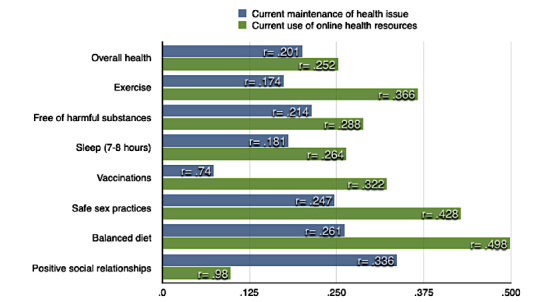
Data were collected via a survey of 422 college students that included the eHEALS measure and questions about health issues based on the recommendations of the American College Health Association. These questions asked about college student current health, subsequent use of online health resources, and their intention to maintain their health and make use of such resources in the future.

RESULTS

eHEALS was positively and significantly associated with all 8 areas of health issues identified by the American College Health Association for college student current maintenance of health and use of online health resources and for future intention of health maintenance and use of online resources. Key issues that emerged with eHealth literacy were maintaining safe sex practices and seeking out related information, seeking out information on an exercise regime, information on vaccinations, and maintaining a balanced diet.

CONCLUSIONS

These results suggest several areas that may be targeted for future health campaigns toward college students. In addition, eHEALS was found to be a useful instrument for college students in the United States. Lastly, these results point to a need to deliver targeted information to college students, particularly since eHEALS captures literacy based on positively phrased items.

摘要

背景

电子健康素养量表(eHEALS)已被研究人员广泛采用,以了解如何将电子健康素养融入实际情况。鉴于互联网在获取和使用健康信息方面的重要性,电子健康研究人员需要知道如何促进大学生积极的健康行为改变。美国大学健康协会确定了一系列影响当今大学生的关键健康问题。通过了解eHEALS如何与大学生的健康维护及其对在线健康资源的使用相关联,研究人员将能更好地理解电子健康素养及其对健康运动和未来干预措施的实际影响。

目的

本研究的目的是探讨eHEALS揭示了美国大学健康协会确定的大学生健康行为的哪些方面。为了解大学生当前的健康维护情况以及他们维护健康和使用在线资源的意图,计划行为理论被用作本研究的理论框架。

方法

通过对422名大学生进行调查收集数据,该调查包括eHEALS测量以及根据美国大学健康协会的建议提出的有关健康问题的询问。这些问题涉及大学生当前的健康状况、随后对在线健康资源的使用情况,以及他们未来维护健康和利用此类资源的意图。

结果

eHEALS与美国大学健康协会确定的大学生当前健康维护、在线健康资源使用以及未来健康维护和在线资源使用的所有8个健康问题领域均呈显著正相关。与电子健康素养相关的关键问题包括保持安全性行为并寻求相关信息、寻找有关锻炼方式的信息、疫苗接种信息以及保持均衡饮食。

结论

这些结果表明了几个可能针对大学生未来健康运动的领域。此外,发现eHEALS对美国大学生是一种有用的工具。最后,这些结果表明有必要向大学生提供有针对性的信息,特别是因为eHEALS基于积极表述的项目来衡量素养。
https://cdn.ncbi.nlm.nih.gov/pmc/blobs/bf8d/5750421/5b2d0d6b06f3/jmir_v19i12e392_fig1.jpg

相似文献

1
eHealth Literacy and Health Behaviors Affecting Modern College Students: A Pilot Study of Issues Identified by the American College Health Association.影响当代大学生的电子健康素养与健康行为:美国大学健康协会所发现问题的初步研究
J Med Internet Res. 2017 Dec 19;19(12):e392. doi: 10.2196/jmir.3100.
2
Ill Literates or Illiterates? Investigating the eHealth Literacy of Users of Online Health Communities.文盲还是健康知识匮乏者?探究在线健康社区用户的电子健康素养
J Med Internet Res. 2017 Oct 4;19(10):e331. doi: 10.2196/jmir.7372.
3
Reliability and Validity of the Telephone-Based eHealth Literacy Scale Among Older Adults: Cross-Sectional Survey.老年人基于电话的电子健康素养量表的信效度:横断面调查
J Med Internet Res. 2017 Oct 26;19(10):e362. doi: 10.2196/jmir.8481.
4
The Korean eHealth Literacy Scale (K-eHEALS): Reliability and Validity Testing in Younger Adults Recruited Online.韩国电子健康素养量表(K-eHEALS):对在线招募的年轻人进行的信效度测试
J Med Internet Res. 2018 Apr 20;20(4):e138. doi: 10.2196/jmir.8759.
5
Association of eHealth Literacy With Lifestyle Behaviors in University Students: Questionnaire-Based Cross-Sectional Study.大学生电子健康素养与生活方式行为的关联:基于问卷调查的横断面研究
J Med Internet Res. 2020 Jun 24;22(6):e18155. doi: 10.2196/18155.
6
Assessing Electronic Health Literacy in the State of Kuwait: Survey of Internet Users From an Arab State.科威特国电子健康素养评估:对一个阿拉伯国家互联网用户的调查
J Med Internet Res. 2019 May 24;21(5):e11174. doi: 10.2196/11174.
7
The Associations Among Individual Factors, eHealth Literacy, and Health-Promoting Lifestyles Among College Students.大学生个体因素、电子健康素养与健康促进生活方式之间的关联
J Med Internet Res. 2017 Jan 10;19(1):e15. doi: 10.2196/jmir.5964.
8
Correlation Between eHealth Literacy and Health Literacy Using the eHealth Literacy Scale and Real-Life Experiences in the Health Sector as a Proxy Measure of Functional Health Literacy: Cross-Sectional Web-Based Survey.使用电子健康素养量表及卫生部门的实际生活经历作为功能性健康素养的替代指标,探讨电子健康素养与健康素养之间的相关性:基于网络的横断面调查
J Med Internet Res. 2018 Oct 31;20(10):e281. doi: 10.2196/jmir.9401.
9
Relationship Between Coronavirus-Related eHealth Literacy and COVID-19 Knowledge, Attitudes, and Practices among US Adults: Web-Based Survey Study.美国成年人中与冠状病毒相关的电子健康素养与COVID-19知识、态度和行为之间的关系:基于网络的调查研究
J Med Internet Res. 2021 Mar 29;23(3):e25042. doi: 10.2196/25042.
10
Online Health Information Seeking and eHealth Literacy Among Patients Attending a Primary Care Clinic in Hong Kong: A Cross-Sectional Survey.香港基层医疗诊所患者的在线健康信息搜索与电子健康素养:一项横断面调查
J Med Internet Res. 2019 Mar 27;21(3):e10831. doi: 10.2196/10831.

引用本文的文献

1
eHealth Literacy and Its Outcomes Among Postsecondary Students: Systematic Review.高等院校学生的电子健康素养及其结果:系统评价
J Med Internet Res. 2025 Jul 2;27:e64489. doi: 10.2196/64489.
2
Digital natives: A systematic review of the digital health literacy and influencing factors among Chinese college students.数字原生代:中国大学生数字健康素养及其影响因素的系统评价
Digit Health. 2025 May 25;11:20552076251346006. doi: 10.1177/20552076251346006. eCollection 2025 Jan-Dec.
3
The Impact of eHealth Literacy on Health Behaviors for Non-communicable Disease Prevention Among University Students in Japan and Indonesia.

本文引用的文献

1
Formation of a New Entity to Support Effective Use of Technology in Medical Education: The Student Technology Committee.成立一个新实体以支持医学教育中技术的有效应用:学生技术委员会。
JMIR Med Educ. 2015 Sep 17;1(2):e9. doi: 10.2196/mededu.4676.
2
Enhancing the Effectiveness of Consumer-Focused Health Information Technology Systems Through eHealth Literacy: A Framework for Understanding Users' Needs.通过电子健康素养提高以消费者为中心的健康信息技术系统的有效性:理解用户需求的框架
JMIR Hum Factors. 2015 May 20;2(1):e9. doi: 10.2196/humanfactors.3696.
3
A participatory approach to designing and enhancing integrated health information technology systems for veterans: protocol.
电子健康素养对日本和印度尼西亚大学生预防非传染性疾病健康行为的影响。
Cureus. 2025 Feb 3;17(2):e78450. doi: 10.7759/cureus.78450. eCollection 2025 Feb.
4
The impact of digital literacy in enhancing individuals' health in China.数字素养对提升中国个人健康的影响。
BMC Public Health. 2025 Jan 29;25(1):364. doi: 10.1186/s12889-025-21454-8.
5
How does mHealth benefit older Chinese adults' quality of life? Examining the roles of eHealth literacy, health motivation, and patient activation.移动健康如何有益于中国老年人的生活质量?审视电子健康素养、健康动机和患者激活的作用。
Digit Health. 2025 Jan 13;11:20552076241313160. doi: 10.1177/20552076241313160. eCollection 2025 Jan-Dec.
6
Associations between health anxiety, eHealth literacy and self-reported health: A cross-sectional study.健康焦虑、电子健康素养与自我报告的健康状况之间的关联:一项横断面研究。
Rev Esc Enferm USP. 2024 Nov 29;58:e20240160. doi: 10.1590/1980-220X-REEUSP-2024-0160en. eCollection 2024.
7
Relationships Among eHealth Literacy, Physical Literacy, and Physical Activity in Chinese University Students: Cross-Sectional Study.电子健康素养、身体素养与中国大学生身体活动的关系:横断面研究。
J Med Internet Res. 2024 Nov 4;26:e56386. doi: 10.2196/56386.
8
e-Health literacy and online health information utilization among Jordanians: A population-based study.约旦人的电子健康素养与在线健康信息利用情况:一项基于人群的研究。
Digit Health. 2024 Oct 7;10:20552076241288380. doi: 10.1177/20552076241288380. eCollection 2024 Jan-Dec.
9
From Validation to Assessment of e-Health Literacy: A Study among Higher Education Students in Portugal.从电子健康素养的验证到评估:葡萄牙高等教育学生的一项研究。
Healthcare (Basel). 2024 Aug 15;12(16):1626. doi: 10.3390/healthcare12161626.
10
Associations Between Sociodemographic Characteristics, eHealth Literacy, and Health-Promoting Lifestyle Among University Students in Taipei: Cross-Sectional Validation Study of the Chinese Version of the eHealth Literacy Scale.台北大学生社会人口特征、电子健康素养与促进健康生活方式之间的关联:电子健康素养量表中文版的横断面验证研究。
J Med Internet Res. 2024 Jul 18;26:e52314. doi: 10.2196/52314.
一种用于为退伍军人设计和增强综合健康信息技术系统的参与式方法:方案
JMIR Res Protoc. 2015 Feb 27;4(1):e28. doi: 10.2196/resprot.3815.
4
Engaging community stakeholders to evaluate the design, usability, and acceptability of a chronic obstructive pulmonary disease social media resource center.让社区利益相关者参与评估慢性阻塞性肺疾病社交媒体资源中心的设计、可用性和可接受性。
JMIR Res Protoc. 2015 Jan 28;4(1):e17. doi: 10.2196/resprot.3959.
5
The digital divide among low-income homebound older adults: Internet use patterns, eHealth literacy, and attitudes toward computer/Internet use.低收入居家老年人中的数字鸿沟:互联网使用模式、电子健康素养以及对计算机/互联网使用的态度。
J Med Internet Res. 2013 May 2;15(5):e93. doi: 10.2196/jmir.2645.
6
Human papillomavirus vaccine introduction--the first five years.人乳头瘤病毒疫苗接种——头五年。
Vaccine. 2012 Nov 20;30 Suppl 5:F139-48. doi: 10.1016/j.vaccine.2012.05.039.
7
Association of eHealth literacy with colorectal cancer knowledge and screening practice among internet users in Japan.日本互联网用户的电子健康素养与结直肠癌知识及筛查实践的关联
J Med Internet Res. 2012 Nov 13;14(6):e153. doi: 10.2196/jmir.1927.
8
Gender and race are significant determinants of students' food choices on a college campus.性别和种族是影响大学校园学生食物选择的重要决定因素。
J Nutr Educ Behav. 2012 Jul-Aug;44(4):372-8. doi: 10.1016/j.jneb.2011.12.007. Epub 2012 May 17.
9
Adolescent health literacy: the importance of credible sources for online health information.青少年健康素养:网络健康信息可信来源的重要性。
J Sch Health. 2012 Jan;82(1):28-36. doi: 10.1111/j.1746-1561.2011.00664.x.
10
Does the eHealth Literacy Scale (eHEALS) measure what it intends to measure? Validation of a Dutch version of the eHEALS in two adult populations.电子健康素养量表(eHEALS)是否如其所旨在测量的那样进行测量?eHEALS荷兰语版本在两个成年人群中的效度验证。
J Med Internet Res. 2011 Nov 9;13(4):e86. doi: 10.2196/jmir.1840.