Sorbonne Universités, UPMC Univ Paris 06, INSERM, CNRS, Neurosciences Paris Seine - Institut de Biologie Paris Seine (NPS - IBPS), Cerebellum Navigation and Memory team (CeZaMe), 75005, Paris, France.
Sorbonne Universités, Université Pierre et Marie Curie (UPMC), CNRS UMR 7222, Institut des Systèmes Intelligents et de Robotique (ISIR), F-75005, Paris, France.
Sci Rep. 2017 Dec 19;7(1):17812. doi: 10.1038/s41598-017-18004-7.
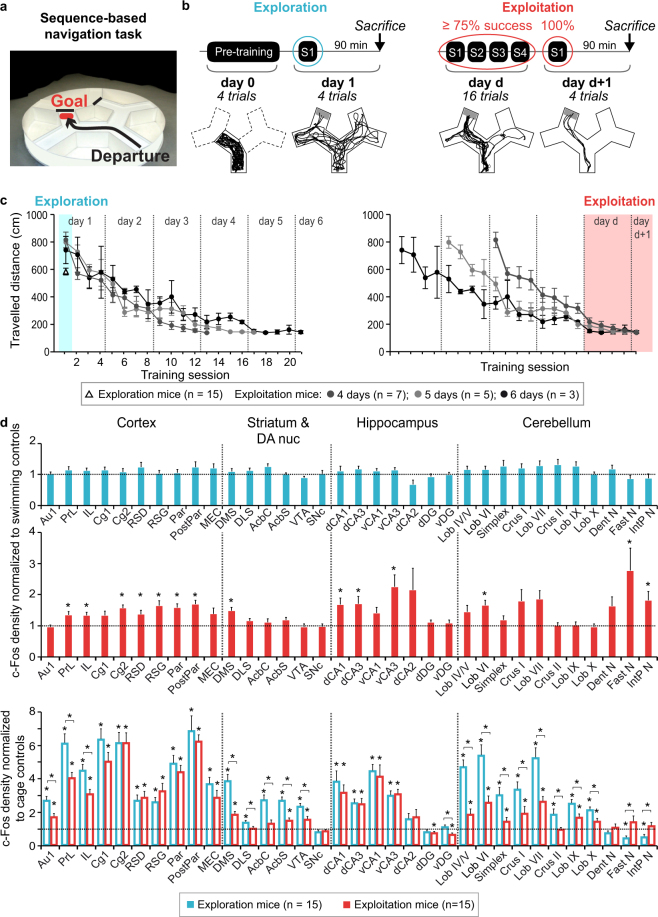
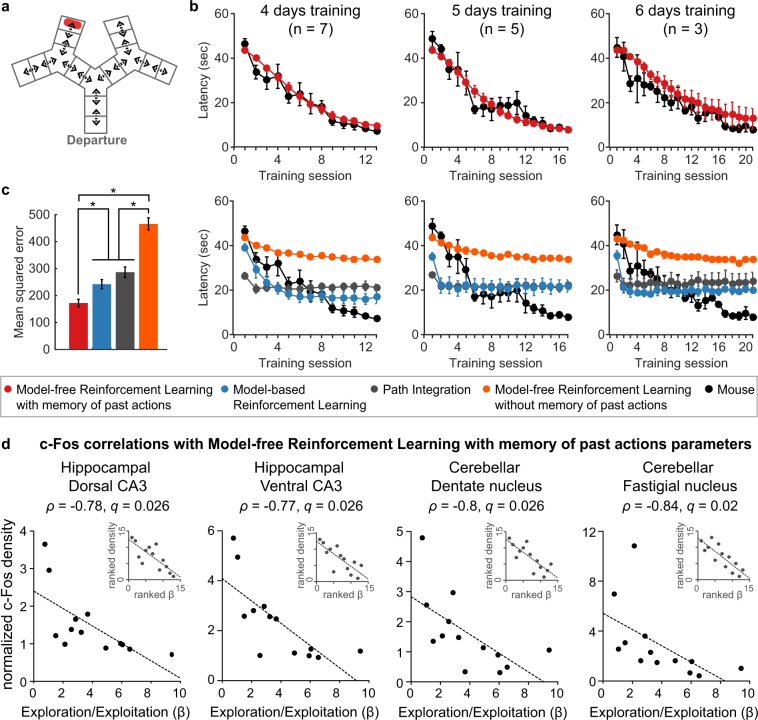
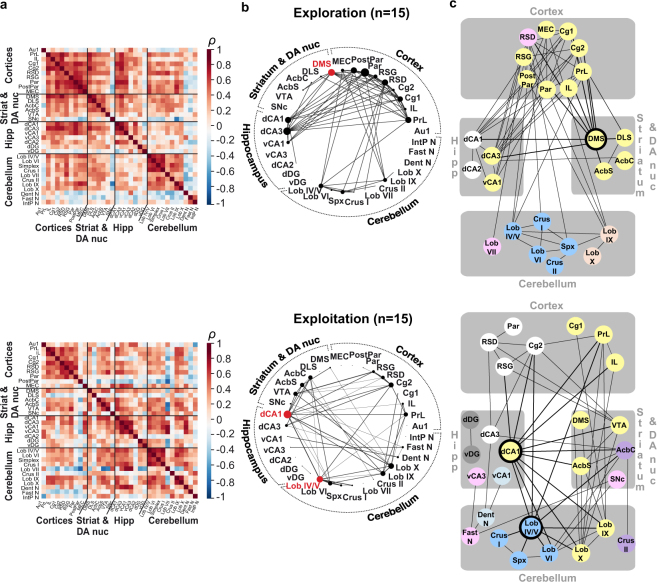
How do we translate self-motion into goal-directed actions? Here we investigate the cognitive architecture underlying self-motion processing during exploration and goal-directed behaviour. The task, performed in an environment with limited and ambiguous external landmarks, constrained mice to use self-motion based information for sequence-based navigation. The post-behavioural analysis combined brain network characterization based on c-Fos imaging and graph theory analysis as well as computational modelling of the learning process. The study revealed a widespread network centred around the cerebral cortex and basal ganglia during the exploration phase, while a network dominated by hippocampal and cerebellar activity appeared to sustain sequence-based navigation. The learning process could be modelled by an algorithm combining memory of past actions and model-free reinforcement learning, which parameters pointed toward a central role of hippocampal and cerebellar structures for learning to translate self-motion into a sequence of goal-directed actions.
我们如何将自身运动转化为目标导向的行为?在这里,我们研究了探索和目标导向行为期间自身运动处理的认知架构。该任务在一个外部地标有限且模糊的环境中进行,限制了老鼠使用基于自身运动的信息进行基于序列的导航。在行为后分析中,我们结合了基于 c-Fos 成像和图论分析的大脑网络特征以及学习过程的计算建模。该研究揭示了在探索阶段,一个以大脑皮层和基底神经节为中心的广泛网络,而一个以海马体和小脑活动为主的网络似乎维持着基于序列的导航。学习过程可以通过一种算法来建模,该算法结合了对过去行为的记忆和无模型的强化学习,其参数指向海马体和小脑结构在学习将自身运动转化为一系列目标导向行为方面的核心作用。