The Institute of Chemical Ecology & College of Plant Protection, Henan Agricultural University, Zhengzhou, 450002, China.
Hengyang Normal University, Hengyang, 421008, China.
Sci Rep. 2017 Dec 19;7(1):17876. doi: 10.1038/s41598-017-18244-7.
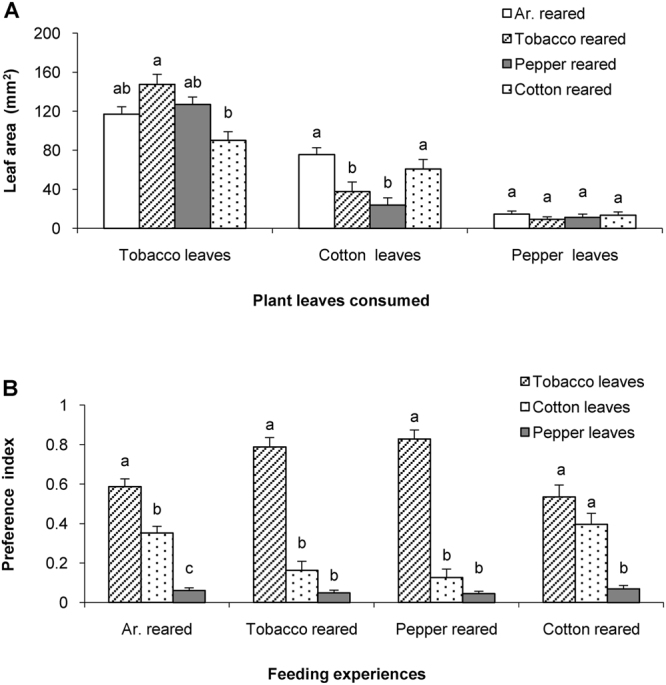
Herbivorous insects have been categorized as generalists or specialists depending on the taxonomic relatedness of the plants they use as food or oviposition substrates. The plasticity in host plant selection behavior of species belonging to the two categories received little attention. In the present work, fifth instar caterpillars of the generalist herbivore Helicoverpa armigera and its closely related species, the specialist Helicoverpa assulta, were fed on common host plants or artificial diet, after which their feeding preference was assessed individually by using dual - and triple- plant choice assays. Results show both the two Helicoverpa species have a preference hierarchy for host plants. Compared to the fixed preference hierarchy of the specialist H. assulta, the generalist H. armigera exhibited extensive plasticity in feeding preference depending on the host plant experienced during larval development. Whereas the specialist H. assulta exhibited a rigid preference in both dual and triple-plant choice assays, our findings demonstrate that the generalist H. armigera expressed stronger preferences in the dual-plant choice assay than in the triple-plant choice assay. Our results provide additional evidence supporting the neural constraints hypothesis which predicts that generalist herbivores make less accurate decisions than specialists when selecting plants.
植食性昆虫被分为广食性或专食性昆虫,这取决于它们作为食物或产卵基质的植物的分类学亲缘关系。然而,人们对属于这两类的物种在寄主植物选择行为上的可塑性关注甚少。在本研究中,使用双植物和三植物选择实验,评估了取食普通寄主植物或人工饲料的 5 龄幼虫对取食的偏好性。结果表明,两种烟夜蛾都对寄主植物有偏好等级。与专食性的 H. assulta 固定的偏好等级相比,广食性的 H. armigera 在幼虫发育过程中取食的寄主植物不同,其取食偏好表现出广泛的可塑性。而专食性的 H. assulta 在双植物和三植物选择实验中都表现出刚性偏好,我们的研究结果表明,广食性的 H. armigera 在双植物选择实验中比在三植物选择实验中表现出更强的偏好。我们的结果为神经约束假说提供了额外的证据,该假说预测,在选择植物时,广食性昆虫的决策准确性不如专食性昆虫。