Section of Gastroenterology, University of Pennsylvania Perelman School of Medicine, Philadelphia, PA 19104, United States.
Department of Gastroenterology, Drexel University College of Medicine, Philadelphia, PA 19102, United States.
World J Gastroenterol. 2017 Dec 7;23(45):8008-8016. doi: 10.3748/wjg.v23.i45.8008.
To evaluate the role of albumin at the time of ulcerative colitis (UC) diagnosis in predicting the clinical course of disease.
Nationwide cohort of patients with newly diagnosed UC in the Veterans Affairs health care system was identified and divided into two categories: hypoalbuminemia (., ≤ 3.5 gm/dL) or normal albumin levels (., > 3.5 gm/dL) at the time of UC diagnosis. The exposure of interest was presence of hypoalbuminemia defined as albumin level ≤ 3.5 g/dL at the time of UC diagnosis. Patients were then followed over time to identify the use of ≥ 2 courses of corticosteroids (CS), thiopurines, anti-TNF medications and requirement of colectomy for UC management.
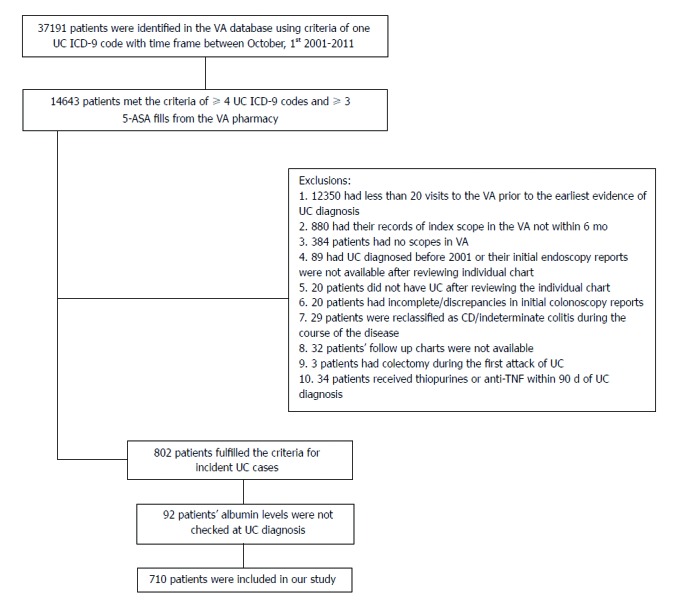
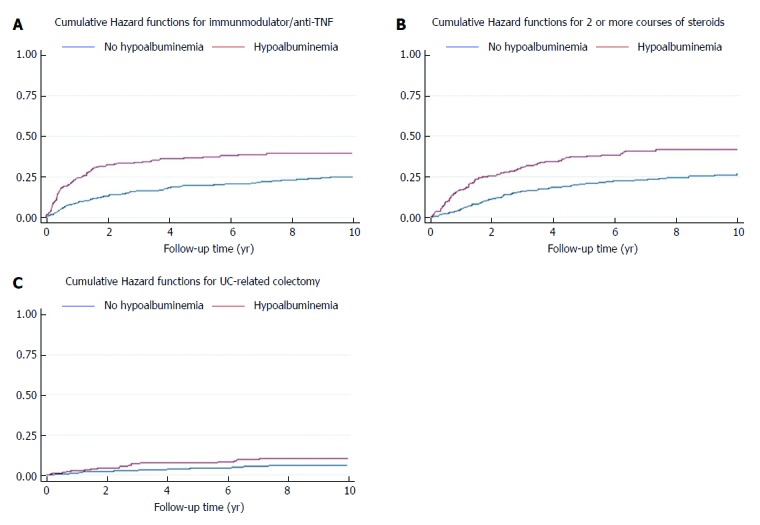
The eligible study cohort included 802 patients, but 92 (11.4%) patients did not have their albumin levels checked at the time of UC diagnosis, and they were excluded. A total of 710 patients, who had albumin levels checked at time of UC diagnosis, were included in our study. Amongst them, 536 patients had a normal albumin level and 174 patients had hypoalbuminemia. Patients with hypoalbuminemia at diagnosis had a higher likelihood of ≥ 2 courses of CS use (adjusted HR = 1.7, 95%CI: 1.3-2.3), higher likelihood of thiopurine or anti- TNF use (adjusted HR = 1.72, 95%CI: 1.23-2.40) than patients with normal albumin level at diagnosis. There was a trend of higher likelihood of colectomy in hypoalbuminemic patients, but it was not statistically significant (Adjusted HR = 1.7, 95%CI: 0.90-3.25).
Hypoalbuminemia at disease diagnosis can serve as a prognostic marker to predict the clinical course of UC at the time of diagnosis.
评估溃疡性结肠炎(UC)诊断时白蛋白的作用,以预测疾病的临床病程。
在退伍军人保健系统中确定了新诊断为 UC 的患者的全国性队列,并将其分为两类:在 UC 诊断时白蛋白水平低(即,≤3.5g/dL)或正常白蛋白水平(即,>3.5g/dL)。感兴趣的暴露因素是存在低白蛋白血症,定义为 UC 诊断时白蛋白水平≤3.5g/dL。然后,随着时间的推移对患者进行随访,以确定是否使用了≥2 个疗程的皮质类固醇(CS)、硫嘌呤、抗 TNF 药物以及是否需要进行 UC 管理的结肠切除术。
合格的研究队列包括 802 名患者,但有 92 名(11.4%)患者在 UC 诊断时没有检查白蛋白水平,因此被排除在外。共有 710 名在 UC 诊断时检查过白蛋白水平的患者被纳入我们的研究。其中,536 名患者白蛋白水平正常,174 名患者低白蛋白血症。在诊断时存在低白蛋白血症的患者更有可能使用≥2 个疗程的 CS(调整后的 HR=1.7,95%CI:1.3-2.3),更有可能使用硫嘌呤或抗 TNF(调整后的 HR=1.72,95%CI:1.23-2.40)比诊断时白蛋白水平正常的患者。低白蛋白血症患者行结肠切除术的可能性更高,但无统计学意义(调整后的 HR=1.7,95%CI:0.90-3.25)。
在疾病诊断时出现低白蛋白血症可以作为预测 UC 诊断时临床病程的预后标志物。