Nakayamada Shingo, Tanaka Yoshiya
The First Department of Internal Medicine, School of Medicine, University of Occupational and Environmental Health, 1-1 Iseigaoka, Yahata-nishi, Kitakyushu, 807-8555 Japan.
Inflamm Regen. 2016 Jul 21;36:6. doi: 10.1186/s41232-016-0015-4. eCollection 2016.
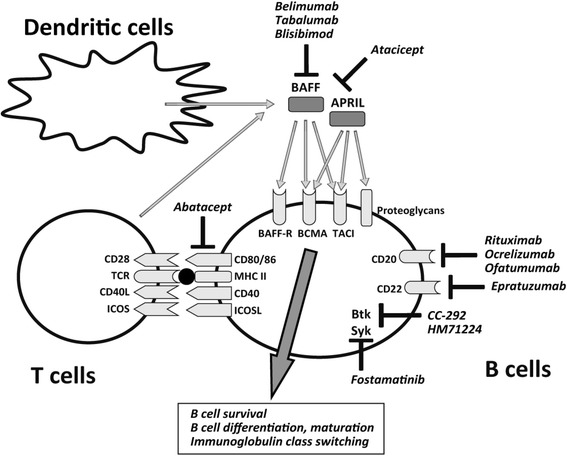
B cells play a pivotal role in autoimmunity not only by producing pathogenic autoantibodies but also by modulating immune responses via the production of cytokines and chemokines. The B cell-activating factor/a proliferation-inducing ligand (BAFF/APRIL) system promotes B cell survival and differentiation and thus plays a prominent role in the pathogenesis of autoimmune diseases. Currently, BAFF and APRIL inhibitors are in clinical trials for systemic lupus erythematosus with significant efficacy. However, several studies have demonstrated the efficacy of the BAFF/APRIL blockade which showed considerable variability in the response to B cell-targeted therapy. This may indicate substantial heterogeneity in the pathogenesis of autoimmune diseases. Therefore, objective markers that can predict the effect of BAFF/APRIL-blocking agents could be valuable to the precision medicine linked clinically and to cost-effective therapy.
B细胞在自身免疫中起关键作用,不仅通过产生致病性自身抗体,还通过产生细胞因子和趋化因子来调节免疫反应。B细胞激活因子/增殖诱导配体(BAFF/APRIL)系统促进B细胞存活和分化,因此在自身免疫性疾病的发病机制中起重要作用。目前,BAFF和APRIL抑制剂正在系统性红斑狼疮的临床试验中,疗效显著。然而,多项研究证明了BAFF/APRIL阻断的疗效,显示出对B细胞靶向治疗的反应存在相当大的变异性。这可能表明自身免疫性疾病发病机制存在实质性异质性。因此,能够预测BAFF/APRIL阻断剂效果的客观标志物对于临床相关的精准医学和具有成本效益的治疗可能具有重要价值。