Kamo Takehiro, Akazawa Hiroshi, Suzuki Jun-Ichi, Komuro Issei
Department of Cardiovascular Medicine, Graduate School of Medicine, The University of Tokyo, 7-3-1 Hongo, Bunkyo-ku, Tokyo, 113-8655 Japan.
AMED-CREST, Japan Agency for Medical Research and Development, Chiyoda-ku, Tokyo, 100-0004 Japan.
Inflamm Regen. 2016 Aug 9;36:12. doi: 10.1186/s41232-016-0018-1. eCollection 2016.
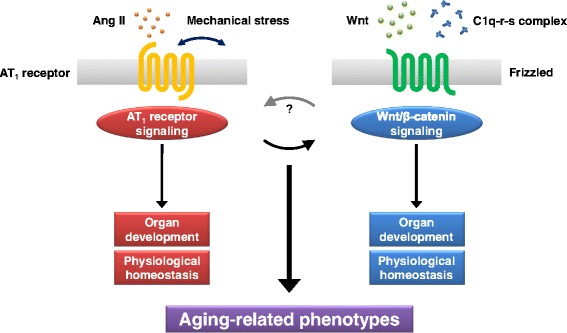
The renin-angiotensin system (RAS) regulates diverse cellular responses and is crucial for normal organ development and function. On the other hand, RAS exerts deleterious effects promoting cardiovascular and multiple organ damage and contributes to promoting various aging-related diseases and aging-related decline in multiple organ functions. RAS blockade has been shown to prevent the progression of aging-related phenotypes and promote longevity. Wnt signaling pathway also plays a major role in the regulation of mammalian pathophysiology and is essential for organismal survival, and furthermore, it is substantially involved in the promotion of aging process. In this way, both RAS signaling and Wnt signaling have the functions of antagonistic pleiotropy during the process of growth and aging. Our recent study has demonstrated that an anti-aging effect of RAS blockade is associated with down-regulation of canonical Wnt signaling pathway, providing evidence for the hierarchical relationship between RAS signaling and Wnt signaling in promoting aging-related phenotypes. Here, we review how RAS signaling and Wnt signaling regulate the aging process and promote aging-related diseases.
肾素-血管紧张素系统(RAS)调节多种细胞反应,对正常器官发育和功能至关重要。另一方面,RAS会产生有害作用,促进心血管和多器官损伤,并导致多种与衰老相关的疾病以及多器官功能与衰老相关的衰退。已证明RAS阻断可防止与衰老相关表型的进展并促进长寿。Wnt信号通路在哺乳动物病理生理学调节中也起主要作用,对机体存活至关重要,此外,它还大量参与衰老过程的促进。这样,在生长和衰老过程中,RAS信号和Wnt信号都具有拮抗性多效性的功能。我们最近的研究表明,RAS阻断的抗衰老作用与经典Wnt信号通路的下调有关,为RAS信号和Wnt信号在促进与衰老相关表型中的层级关系提供了证据。在此,我们综述RAS信号和Wnt信号如何调节衰老过程并促进与衰老相关的疾病。