Yasui Takazumi, Mabuchi Yo, Morikawa Satoru, Onizawa Katsuhiro, Akazawa Chihiro, Nakagawa Taneaki, Okano Hideyuki, Matsuzaki Yumi
Department of Dentistry and Oral Surgery, Keio University School of Medicine, 35 Shinanomachi, Shinjuku-ku, Tokyo, 160-8582 Japan.
Department of Physiology, Keio University School of Medicine, 35 Shinanomachi, Shinjuku-ku, Tokyo, 160-8582 Japan.
Inflamm Regen. 2017 Apr 10;37:8. doi: 10.1186/s41232-017-0039-4. eCollection 2017.
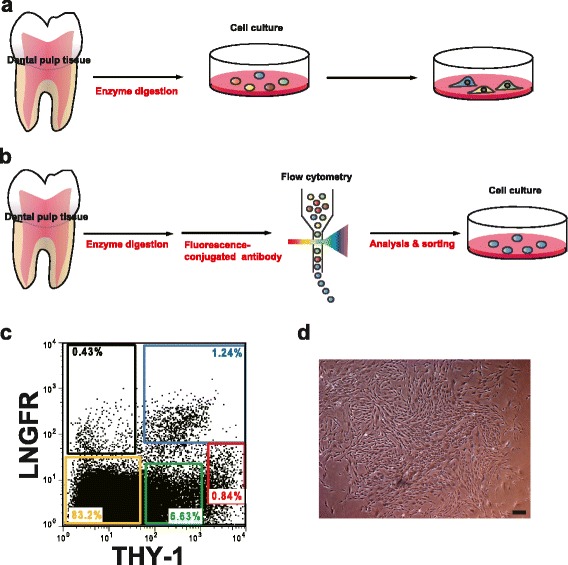
Dental pulp stem cells/progenitor cells (DPSCs) can be easily obtained and can have excellent proliferative and mineralization potentials. Therefore, many studies have investigated the isolation and bone formation of DPSCs. In most previous reports, human DPSCs were traditionally isolated by exploiting their ability to adhere to plastic tissue culture dishes. DPSCs isolated by plastic adherence are frequently contaminated by other cells, which limits the ability to investigate their basic biology and regenerative properties. Additionally, the proliferative and osteogenic potentials vary depending on the isolated cells. It is very difficult to obtain cells of a sufficient quality to elicit the required effect upon transplantation. Considering clinical applications, stem cells used for regenerative medicine need to be purified in order to increase the efficiency of bone regeneration, and a stable supply of these cells must be generated. Here, we review the purification of DPSCs and studies of cranio-maxillofacial bone regeneration using these cells. Additionally, we introduce the prospective isolation of DPSCs using specific cell surface markers: low-affinity nerve growth factor and thymocyte antigen 1.
牙髓干细胞/祖细胞(DPSCs)易于获取,且具有出色的增殖和矿化潜能。因此,许多研究都对DPSCs的分离及骨形成进行了探究。在大多数先前的报道中,传统上是利用人DPSCs附着于塑料组织培养皿的能力来进行分离。通过塑料贴壁法分离的DPSCs经常会被其他细胞污染,这限制了对其基本生物学特性和再生特性的研究能力。此外,增殖和成骨潜能会因分离出的细胞而异。很难获得足够质量的细胞以在移植时产生所需的效果。考虑到临床应用,用于再生医学的干细胞需要进行纯化,以提高骨再生效率,并且必须确保这些细胞的稳定供应。在此我们综述了DPSCs的纯化以及使用这些细胞进行颅颌面骨再生的研究。此外,我们介绍了利用特定细胞表面标志物:低亲和力神经生长因子和胸腺细胞抗原1对DPSCs进行前瞻性分离的方法。