Sun Jianguo, Zheng Hui, Qin Xiuxia, Qi Liqin
People's Hospital of Rizhaolanshan, Rizhao, Shandong, PR China.
People's Hospital of Wulian, Rizhao, Shandong, PR China.
Iran J Public Health. 2017 Dec;46(12):1632-1638.
This study was designed to explore the correlation of connective tissue growth factor (CTGF), heme oxygenase (HO-1), neurotrophic factors (NT-3) with type 2 diabetic peripheral neuropathy, as well as the changes after immune cytokine alone and combined with cattleencephalon glycoside and ignotin treatment.
Seventy-six patients with type 2 diabetes and peripheral neuropathy charged into People's Hospital of Rizhaolanshan, China from 2014-2016 were selected. The severity of neuropathy was evaluated by TCSS. Pearson analysis was used to analyze the correlation between the degree of neuropathy and CTGF, HO-1 and NT-3. The patients were randomly divided into control group and observation group, n=38. The control group accepted TGF-β1 treatment on the basis of controlling diet and blood sugar, while the observation group was treated with cattle encephalon glycoside and ignotin injection on the basis of control group. CTGF, HO-1, NT-3 concentration in the blood and nerve conductive velocity (NCV) were detected and analyzed before and after treatment.
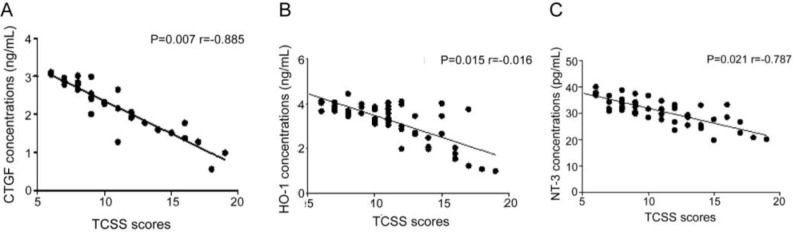
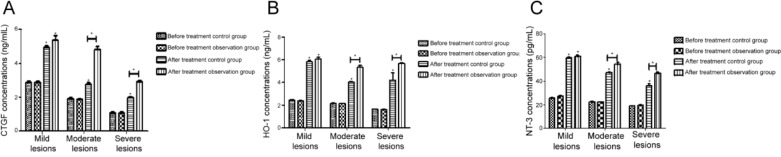
CTGF(r=-0.865), HO-1(r=-0.706), NT-3(r=-0.587) was negatively correlated with TCSS scores. After treatment, the concentrations of CTGF, HO-1and NT-3 in the observation group were higher than the control group (<0.05). In moderate and severe lesions, the concentrations of CTGF, HO-1and NT-3 in the observation group were higher than the control group (<0.05). The conduction velocity of nerve increased with the increase of CTGF, HO-1 and NT-3 concentrations. The obvious effective rate and total effective rate of observation group were both higher than the control group.
Immune cytokine TGF-β1 combined with cattle encephalon glycoside and ignotin injection could improve the contents of CTGF, HO-1 and NT-3, and be better to treat the peripheral neuropathy of type 2 diabetes.
本研究旨在探讨结缔组织生长因子(CTGF)、血红素加氧酶(HO-1)、神经营养因子(NT-3)与2型糖尿病周围神经病变的相关性,以及单独免疫细胞因子和联合脑苷肌肽治疗后的变化。
选取2014年至2016年入住日照岚山人民医院的76例2型糖尿病合并周围神经病变患者。采用多伦多临床评分系统(TCSS)评估神经病变的严重程度。采用Pearson分析方法分析神经病变程度与CTGF、HO-1和NT-3之间的相关性。将患者随机分为对照组和观察组,每组38例。对照组在控制饮食和血糖的基础上接受TGF-β1治疗,观察组在对照组基础上给予脑苷肌肽注射液治疗。检测并分析治疗前后血液中CTGF、HO-1、NT-3浓度及神经传导速度(NCV)。
CTGF(r=-0.865)、HO-1(r=-0.706)、NT-3(r=-0.587)与TCSS评分呈负相关。治疗后,观察组CTGF、HO-1和NT-3浓度高于对照组(P<0.05)。在中度和重度病变中,观察组CTGF、HO-1和NT-3浓度高于对照组(P<0.05)。神经传导速度随CTGF、HO-1和NT-3浓度的升高而增加。观察组的显效率和总有效率均高于对照组。
免疫细胞因子TGF-β1联合脑苷肌肽注射液可提高CTGF、HO-1和NT-3的含量,对2型糖尿病周围神经病变有较好的治疗效果。