Department of the Environment, University of the Aegean, Mytilene 81100, Greece.
Institute of Biodiversity, Animal Health & Comparative Medicine, University of Glasgow, Glasgow G12 8QQ, Scotland, United Kingdom.
Proc Natl Acad Sci U S A. 2018 Jan 23;115(4):738-743. doi: 10.1073/pnas.1705944115. Epub 2017 Dec 20.
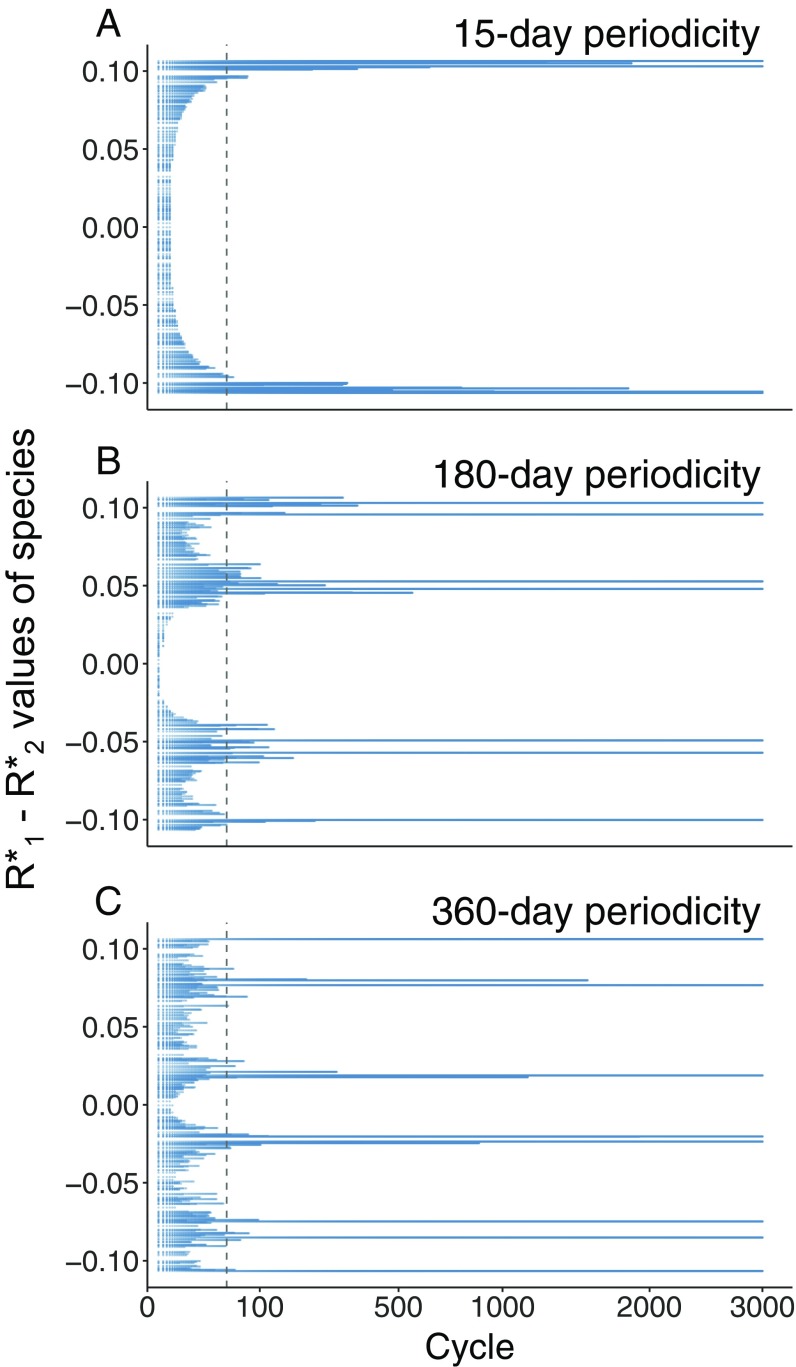
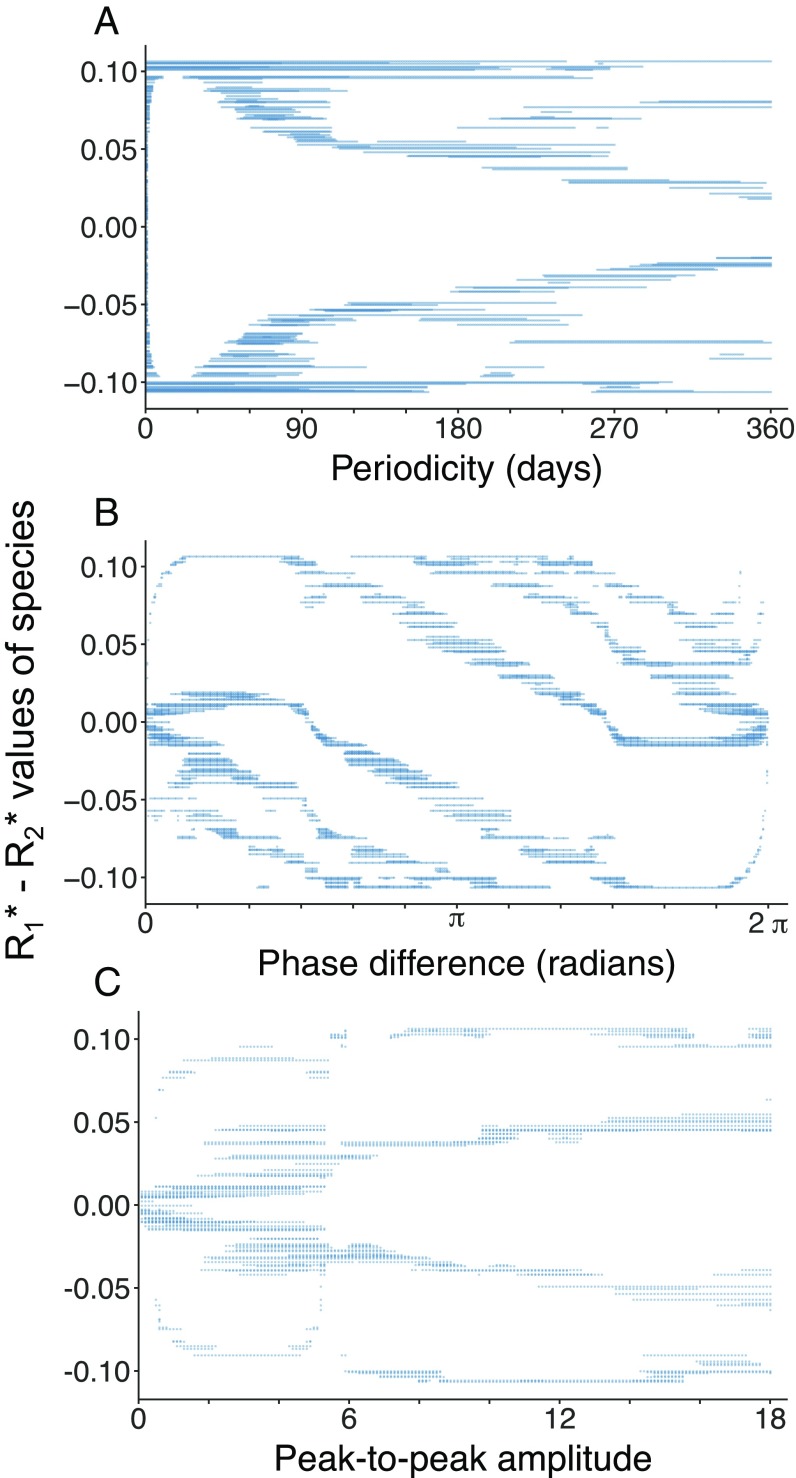
The effect of life-history traits on resource competition outcomes is well understood in the context of a constant resource supply. However, almost all natural systems are subject to fluctuations of resources driven by cyclical processes such as seasonality and tidal hydrology. To understand community composition, it is therefore imperative to study the impact of resource fluctuations on interspecies competition. We adapted a well-established resource-competition model to show that fluctuations in inflow concentrations of two limiting resources lead to the survival of species in clumps along the trait axis, consistent with observations of "lumpy coexistence" [Scheffer M, van Nes EH (2006) 103:6230-6235]. A complex dynamic pattern in the available ambient resources arose very early in the self-organization process and dictated the locations of clumps along the trait axis by creating niches that promoted the growth of species with specific traits. This dynamic pattern emerged as the combined result of fluctuations in the inflow of resources and their consumption by the most competitive species that accumulated the bulk of biomass early in assemblage organization. Clumps emerged robustly across a range of periodicities, phase differences, and amplitudes. Given the ubiquity in the real world of asynchronous fluctuations of limiting resources, our findings imply that assemblage organization in clumps should be a common feature in nature.
在资源供应稳定的情况下,人们对生物生活史特征如何影响资源竞争结果有了很好的理解。然而,几乎所有的自然系统都受到周期性过程(如季节性和潮汐水文学)驱动的资源波动的影响。为了了解群落组成,因此必须研究资源波动对种间竞争的影响。我们改编了一个成熟的资源竞争模型,表明两种限制资源的流入浓度波动会导致物种沿着特征轴聚集生存,这与“块状共存”的观察结果一致[Scheffer M, van Nes EH (2006) 103:6230-6235]。在自组织过程的早期,可用环境资源中就出现了复杂的动态模式,通过创造有利于具有特定特征的物种生长的小生境,决定了聚集体在特征轴上的位置。这种动态模式是资源流入波动及其被早期在组合组织中积累了大部分生物量的最具竞争力的物种消耗的综合结果。在各种周期、相位差和幅度下,聚集体都能稳定地出现。鉴于在现实世界中限制资源的异步波动普遍存在,我们的发现意味着块状聚集的组合组织应该是自然界的一个共同特征。