Al-Salameh Abdallah, Becquemont Laurent, Brailly-Tabard Sylvie, Aubourg Patrick, Chanson Philippe
Assistance Publique-Hôpitaux de Paris, Hôpitaux Universitaires Paris-Sud, Hôpital de Bicêtre, Service d'Endocrinologie et des Maladies de la Reproduction, Le Kremlin Bicêtre, F-94275, France.
Assistance Publique-Hôpitaux de Paris, Hôpitaux Universitaires Paris-Sud, Hôpital de Bicêtre, Département de Pharmacologie Clinique, Le Kremlin Bicêtre, F-94275, France.
J Endocr Soc. 2017 Mar 23;1(5):431-435. doi: 10.1210/js.2017-00054. eCollection 2017 May 1.
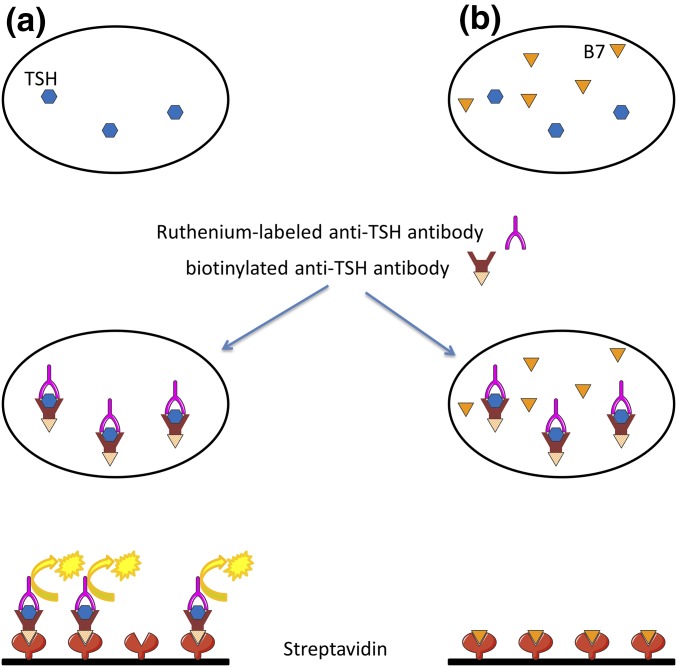
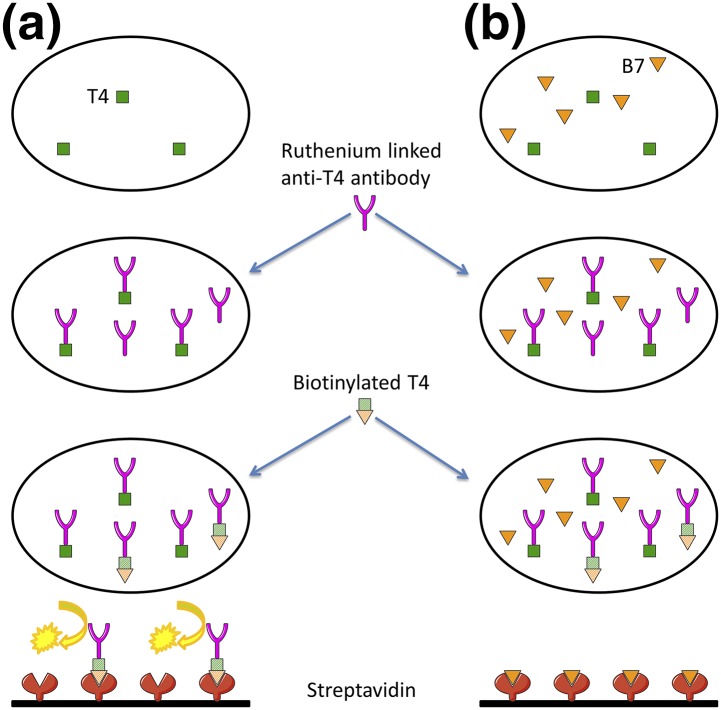
Accurate measurements of circulating hormones is essential for the practice of endocrinology. Immunometric assays employing the streptavidin-biotin system are widely used to measure hormones. However, these assays are susceptible to interference in patients taking biotin supplementations. This interference could mimic a coherent hormone profile, leading to misdiagnosis and unnecessary treatment.
The patient, a 32-year-old man with X-linked adrenomyeloneuropathy recently diagnosed with Graves disease, was referred to our department to evaluate his response to antithyroid drugs. His thyroid function tests were still consistent with hyperthyroidism while he had been receiving carbimazole 40 mg/d for 6 weeks. We found no signs of thyrotoxicosis on physical examination despite the "frank and severe" biochemical hyperthyroidism. Noticing that all the patient's assays had been done at the same laboratory, we suspected assay interference. We therefore repeated the thyroid function tests at our hospital laboratory, which uses a different assay platform. Surprisingly, all the results were normal, confirming assay interference. The patient was taking an investigational "vitamin" therapy, which turned out to be biotin, prescribed at a dose of 100 mg tid as part of a trial of high-dose biotin in X-linked adrenomyeloneuropathy.
This case should encourage physicians to ask their patients about possible biotin intake, especially when laboratory results are not compatible with clinical findings. If biotin interference is suspected, we propose either using a different assay not based on the streptavidin-biotin system or repeating the analyses after stopping biotin supplementation for one week.
准确测量循环激素对于内分泌学实践至关重要。采用链霉亲和素-生物素系统的免疫测定法被广泛用于测量激素。然而,这些测定法在服用生物素补充剂的患者中易受干扰。这种干扰可能会模拟出连贯的激素谱,导致误诊和不必要的治疗。
该患者为一名32岁男性,患有X连锁肾上腺脑白质营养不良,近期被诊断为格雷夫斯病,转诊至我科评估其对抗甲状腺药物的反应。在他接受40mg/d卡比马唑治疗6周后,其甲状腺功能检查仍与甲状腺功能亢进相符。尽管有“明显且严重”的生化性甲状腺功能亢进,但我们在体格检查中未发现甲状腺毒症的迹象。注意到该患者所有的检测均在同一实验室进行,我们怀疑存在检测干扰。因此,我们在我院实验室重复了甲状腺功能检查,该实验室使用不同的检测平台。令人惊讶的是,所有结果均正常,证实了检测干扰。该患者正在接受一种试验性“维生素”治疗,结果发现是生物素,作为X连锁肾上腺脑白质营养不良高剂量生物素试验的一部分,剂量为每日三次,每次100mg。
该病例应促使医生询问患者是否可能摄入生物素,尤其是当实验室结果与临床发现不相符时。如果怀疑存在生物素干扰,我们建议要么使用不基于链霉亲和素-生物素系统的不同检测方法,要么在停止生物素补充一周后重复分析。