Knutsen Kirsten V, Madar Ahmed A, Brekke Mette, Meyer Haakon E, Eggemoen Åse Ruth, Mdala Ibrahimu, Lagerløv Per
Department of General Practice, Institute of Health and Society, University of Oslo, 0318 Oslo, Norway.
Department of Community Medicine and Global Health, Institute of Health and Society, University of Oslo, 0318 Oslo, Norway.
J Endocr Soc. 2017 Apr 11;1(5):470-479. doi: 10.1210/js.2017-00037. eCollection 2017 May 1.
Autoimmune thyroid disorders have been linked to vitamin D deficiency, but an effect of vitamin D supplementation is not established.
Our objective was to test whether vitamin D compared with placebo could reduce thyroid autoantibodies.
Predefined additional analyses from a randomized, double-blind, placebo-controlled trial.
The study was conducted in different community centers in Oslo, Norway.
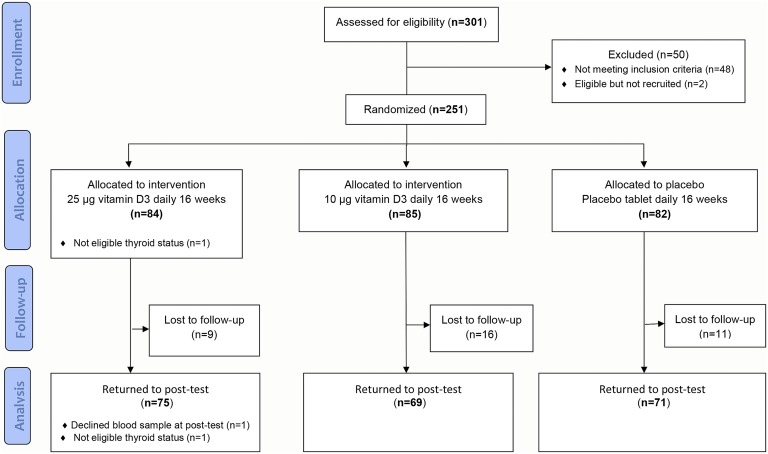
A total of 251 presumed healthy men and women, aged 18 to 50 years, with backgrounds from South Asia, the Middle East, and Africa were included.
Daily supplementation with 25 µg (1000 IU) vitamin D, 10 µg (400 IU) vitamin D, or placebo for 16 weeks.
Difference in preintervention and postintervention antithyroid peroxidase antibody (TPOAb) levels. Additional outcomes were differences in thyroid-stimulating hormone (TSH) and free fraction of thyroxine (fT4).
There were no differences in change after 16 weeks on TPOAb (27 kU/L; 95% CI, -17 to 72; = 0.23), TSH (-0.10 mU/L; 95% CI, -0.54 to 0.34; = 0.65), or fT4 (0.09 pmol/L; 95% CI, -0.37 to 0.55; = 0.70) between those receiving vitamin D supplementation or placebo. Mean serum 25(OH)D increased from 26 to 49 nmol/L in the combined supplementation group, but there was no change in the placebo group.
Vitamin D supplementation, 25 µg or 10 µg, for 16 weeks compared with placebo did not affect TPOAb level in this randomized, double-blind study among participants with backgrounds from South Asia, the Middle East, and Africa who had low vitamin D levels at baseline.
自身免疫性甲状腺疾病与维生素D缺乏有关,但维生素D补充剂的效果尚未确定。
我们的目的是测试维生素D与安慰剂相比是否能降低甲状腺自身抗体。
来自一项随机、双盲、安慰剂对照试验的预定义附加分析。
该研究在挪威奥斯陆的不同社区中心进行。
共纳入251名年龄在18至50岁之间、来自南亚、中东和非洲的假定健康男性和女性。
每日补充25μg(1000IU)维生素D、10μg(400IU)维生素D或安慰剂,持续16周。
干预前后抗甲状腺过氧化物酶抗体(TPOAb)水平的差异。其他观察指标包括促甲状腺激素(TSH)和甲状腺素游离部分(fT4)的差异。
在接受维生素D补充剂或安慰剂的人群中,16周后TPOAb(27kU/L;95%CI,-17至72;P = 0.23)、TSH(-0.10mU/L;95%CI,-0.54至0.34;P = 0.65)或fT4(0.09pmol/L;95%CI,-0.37至0.55;P = 0.70)的变化没有差异。联合补充组的平均血清25(OH)D从26nmol/L增加到49nmol/L,但安慰剂组没有变化。
在这项针对基线维生素D水平较低、来自南亚、中东和非洲的参与者的随机双盲研究中,与安慰剂相比,补充25μg或10μg维生素D 16周并未影响TPOAb水平。