Department of Pulmonary & Critical Care Medicine, West China Hospital of Sichuan University, Chengdu, 610041, Sichuan Province, People's Republic of China.
Clinical Laboratory Department, Sichuan Academy of Medical Sciences & Sichuan Provincial People's Hospital, Affiliated Hospital of University of Electronic Science and Technology of China, Chengdu, 610072, Sichuan Province, People's Republic of China.
BMC Cancer. 2017 Dec 21;17(1):882. doi: 10.1186/s12885-017-3893-1.
The neutrophil-to-lymphocyte ratio (NLR) and platelet-to-lymphocyte ratio (PLR) are easily obtained from routine blood tests. We investigated the associations of the NLR and PLR with the clinical parameters and prognoses of small cell lung cancer (SCLC) patients.
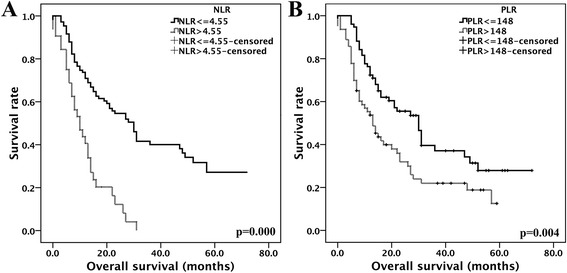
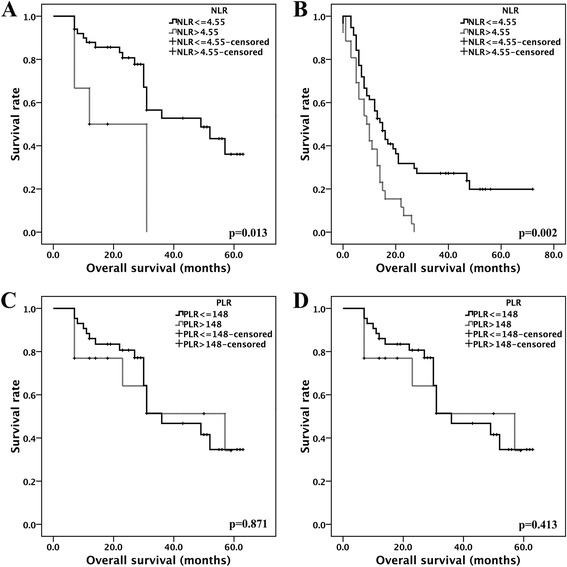
Pre-treatment clinical and laboratory data from 139 patients with SCLC were retrospectively studied with univariate analyses. The NLR and PLR values were divided into two separate groups: high NLR (>4.55, n = 32) vs low NLR (≤4.55, n = 107) and high PLR (>148, n = 63) vs low PLR (≤148, n = 76). Kaplan-Meier survival analyses and Cox proportional hazard models were used to examine the effects of NLR and PLR on overall survival.
Chi-square analyses revealed significant associations of high NLR with tumour stage, hepatic metastasis, radiotherapy and chemotherapy and significant associations of high PLR with tumour stage, bone and hepatic metastases, exposure to cooking oil fumes, and chemotherapy. Mann-Whitney U tests demonstrated an association of high NLR with smoking exposure, and high NLR and high PLR were correlated with several laboratory parameters. Kaplan-Meier analyses revealed that high NLR and high PLR conferred poor prognoses for SCLC patients. Moreover, multivariate analysis demonstrated that NLR, tumour stage, and hepatic metastasis were independent prognostic factors for survival. In this study, we found that NLR and PLR were associated with several factors that reflect the inflammatory (white blood cell count, WBC; lactate dehydrogenase, LDH) and nutritional (albumin, ALB; haemoglobin, HB; and cholesterol) status of SCLC patients at diagnosis.
NLR is an independent prognostic factor and can be used to predict the mortality risk of SCLC patients.
中性粒细胞与淋巴细胞比值(NLR)和血小板与淋巴细胞比值(PLR)可通过常规血液检查轻易获得。我们研究了 NLR 和 PLR 与小细胞肺癌(SCLC)患者临床参数和预后的相关性。
回顾性分析了 139 例 SCLC 患者的治疗前临床和实验室数据,并进行了单因素分析。将 NLR 和 PLR 值分为两组:高 NLR(>4.55,n=32)与低 NLR(≤4.55,n=107)和高 PLR(>148,n=63)与低 PLR(≤148,n=76)。使用 Kaplan-Meier 生存分析和 Cox 比例风险模型来研究 NLR 和 PLR 对总生存期的影响。
卡方检验显示,高 NLR 与肿瘤分期、肝转移、放疗和化疗显著相关,高 PLR 与肿瘤分期、骨和肝转移、接触油烟以及化疗显著相关。Mann-Whitney U 检验显示,高 NLR 与吸烟暴露显著相关,高 NLR 和高 PLR 与多个实验室参数相关。Kaplan-Meier 分析表明,高 NLR 和高 PLR 预示着 SCLC 患者预后不良。此外,多变量分析表明,NLR、肿瘤分期和肝转移是生存的独立预后因素。在这项研究中,我们发现 NLR 和 PLR 与反映 SCLC 患者炎症(白细胞计数、LDH)和营养状况(白蛋白、ALB、血红蛋白、HB 和胆固醇)的多个因素相关。
NLR 是一个独立的预后因素,可以用来预测 SCLC 患者的死亡风险。