Luz-Santos Cleber, Ribeiro Camatti Janine, Barbosa Paixão Alaí, Nunes Sá Katia, Montoya Pedro, Lee Michael, Fontes Baptista Abrahão
Functional Electrostimulation Laboratory, Health Sciences Institute, Federal University of Bahia, Salvador, Brazil.
Graduate Program in Medicine and Health, Faculty of Medicine, Federal University of Bahia, Salvador, Brazil.
Trials. 2017 Dec 21;18(1):609. doi: 10.1186/s13063-017-2332-6.
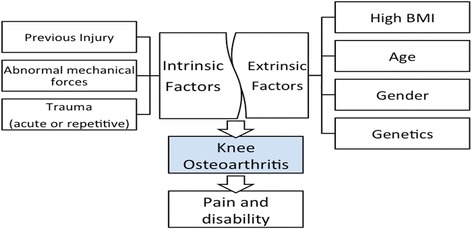
Knee osteoarthritis (OA) has been linked to maladaptive plasticity in the brain, which may contribute to chronic pain. Neuromodulatory approaches, such as Transcranial Direct Current Stimulation (tDCS) and Peripheral Electrical Stimulation (PES), have been used therapeutically to counteract brain maladaptive plasticity. However, it is currently unclear whether these neuromodulatory techniques enhance the benefits of exercise when administered together. Therefore, this protocol aims to investigate whether the addition of tDCS combined or not with PES enhances the effects of a land-based strengthening exercise program in patients with knee OA.
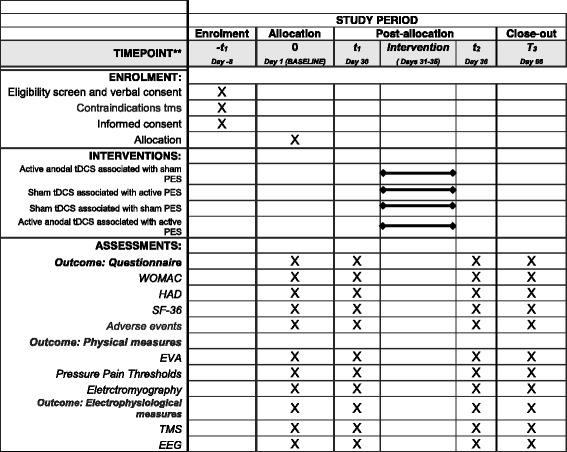
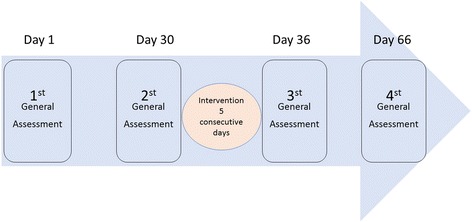
Patients with knee OA (n = 80) will undertake a structured exercise program for five consecutive days. In addition, they will be randomized into four subgroups receiving either active anodal tDCS and sham PES (group 1; n = 20), sham tDCS and active PES (group 2, n = 20), sham tDCS and PES (group 3, n = 20), or active tDCS and PES (group 4, n = 20) for 20 min/day for five consecutive days just prior to commencement of the exercise program. The primary outcomes will be subjective pain intensity (VAS) and related function (WOMAC). Secondary outcomes will include quality of life (SF-36), anxiety and depression symptoms (HAD), self-perception of improvement, pressure pain thresholds over the knee, quadriceps strength, and quadriceps electromyographic activity during maximum knee extension voluntary contraction. We will also investigate cortical excitability using transcranial magnetic stimulation. Outcome measures will be assessed at baseline, 1 month after, before any intervention, after 5 days of intervention, and at 1 month post exercise intervention.
The motor cortex becomes less responsive in knee OA because of poorly adapted plastic changes, which can impede exercise therapy benefits. Adding tDCS and/or PES may help to counteract those maladaptive plastic changes and improve the benefits of exercises, and the combination of both neuromodulatory techniques must have a higher magnitude of effect.
Brazilian Registry on Clinical Trials (ReBEC) - Effects of electrical stimulation over the skull and tight together with exercises for knee OA; protocol number RBR-9D7C7B.
ID: RBR-9D7C7B . Registered on 29 February 2016.
膝关节骨关节炎(OA)与大脑中的适应性不良可塑性有关,这可能导致慢性疼痛。神经调节方法,如经颅直流电刺激(tDCS)和外周电刺激(PES),已被用于治疗以对抗大脑适应性不良可塑性。然而,目前尚不清楚这些神经调节技术联合使用时是否能增强运动的益处。因此,本方案旨在研究添加tDCS联合或不联合PES是否能增强陆地强化运动计划对膝关节OA患者的效果。
膝关节OA患者(n = 80)将连续五天进行结构化运动计划。此外,他们将被随机分为四个亚组,分别接受主动阳极tDCS和假PES(第1组;n = 20)、假tDCS和主动PES(第2组,n = 20)、假tDCS和假PES(第3组,n = 20)或主动tDCS和PES(第4组,n = 20),在运动计划开始前连续五天每天进行20分钟。主要结局将是主观疼痛强度(视觉模拟评分法[VAS])和相关功能(西安大略和麦克马斯特大学骨关节炎指数[WOMAC])。次要结局将包括生活质量(36项简短健康调查[SF - 36])、焦虑和抑郁症状(医院焦虑抑郁量表[HAD])、自我改善认知、膝关节压力疼痛阈值、股四头肌力量以及最大膝关节伸展自主收缩时股四头肌肌电图活动。我们还将使用经颅磁刺激研究皮质兴奋性。结局指标将在基线、干预前、干预5天后、运动干预后1个月以及任何干预前1个月进行评估。
由于适应性不良的可塑性变化,膝关节OA患者的运动皮层反应性降低,这可能会阻碍运动疗法的益处。添加tDCS和/或PES可能有助于对抗这些适应性不良的可塑性变化并改善运动的益处,并且两种神经调节技术的联合使用必定具有更大的效果。
巴西临床试验注册中心(ReBEC) - 颅骨电刺激与膝关节OA运动联合的效果;方案编号RBR - 9D7C7B。
标识符:RBR - 9D7C7B。于2016年2月29日注册。