Thorn Simon, Bässler Claus, Brandl Roland, Burton Philip J, Cahall Rebecca, Campbell John L, Castro Jorge, Choi Chang-Yong, Cobb Tyler, Donato Daniel C, Durska Ewa, Fontaine Joseph B, Gauthier Sylvie, Hebert Christian, Hothorn Torsten, Hutto Richard L, Lee Eun-Jae, Leverkus Alexandro B, Lindenmayer David B, Obrist Martin K, Rost Josep, Seibold Sebastian, Seidl Rupert, Thom Dominik, Waldron Kaysandra, Wermelinger Beat, Winter Maria-Barbara, Zmihorski Michal, Müller Jörg
Field Station Fabrikschleichach, Department of Animal Ecology and Tropical Biology (Zoology III), Julius-Maximilians-University Würzburg, Rauhenebrach, Germany.
Bavarian Forest National Park, Grafenau, Germany.
J Appl Ecol. 2018 Jan;55(1):279-289. doi: 10.1111/1365-2664.12945. Epub 2017 Jul 5.
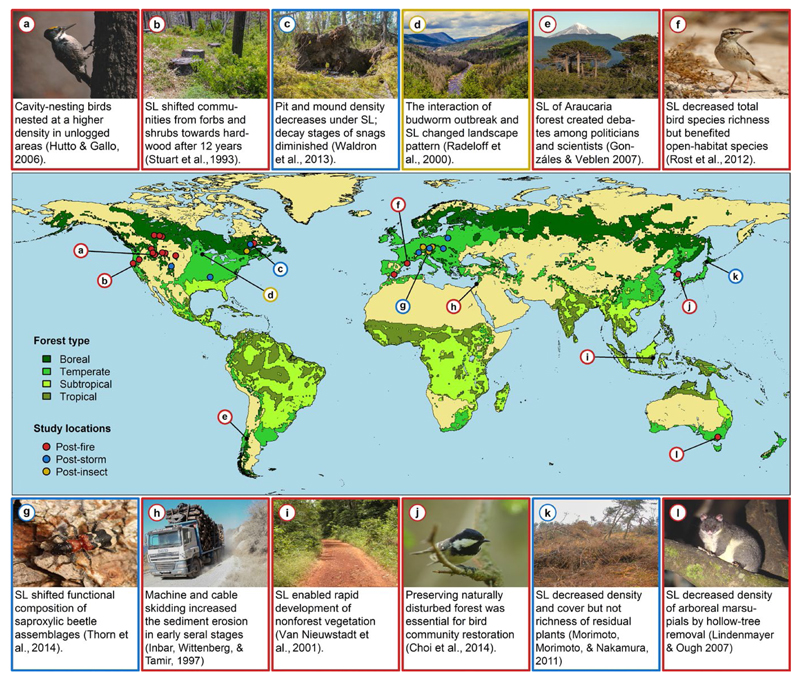
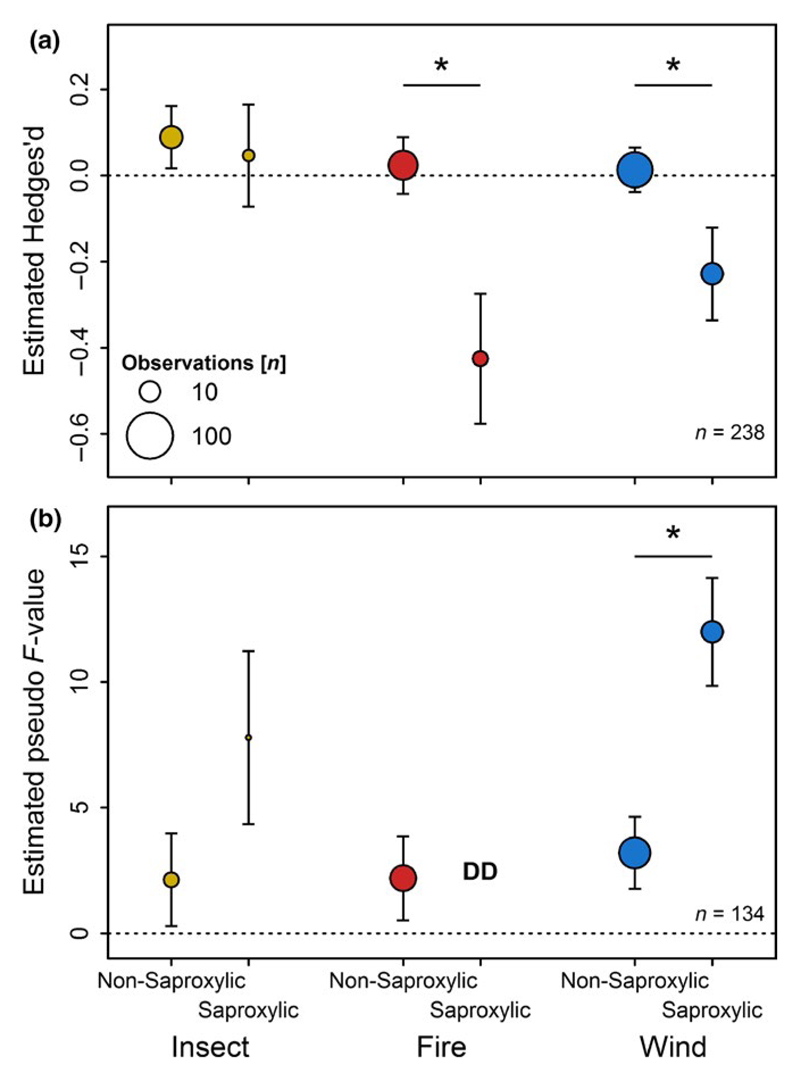
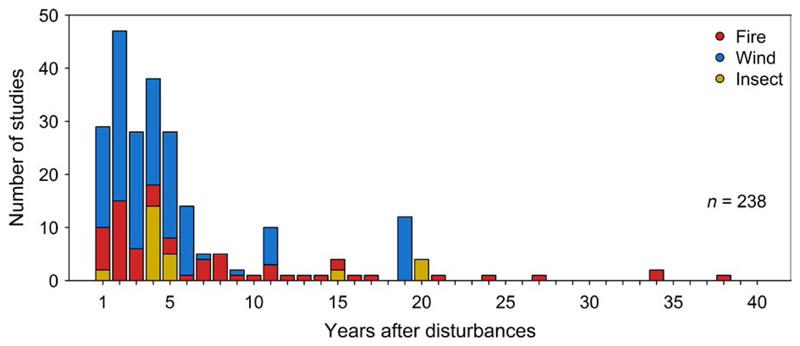
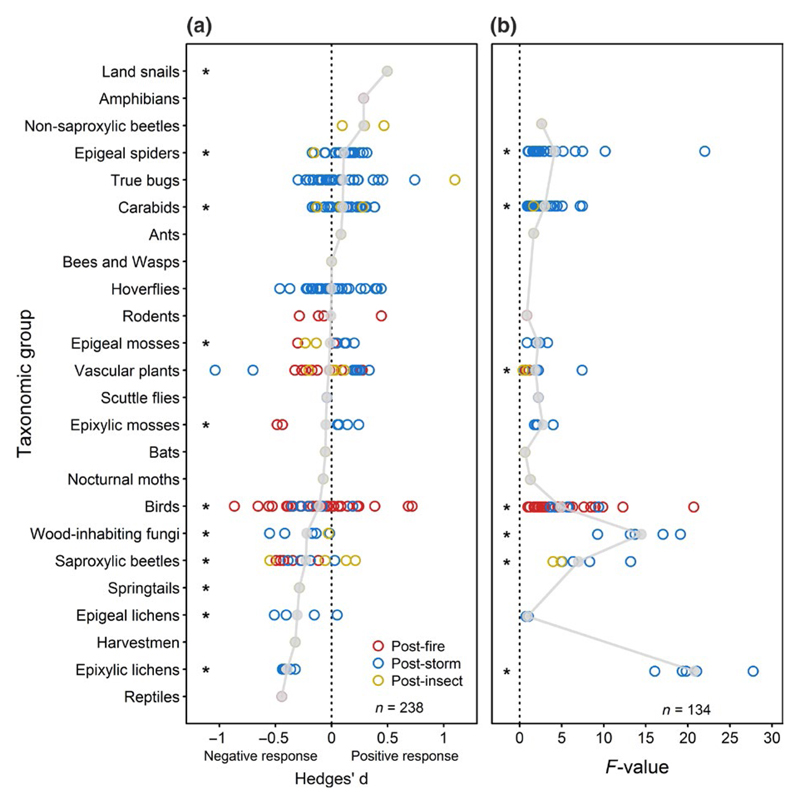
Logging to "salvage" economic returns from forests affected by natural disturbances has become increasingly prevalent globally. Despite potential negative effects on biodiversity, salvage logging is often conducted, even in areas otherwise excluded from logging and reserved for nature conservation, inter alia because strategic priorities for post-disturbance management are widely lacking.A review of the existing literature revealed that most studies investigating the effects of salvage logging on biodiversity have been conducted less than 5 years following natural disturbances, and focused on non-saproxylic organisms.A meta-analysis across 24 species groups revealed that salvage logging significantly decreases numbers of species of eight taxonomic groups. Richness of dead wood dependent taxa (i.e. saproxylic organisms) decreased more strongly than richness of non-saproxylic taxa. In contrast, taxonomic groups typically associated with open habitats increased in the number of species after salvage logging.By analysing 134 original species abundance matrices, we demonstrate that salvage logging significantly alters community composition in 7 of 17 species groups, particularly affecting saproxylic assemblages. Our results suggest that salvage logging is not consistent with the management objectives of protected areas. Substantial changes, such as the retention of dead wood in naturally disturbed forests, are needed to support biodiversity. Future research should investigate the amount and spatio-temporal distribution of retained dead wood needed to maintain all components of biodiversity.
为从受自然干扰影响的森林中“挽回”经济收益而进行的采伐在全球范围内日益普遍。尽管对生物多样性可能产生负面影响,但即使在其他禁止采伐并预留作自然保护的区域,也常常进行这种采伐,特别是因为普遍缺乏灾后管理的战略重点。对现有文献的综述表明,大多数调查采伐对生物多样性影响的研究都是在自然干扰发生不到5年后进行的,并且主要关注非树栖腐生生物。一项对24个物种组的荟萃分析表明,采伐显著减少了八个分类群的物种数量。依赖枯木的类群(即树栖腐生生物)的丰富度下降幅度比非树栖腐生类群的丰富度更大。相比之下,通常与开阔栖息地相关的分类群在采伐后的物种数量增加了。通过分析134个原始物种丰度矩阵,我们证明采伐显著改变了17个物种组中7个组的群落组成,尤其影响了树栖腐生生物群落。我们的结果表明,采伐不符合保护区的管理目标。需要进行重大变革,例如在自然干扰的森林中保留枯木,以支持生物多样性。未来的研究应调查维持生物多样性所有组成部分所需保留的枯木数量及其时空分布。