Bai Ying, Osikowicz Lynn M, Kosoy Michael Y, Eisen Rebecca J, Atiku Linda A, Mpanga Joseph T, Boegler Karen A, Enscore Russell E, Gage Kenneth L
Bacterial Diseases Branch, Division of Vector-Borne Disease, Centers for Disease Control and Prevention, Fort Collins, Colorado, USA.
Uganda Virus Research Institute, Entebbe, Uganda.
mSphere. 2017 Dec 20;2(6). doi: 10.1128/mSphere.00402-17. eCollection 2017 Nov-Dec.
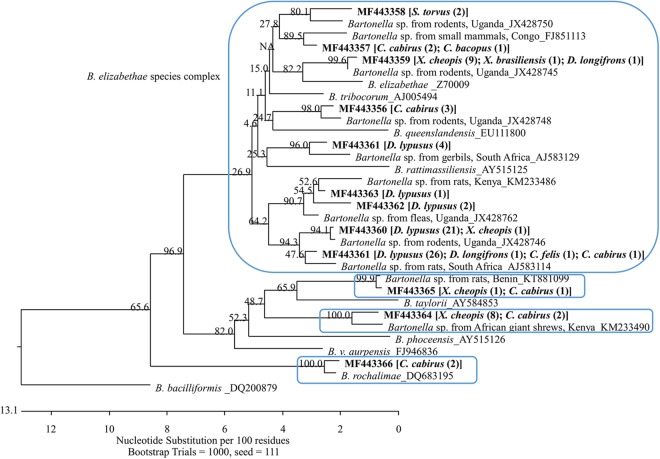
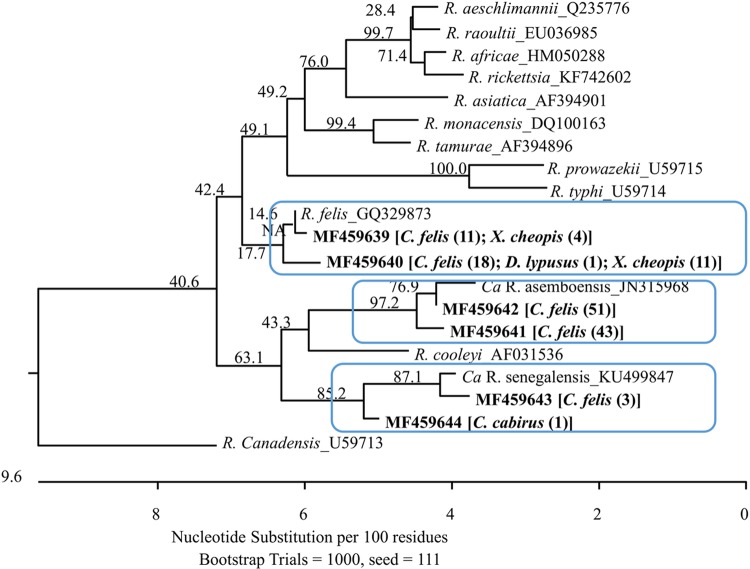
Fleas ( = 407) were collected from small mammals trapped inside huts and surroundings of homesteads in five villages within the Arua and Zombo districts of Uganda. The most common flea species were (26%) and (50%). Off-host fleas ( = 225) were collected inside huts by using Kilonzo flea traps. The majority of the off-host fleas were (80%). All fleas were examined for the presence of spp., spp., and spp. DNA was detected in 91 fleas, with an overall prevalence of 14%. prevalence was significantly higher in rodent or shrew fleas than in off-host fleas (22% versus 1%). The majority of -positive fleas were of the species (61%), (20%), and (14%). Sequencing analysis identified 12 genetic variants, 9 of which belonged to the zoonotic pathogen species complex. DNA was detected in 143 fleas, giving an overall prevalence of 23%, with a significantly higher prevalence in off-host fleas than in rodent or shrew fleas (56% versus 4%). The majority (88%) of -positive fleas were and were collected from Kilonzo traps, while a small portion (10%) were collected from rodents. Sequencing analysis identified six genogroups that belonged either to zoonotic or to the closely related " Ricksettia asemboensis" and " Ricksettia sengalensis." DNA was not detected in the fleas tested. These observations suggested that fleas in northwestern Uganda commonly carry the zoonotic agents and and potentially play an important role in transmitting these infections to humans. Fleas play critical roles in transmitting some infections among animals and from animals to humans. Detection of pathogens in fleas is important to determine human risks for flea-borne diseases and can help guide diagnosis and treatment. Our findings of high prevalence rates of and in fleas in the Arua and Zombo districts of Uganda implicate these agents as potential causative agents of undiagnosed febrile illnesses in this area.
在乌干达阿鲁阿区和宗博区的五个村庄,从农舍及其周边捕获的小型哺乳动物身上收集了407只跳蚤。最常见的跳蚤种类是[具体种类1](占26%)和[具体种类2](占50%)。通过使用基隆佐跳蚤诱捕器在农舍内收集了225只宿主外跳蚤。大多数宿主外跳蚤是[具体种类3](占80%)。对所有跳蚤进行检查,以确定是否存在[病原体1]属、[病原体2]属和[病原体3]属。在91只跳蚤中检测到[病原体1]DNA,总体患病率为14%。啮齿动物或鼩鼱跳蚤中[病原体1]的患病率显著高于宿主外跳蚤(22%对1%)。大多数呈[病原体1]阳性的跳蚤是[具体种类4](占61%)、[具体种类5](占20%)和[具体种类6](占14%)。测序分析确定了12种[病原体1]基因变体,其中9种属于人畜共患病原体[病原体1]物种复合体。在143只跳蚤中检测到[病原体2]DNA,总体患病率为23%,宿主外跳蚤中的患病率显著高于啮齿动物或鼩鼱跳蚤(56%对4%)。大多数(88%)呈[病原体2]阳性的跳蚤是[具体种类7],是从基隆佐诱捕器中收集的,而一小部分(10%)是从啮齿动物身上收集的[具体种类8]。测序分析确定了六个[病原体2]基因群,它们要么属于人畜共患病原体[病原体2],要么属于密切相关的“阿森博埃希立克次体”和“塞内加尔立克次体”。在所测试的跳蚤中未检测到[病原体3]DNA。这些观察结果表明,乌干达西北部的跳蚤通常携带人畜共患病原体[病原体1]和[病原体2],并可能在将这些感染传播给人类方面发挥重要作用。跳蚤在动物之间以及从动物到人类传播某些感染方面起着关键作用。检测跳蚤中的病原体对于确定人类感染跳蚤传播疾病的风险很重要,并且有助于指导诊断和治疗。我们在乌干达阿鲁阿区和宗博区跳蚤中发现的[病原体1]和[病原体2]的高患病率表明,这些病原体可能是该地区未确诊发热性疾病的潜在病因。