Clow Katie M, Leighton Patrick A, Ogden Nicholas H, Lindsay L Robbin, Michel Pascal, Pearl David L, Jardine Claire M
Department of Pathobiology, Ontario Veterinary College, University of Guelph, Guelph, Ontario, Canada.
Department of Pathology and Microbiology, Faculty of Veterinary Medicine, University of Montréal, Saint-Hyacinthe, Quebec, Canada.
PLoS One. 2017 Dec 27;12(12):e0189393. doi: 10.1371/journal.pone.0189393. eCollection 2017.
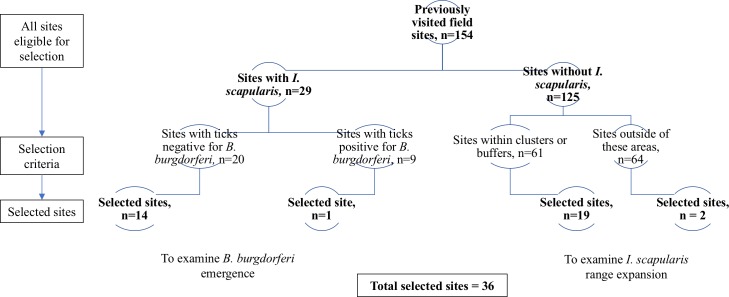
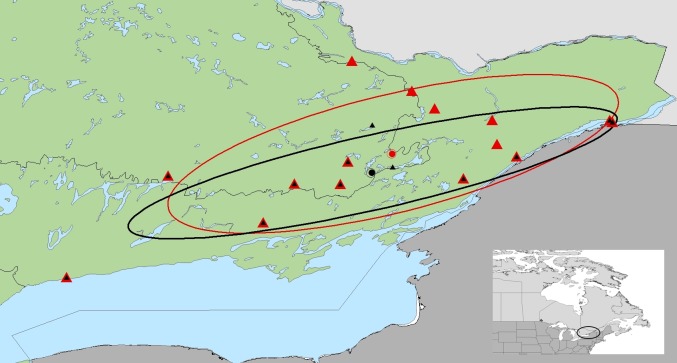
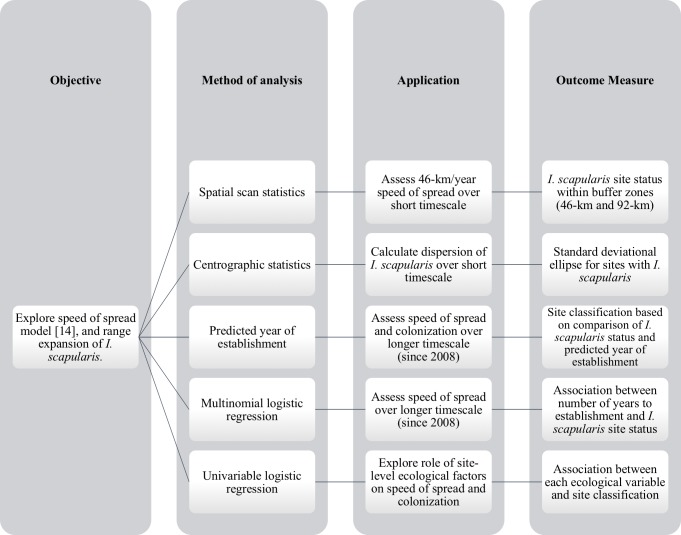
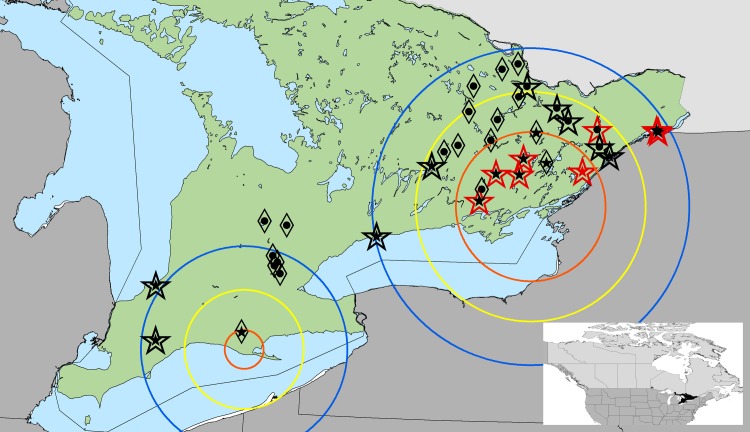
The invasion of the blacklegged tick, Ixodes scapularis into Ontario, Canada poses a significant risk to public health because it is a vector for numerous pathogens, including Borrelia burgdorferi sensu stricto, the causative agent of Lyme disease. Baseline field sampling in 2014 and 2015 detected I. scapularis and B. burgdorferi at sites across southern, eastern and central Ontario, including a hot spot in eastern Ontario. A "speed of spread" model for I. scapularis developed by Leighton and colleagues (2012) estimated that the tick's range was expanding northward at 46 km/year. In 2016, we revisited a subset of sites sampled in 2014 and 2015 to understand the changing nature of risk, and assess whether the rate of tick invasion is consistent with the speed of spread estimate. Ticks were collected via tick dragging at 17 out of 36 sites, 5 of which were new sites for I. scapularis. Samples were positive for B. burgdorferi at 8 sites. No other I. scapularis-borne pathogens were detected. Centrographic statistics revealed an increase in the dispersion of I. scapularis positive sites in eastern Ontario. Field data for each site were then compared to the model's predicted year of establishment for each census subdivision. Our findings illustrate that the range expansion of I. scapularis and the emergence of B. burgdorferi is ongoing, and provide short timescale evidence of the processes associated with I. scapularis spread. The range front appears to be moving at a rate of ~46 km/year, with colonization of the tick behind this range front occurring at a slower and heterogeneous rate. Assessment of site-level ecological factors did not provide any insight into the underlying processes that may be influencing the colonization of I. scapularis in specific areas. Ongoing field sampling is needed to monitor this dynamic process. This study highlights the current geographic risk associated with Lyme disease, which can be used to target public health interventions to the areas of greatest risk.
黑脚硬蜱(肩突硬蜱)入侵加拿大安大略省对公众健康构成了重大风险,因为它是多种病原体的传播媒介,包括莱姆病的病原体——狭义伯氏疏螺旋体。2014年和2015年的基线野外采样在安大略省南部、东部和中部的多个地点检测到了肩突硬蜱和伯氏疏螺旋体,其中安大略省东部有一个热点地区。Leighton及其同事(2012年)建立的肩突硬蜱“传播速度”模型估计,蜱的分布范围正以每年46公里的速度向北扩展。2016年,我们重新走访了2014年和2015年采样的部分地点,以了解风险的变化性质,并评估蜱的入侵速度是否与传播速度估计值一致。通过拖蜱法在36个地点中的17个地点采集了蜱,其中5个是肩突硬蜱的新发现地点。在8个地点的样本中检测到伯氏疏螺旋体呈阳性。未检测到其他由肩突硬蜱传播的病原体。中心统计显示,安大略省东部肩突硬蜱阳性地点的分散程度有所增加。然后将每个地点的实地数据与模型预测的每个普查分区的建立年份进行比较。我们的研究结果表明,肩突硬蜱的分布范围正在扩大,伯氏疏螺旋体也在不断出现,并提供了与肩突硬蜱传播相关过程的短期时间尺度证据。分布范围前沿似乎正以每年约46公里的速度移动,在此范围前沿之后蜱的定殖速度较慢且不均匀。对地点层面生态因素的评估并未提供任何关于可能影响肩突硬蜱在特定区域定殖的潜在过程的见解。需要持续进行野外采样以监测这一动态过程。这项研究突出了当前与莱姆病相关的地理风险,可用于将公共卫生干预措施针对到风险最大的地区。