Shen Manman, Qu Liang, Ma Meng, Dou Taocun, Lu Jian, Guo Jun, Hu Yuping, Wang Xingguo, Li Yongfeng, Wang Kehua, Yang Ning
Jiangsu Institute of Poultry Science, Chinese Academy of Agricultural Science, Yangzhou, China.
College of Animal Science and Technology, Yangzhou University, Yangzhou, China.
PLoS One. 2017 Dec 27;12(12):e0189955. doi: 10.1371/journal.pone.0189955. eCollection 2017.
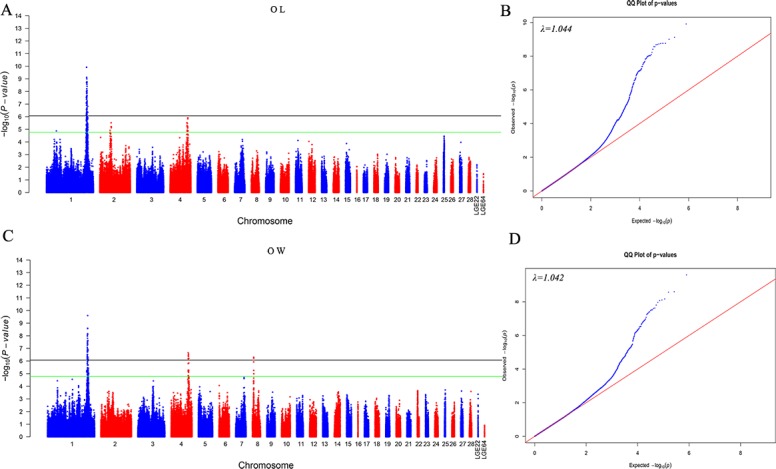
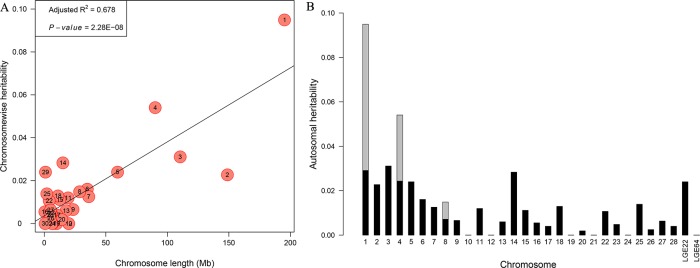
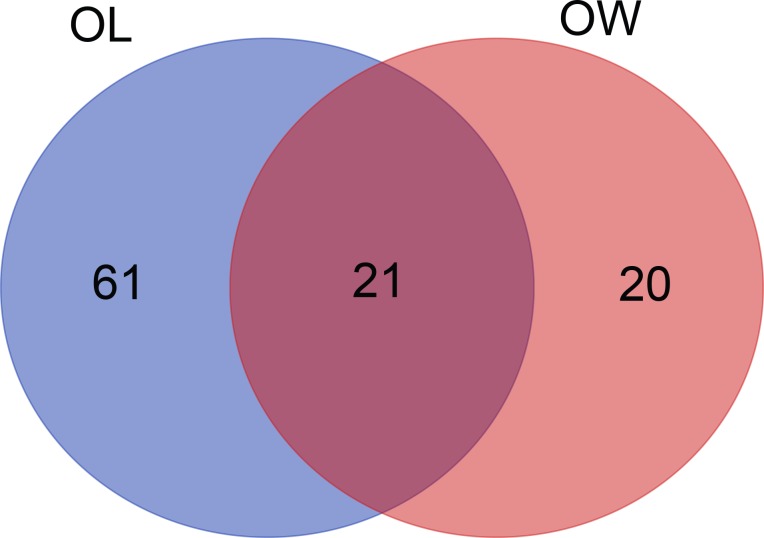
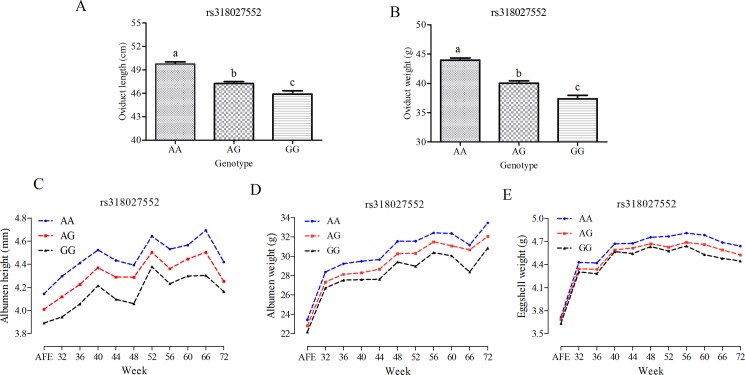
Molecular genetic tools provide a method for improving the breeding selection of chickens (Gallus gallus). Although some studies have identified genes affecting egg quality, little is known about the genes responsible for oviduct development. To address this issue, here we used a genome-wide association (GWA) study to detect genes or genomic regions that are related to oviduct development in a chicken F2 resource population by employing high-density 600 K single-nucleotide polymorphism (SNP) arrays. For oviduct length and weight, which exhibited moderate heritability estimates of 0.35 and 0.39, respectively, chromosome 1 (GGA1) explained 9.45% of the genetic variance, while GGA4 to GGA8 and GGA11 explained over 1% of the variance. Independent univariate genome-wide screens for oviduct length and weight detected 69 significant SNPs on GGA1 and 49 suggestive SNPs on GGA1, GGA4, and GGA8. One hundred and fourteen suggestive SNPs were associated with oviduct length, while 73 SNPs were associated with oviduct weight. The significant genomic regions affecting oviduct weight ranged from 167.79-174.29 Mb on GGA1, 73.16-75.70 Mb on GGA4, and 4.88-4.92 Mb on GGA8. The genes CKAP2, CCKAR, NCAPG, IGFBP3, and GORAB were shown to have potential roles in oviduct development. These genes are involved in cell survival, appetite, and growth control. Our results represent the first GWA analysis of genes controlling oviduct weight and length. The identification of genomic loci and potential candidate genes affecting oviduct development greatly increase our understanding of the genetic basis underlying oviduct development, which could have an impact on the selection of egg quality.
分子遗传工具为改进鸡(原鸡)的育种选择提供了一种方法。尽管一些研究已经鉴定出影响蛋品质的基因,但对于负责输卵管发育的基因却知之甚少。为了解决这个问题,我们在此通过使用高密度600K单核苷酸多态性(SNP)阵列,利用全基因组关联(GWA)研究来检测鸡F2资源群体中与输卵管发育相关的基因或基因组区域。对于输卵管长度和重量,其遗传力估计值分别为0.35和0.39,中等程度,1号染色体(GGA1)解释了9.45%的遗传方差,而GGA4至GGA8和GGA11解释了超过1%的方差。针对输卵管长度和重量的独立单变量全基因组筛选在GGA1上检测到69个显著SNP,在GGA1、GGA4和GGA8上检测到49个提示性SNP。114个提示性SNP与输卵管长度相关,而73个SNP与输卵管重量相关。影响输卵管重量的显著基因组区域在GGA1上为167.79 - 174.29 Mb,在GGA4上为73.16 - 75.70 Mb,在GGA8上为4.88 - 4.92 Mb。基因CKAP2、CCKAR、NCAPG、IGFBP3和GORAB在输卵管发育中显示出潜在作用。这些基因参与细胞存活、食欲和生长控制。我们的结果代表了对控制输卵管重量和长度的基因的首次GWA分析。影响输卵管发育的基因组位点和潜在候选基因的鉴定极大地增进了我们对输卵管发育潜在遗传基础的理解,这可能会对蛋品质的选择产生影响。